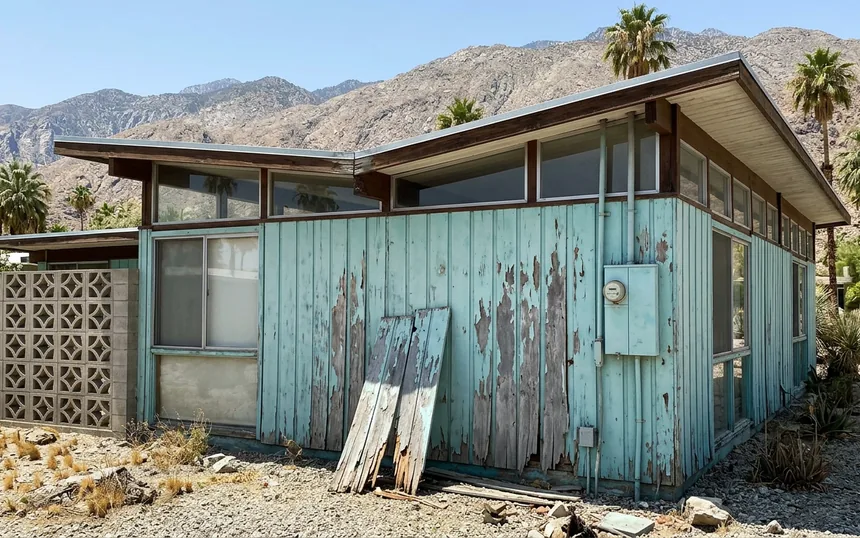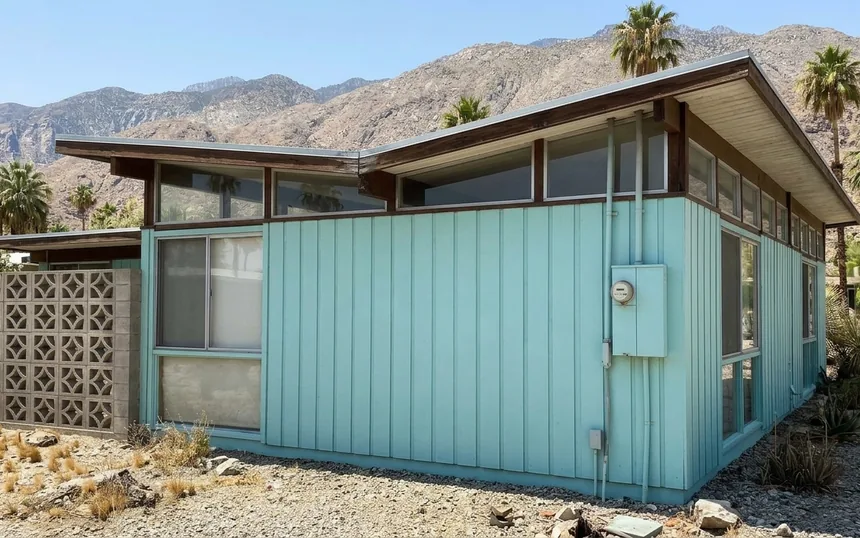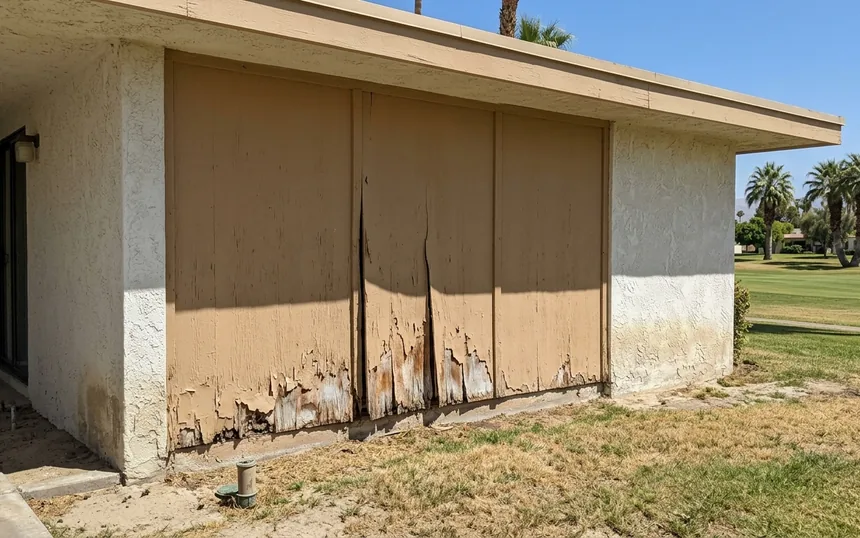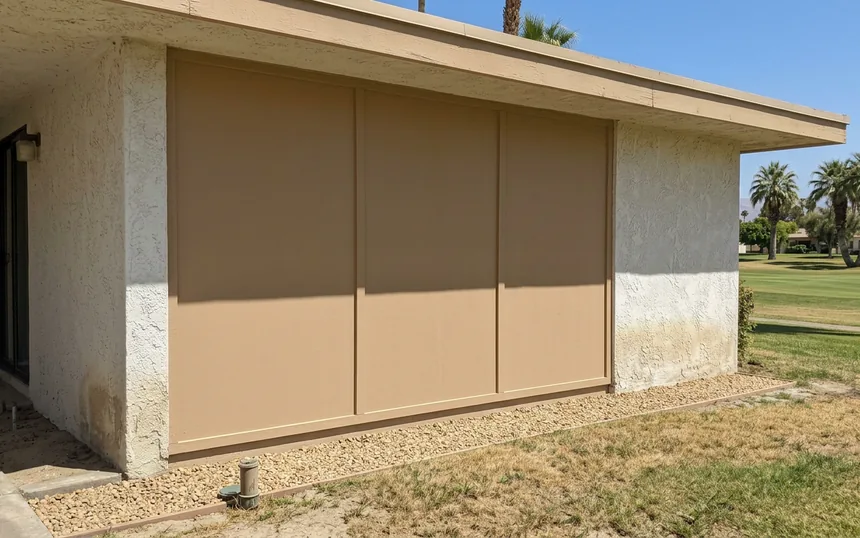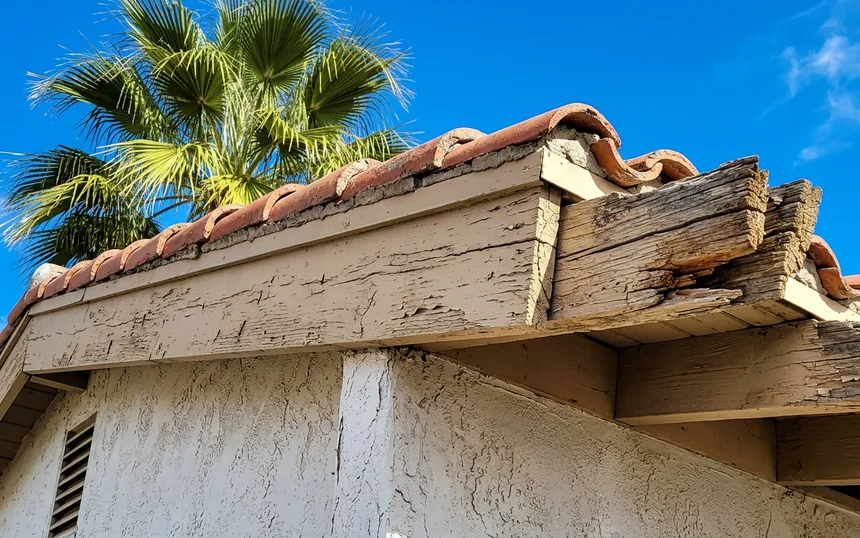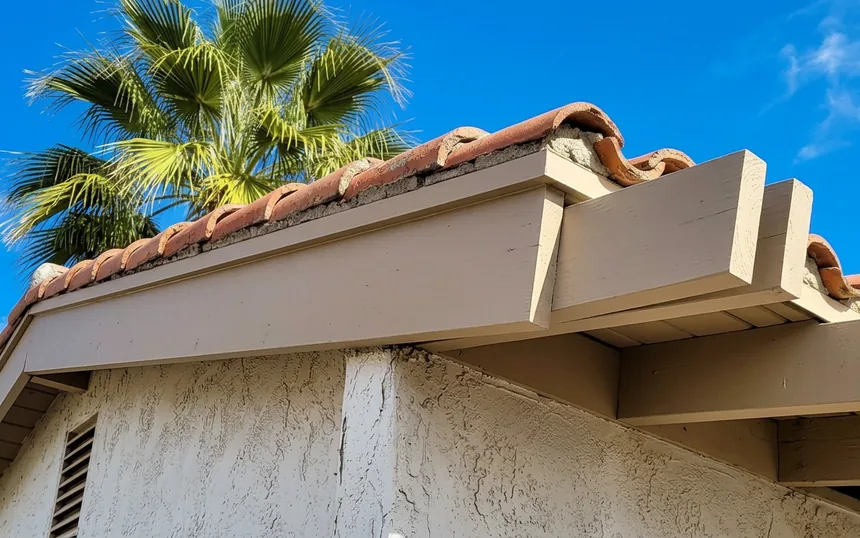
Sun-cupped vertical boards on the mid-century houses, baked T1-11 panels on the country club condos, checked fascia and beam ends, sand-worn fiber cement on the north side: replaced in the same profile and sealed for summers that reach well past a hundred.
 BBBAccredited Business
Kaminskiy Care and Repair repairs and replaces siding across Palm Desert, Palm Springs, Rancho Mirage, La Quinta and Cathedral City: the vertical board and board-and-batten of the mid-century post-and-beam houses, the T1-11 and wood accent panels of the 1970s and 1980s country club condominiums, the fascia and beam ends on the desert ranch homes, and the fiber cement (Hardie) accents on the newer north side. Failed boards are cut out, the paper and flashing behind them lapped, and new material fitted in the same profile, primed on every face and finished with sealants and coatings rated for desert heat and sun. A licensed siding contractor (CSLB #1106209) and an EPA Lead-Safe Certified firm, from our office on Highway 111, every repair priced in writing on the call: 760-284-6993.
 From the Palm Springs tracts to the clubs of Highway 111.
Desert siding does not rot first; it bakes. The paint chalks off the south and west walls, the boards cup and split once the finish is gone, the caulk shrinks out of every joint, and then the sprinklers and the monsoon storms find the openings. We replace what has failed, back-prime every face so new wood does not cup, choose elastomeric sealants and coatings rated for high heat, and schedule the work in the cool hours, so the repair is still tight next August.

 AFTERBEFORE
 Mid-Century Board & Batten
 T1-11 & Accent Panels
 Fiber Cement & Hardie
 Fascia, Beams & Trellises
 Dry Rot & Termite Damage
 Vinyl Siding Repair
 Joints & Heat-Rated Sealant
 Walk-Through & Warranty
We take these calls from Palm Springs to La Quinta every week, mostly in the cool months before the season. Text a photo and most repairs are priced on the call, in writing; when the damage may reach the sheathing, we look first and put the scope on paper.

Tell us the street or the club and what you see. Most repairs are priced in writing from the photo, the profile and the coating named.

The baked or split boards come off, the sheathing and paper behind them are checked, and you see the photos before new material goes on.

New siding in the same profile, primed on every face, joints sealed with heat-rated sealant, finished to the house or the club's scheme.
Every job is backed in writing by our workmanship warranty and done by a Kaminskiy-certified, background checked technician.
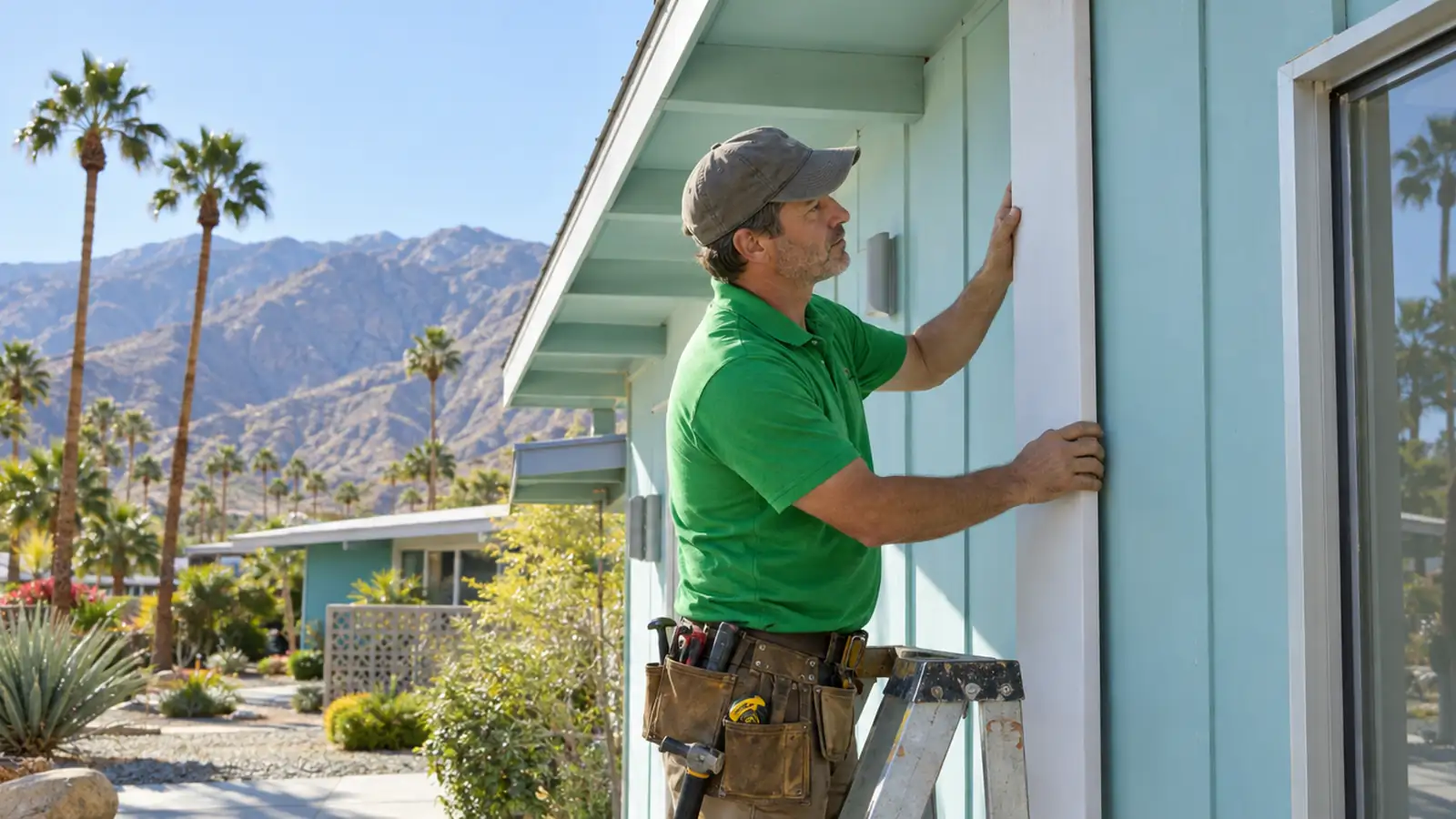
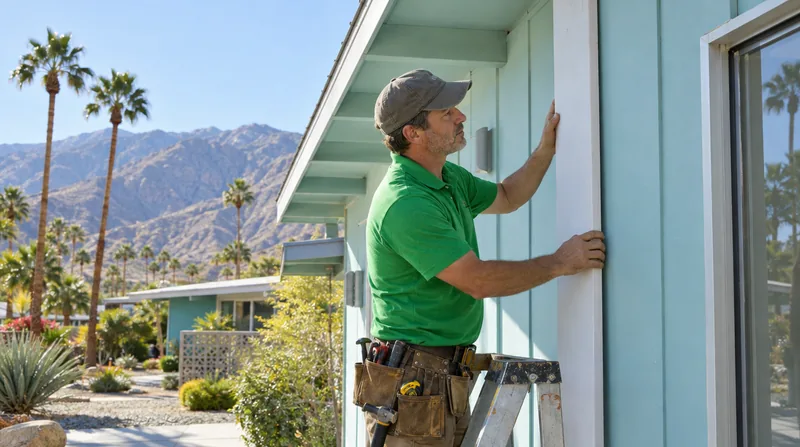
The mid-century post-and-beam houses use vertical boards, board-and-batten and tongue-and-groove, often beside breeze block and glass. The 1970s and 1980s country club condominiums use T1-11 or wood accent panels set between stucco walls. Desert ranch homes carry long wood fascia and patio-cover beams. Newer homes on the north side use fiber cement lap or panels as an accent. We name yours from a photo.
Repair, on most walls: the desert damages one or two faces, the ones that take the afternoon, and the rest is sound. Accent panels that have delaminated through are replaced whole, since they are panels to begin with. On a designated Palm Springs home, the answer is repair in kind, because the board width and spacing are part of what is protected.
Three reasons: new wood primed on the face only, which cups in the first summer; caulk that is not rated for the heat, which shrinks out of the joint by August; and dark colors on west walls, which cook. We back-prime every board, use elastomeric sealant rated for high temperatures, and point out where a lighter color will last longer.
Keep the sprinklers off the walls and the accent panels, recaulk the joints every fall before the season, repaint the south and west faces on a shorter cycle, and cap or seal beam ends before they check. A joint this year is a wall in five.
The Coachella Valley is a stucco valley, but its best-known houses are wood on the outside: the mid-century post-and-beam homes of Palm Springs, the country club condominiums and villas from the 1960s through the 1980s, and the newer homes with fiber cement accents. Heat, sun, sprinklers and the wind decide what fails first.
Post-and-beam houses from the late 1950s and 1960s with vertical boards, battens and tongue-and-groove beside glass and breeze block. The sun bleaches and cups the boards on the south faces and the end grain checks. Many are designated Class 1 historic sites in Palm Springs, so the repair keeps the width and spacing, and every one is older than 1978, so the paint is tested and the work is done lead-safe by an EPA Lead-Safe Certified firm.
Condominiums and villas from the 1960s through the 1980s with T1-11 and wood accent panels between stucco walls, long fascia runs and patio covers, behind a gate and under an architectural committee. The panels delaminate where the fairway sprinklers reach them and bake on the sunny faces, and many owners are away all summer, so the work is scheduled and photographed for them.
Newer stucco homes with fiber cement lap or panel accents, foam trim and less exposed wood, in the windiest part of the valley. Blowing sand wears the paint, fiber cement cracks at corners and nails, and the caulk dries out in the first summers. The repair is a matched board, a flashed and sealed joint and paint that can take the sand.
Repaired, nearly always. The desert works on the south and west faces and the bottom where the water reaches, and the rest of the wall stays sound for decades. We cut out the failed boards or panels, check the sheathing and paper, fit matching material and seal it. A whole face is re-sided only when the sheathing behind it has failed.
On three counts. The profile: board width and spacing, batten size, panel grooves, fiber cement reveal. The texture: smooth or rough-sawn. The finish: matched from a chip or the club's paint code and carried to a corner. On a designated Palm Springs house we photograph before and after and keep the original dimensions, which is what the city's approval protects.
It is priced on the call, in writing, from a photo. The number moves with how much has failed, how high it is, whether the work has to be done in the cool hours or around a club's rules, and how much painting it takes to blend. The materials and the sealant are named on the quote, with no percentage markups.
An unlicensed handyman may take a job only when labor and materials together come to less than one thousand dollars and no permit is needed (Business and Professions Code 7048, raised by AB 2622 in 2025), and Cathedral City issues permits only to the owner or a state-licensed contractor with a city business license. Kaminskiy Care and Repair holds a B general building license (CSLB #1106209), is bonded and insured, and the number checks on the CSLB site.
We name the siding, check whether a club, a historic designation or the city has a say, and price the repair in writing.
Failed boards and panels come off early in the day, the sheathing and paper are checked, and the photos are sent to you, wherever you spend the summer.
Paper and flashing lapped, new siding back-primed on every face, joints and end grain sealed with heat-rated sealant, fastened tight against the wind.
Paint matched to the house or the club and carried to a break, the site cleaned, the photos and the one-year workmanship warranty sent.
Palm Desert, Palm Springs and Rancho Mirage adopt the California Residential Code, and their local amendments leave its ordinary-repairs clause alone: replacing a few boards or a panel like for like needs no application. La Quinta says a permit is needed for any repair beyond the exempt list, and Cathedral City issues permits only to the owner or a state-licensed contractor with a city business license. A re-sided face is checked with the counter before we quote.
Palm Springs has hundreds of designated Class 1 historic sites, and a designated house cannot change on the outside without the city's approval; an in-kind repair is how we work there. La Quinta's Cove has a city historic district for its 1930s casitas. Most country clubs have an architectural committee: a repair finished to the club's color and profile rarely needs more than a note, and a new material or color goes to the committee with our written specification.
The mid-century houses and the first club condominiums were built before 1978 and may carry lead paint under the newer coats. Kaminskiy Care and Repair is an EPA Lead-Safe Certified firm: the paint is tested before boards are cut, the work area is contained and the cleanup checked. In summer we work in the early hours, because a sealant or a coat of paint put on a wall at a hundred and ten degrees does not cure the way the label says.
On Highway 111. Our desert crew works from Highway 111 in Palm Desert and covers the valley from Palm Springs to La Quinta. Call 760-284-6993, text a photo of the siding, or send the form, and we answer in under three rings.
Can't find your answer? Call 760-284-6993 and ask us anything.
Call 760-284-6993Repaired, on most desert homes. The sun bakes the south and west faces and the sprinklers reach the bottom, while the rest of the wall stays sound. We cut out the failed boards or panels, check the paper and sheathing, fit new material in the same profile and seal it for the heat. A whole face is re-sided only when the sheathing behind it has failed.
Yes, and on a mid-century house that is the right way to do it. We match the board width, the spacing and the batten size, back-prime every piece and paint it to the house, so the lines that make the design stay true. On a designated Palm Springs home we keep the original dimensions and photograph the work for the file. Call 760-284-6993 or text a photo.
It is priced on the call, in writing, from a photo of the wall. The number moves with how much has failed, how high it is, whether the club has rules for when and how work is done, and how much painting it takes to make the repair disappear. A few boards at ground level is a small line; a run of accent panels and fascia across a villa is a larger one. Materials are named on the quote, with no percentage markups.
Because the finish goes first. The sun chalks the paint off the south and west faces, the boards cup and split once they are bare, and caulk that is not rated for the heat shrinks out of the joints. Then the sprinklers and the monsoon storms get in. A lasting repair primes every face of the new wood, uses heat-rated sealant and coatings, and keeps the water off the wall.
For a few boards in kind, usually no permit: Palm Desert, Palm Springs and Rancho Mirage keep the state's ordinary-repair clause, while La Quinta asks for a permit beyond its exempt list. A designated Palm Springs home needs the city's approval for any exterior change, and an in-kind repair is the simple case. Most country clubs want a note or a committee form; we write the specification for it.
Only a small job. California lets an unlicensed handyman take work when labor and materials together are less than one thousand dollars and no permit is needed (Business and Professions Code 7048, as raised by AB 2622 in 2025). A run of accent panels or a fascia on a ladder usually passes that line. Kaminskiy Care and Repair is a licensed B general building contractor (CSLB #1106209), bonded and insured.
Yes. Many of our desert customers are part-year owners. We price from photos, coordinate with the club or the house manager, work in the early hours, and send photos before, during and after, so the house is sealed and painted before you come back for the season.
Palm Desert, Palm Springs, Rancho Mirage, La Quinta, Cathedral City, Indian Wells, Indio and Bermuda Dunes, from our office on Highway 111. Call 760-284-6993 with the address and we confirm it on the call.
Tell us the street or the club, the siding and roughly how much of it. We'll call back with a price and a day. Calling is still the fastest way: 760-284-6993.
Boards, panels and fascia matched and sealed for the heat, a one-year workmanship warranty, from one licensed desert team.
We answer in under three rings, 24/7.No price games. You get a clear written quote before any work begins, backed by our workmanship warranty.