
 BBBAccredited Business

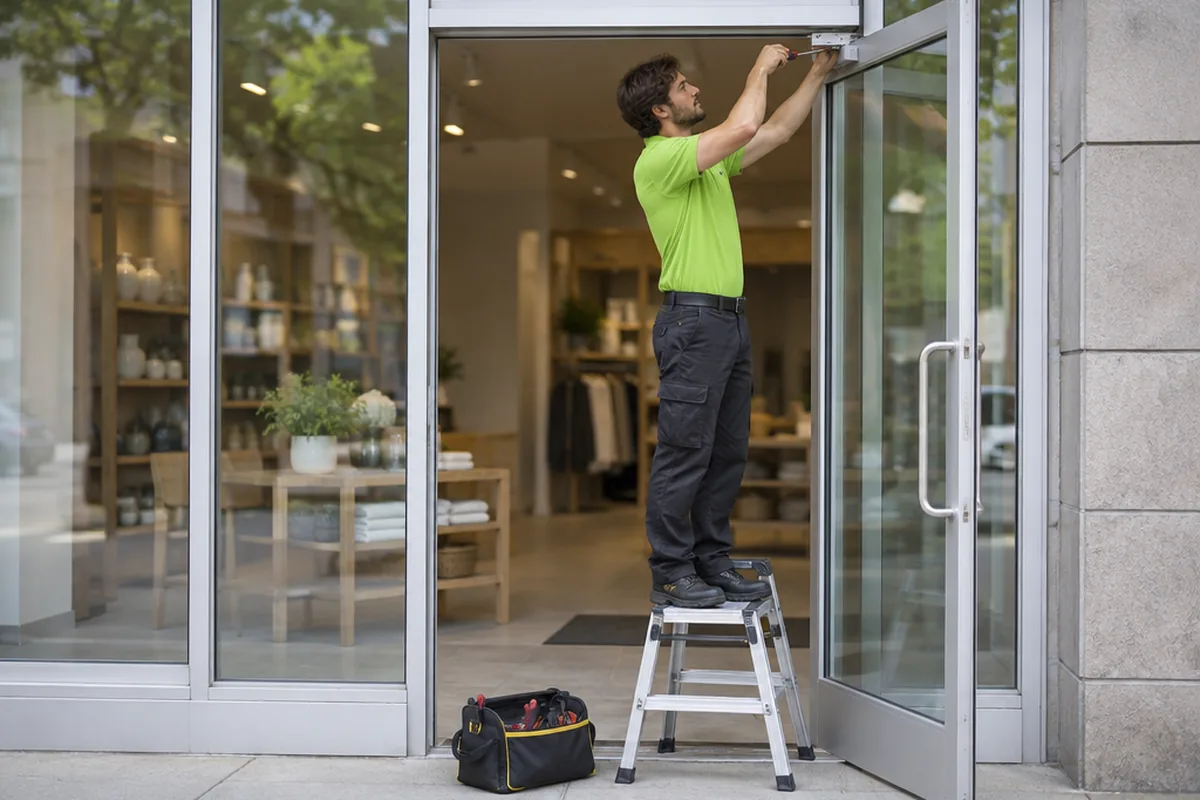
Kaminskiy Care and Repair fixes aluminum and glass storefront doors that drag on the threshold, sag at the pivot, slam, or will not latch. A technician adjusts or replaces pivots, hinges, closers, latches, strikes, sweeps and weatherstrip, usually before opening or after closing. We work on the door and its hardware. Glass and glazing belong to a glazier, and we tell you when that is the fix. This is one of our commercial door and hardware services.
A shop door opens hundreds of times a day. The top pivot loosens, the leaf drops a fraction of an inch and the bottom rail starts to scrape the threshold. We reset the pivot, tighten the frame connections and bring the door back to an even gap on all four sides.
Double doors at a lobby have to close against each other. When one leaf sags, the lock bolt misses the strike and the pair rattles in the wind. We square both leaves, adjust the flush bolts and the strike, and replace the weatherstrip at the meeting edge so the pair seals.
A strip center has a door for every tenant, and each one has been adjusted by someone different. For property managers we walk the whole row, write one list by suite number and correct closers, sweeps and latches in a single scheduled round, so every entry works the same way.
Send a photo of the whole door, the top corner and the threshold. From those we can usually tell a pivot door from a hinged one and load the right parts before we drive out.
The technician checks the frame for plumb, the gaps at all four edges and the closer before touching a screw. A door that drags is often a loose frame anchor, not the door itself.
Pivots, hinges, closer valves, latches and strikes are adjusted first. Worn parts are replaced with commercial-grade parts that fit the door maker's prep. You approve anything beyond the written scope.
We cycle the door, time the closing sweep, confirm it latches without a push and photograph the result. The photos and the parts list go to you for the work order file.
The 2010 ADA Standards (section 404.2.8.1) say a door with a closer must take at least 5 seconds to move from 90 degrees open to 12 degrees from the latch. A door that slams is a complaint waiting to happen. The fix is usually a two-valve adjustment, or a new closer when the old one has leaked its oil.
Thresholds at accessible doorways may be no higher than 1/2 inch, with the edge beveled (section 404.2.5). The push side of a swinging door also needs a smooth surface across the bottom 10 inches (section 404.2.10), which matters when a sweep or a kick plate is added. Related work: threshold and sweep replacement.
Model building codes require exit doors to open from the inside without a key, special knowledge or unusual effort while a building is occupied. A storefront door that binds or needs a shoulder is an exit problem, not only an annoyance. Your building or fire official decides what a given door needs. We fix the door and note what we found. For the hardware itself, see exit device installation.
Sources for the rules on this page: 2010 ADA Standards for Accessible Design, 404.2.8.1; 2010 ADA Standards, 404.2.5 and 404.2.10; U.S. Access Board guide to Chapter 4; International Building Code (2021), Section 1010.2.
The entry is the first thing a customer touches. We keep it swinging, closing and locking the way it did when it was new.
Most storefront door calls end the same way. The top and bottom pivots are reset, the closer is tuned so the door closes in a controlled sweep and latches on its own, and the strike is moved to meet the bolt. Worn sweeps and weatherstrip are replaced while the door is apart.
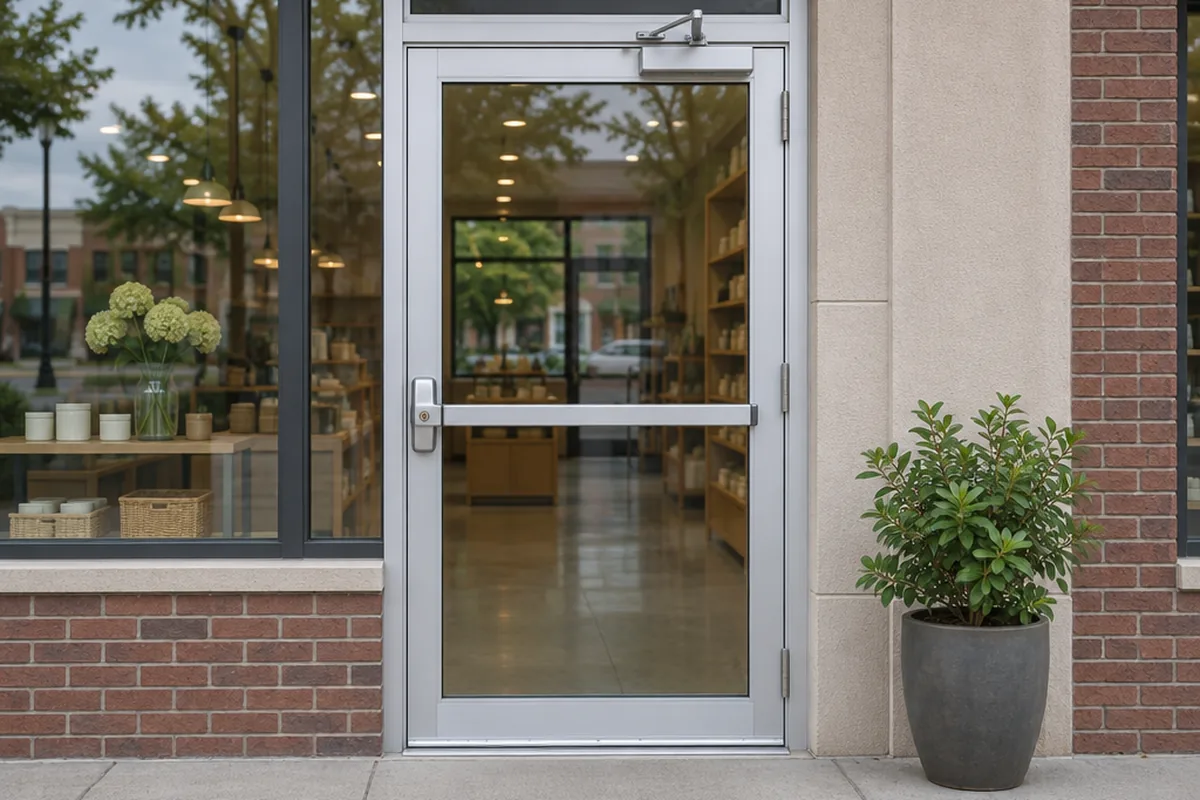
Each of these is an adjustment or a worn part, not a new door. A technician can usually tell which from two photos, and the visit is scheduled outside your business hours.

Call or send two photos of the door and tell us when the space is empty.

You get a written scope and price for the adjustment and any parts before we schedule.

We correct the door, test it through a full cycle and send photos for your file.
The work is backed in writing by our workmanship warranty and done by a Kaminskiy-certified, background checked technician.
Most aluminum storefront doors hang on a top and a bottom pivot, or on an offset pivot set, rather than on butt hinges. The whole weight rests on the bottom pivot. When its screws loosen or its bearing wears, the door drops and drags. Tightening the closer does nothing for that. The pivot has to be reset or replaced.
The closer may be a surface body on the door, a concealed unit in the header above it, or a floor closer under a cover plate at the threshold. Each one adjusts differently. Tell us which you have, or send a photo of the top of the frame, and we bring the right tools and a matching replacement if yours is leaking oil.
A door that closes but does not latch is usually out of line by an eighth of an inch. The bolt hits the edge of the strike plate instead of the opening. Shimming the pivot or moving the strike fixes it. Filing the strike is the shortcut we avoid, because the door keeps moving and the gap keeps growing.
We do not cut, set or reglaze glass. If the glass is cracked or its seal has failed, a glazier does that work, and doors take tempered or laminated safety glass. What we handle is everything that makes a glass door swing, close, seal and lock: pivots, closers, latches, locks, push and pull hardware, sweeps and weatherstrip.
Can't find your answer? Call 855-695-1195 and ask us anything.
Call 855-695-1195Almost always. A dragging, sagging or slamming storefront door usually needs its pivots reset, its closer adjusted or replaced, or its strike moved. The aluminum door and frame last for decades. We recommend a new door only when the frame is bent or the stiles are cracked, and we tell you that before any work starts.
No. We work on the door and its hardware: pivots, hinges, closers, latches, locks, sweeps and weatherstrip. Cutting and setting glass is a glazing contractor's work, and doors need safety glass. If your door needs glass, we say so up front so you do not pay for an adjustment that will not solve it.
Yes. Most storefront door work is scheduled before opening or after closing, so the entry is never blocked while customers are coming and going. Tell us your hours when you call and we plan the visit around them.
The closer controls the door with oil moving through two small valves. When a valve is set too far open, or the closer has leaked its oil, nothing slows the door on the way shut. An adjustment fixes the first case. A leaking closer has to be replaced, and oil on the door or the floor is the sign.
The 2010 ADA Standards call for at least 5 seconds for a door with a closer to move from 90 degrees open to 12 degrees from the latch. Slower is fine as long as the door still latches. We time the sweep after every adjustment and note it on the work order.
It depends on whether the door needs an adjustment or parts, and on which closer and pivots it uses. You get a written price before any work is scheduled, and nothing beyond that scope is done without your approval. Two photos are usually enough for us to tell you what the visit will involve.
Yes. For property managers we walk every tenant entry, write one list by suite number and correct the doors in a scheduled round. You get photos of each door afterwards, which helps when a tenant or an insurer asks what was done and when.
Yes. Storefront door repairs are backed in writing by our workmanship warranty, and parts carry their maker's warranty. If a door we adjusted drifts out of line again inside the warranty period, we come back and correct it.
Send the address, your business hours and two photos of the door. We reply with a written scope and a time that keeps the entry clear. Calling is still fastest: 855-695-1195.
A written scope first. Work around your hours. A workmanship warranty in writing.
We answer in under three rings, 24/7.No price games. You get a clear written quote before any work begins, backed by our workmanship warranty.
