
 BBBAccredited Business

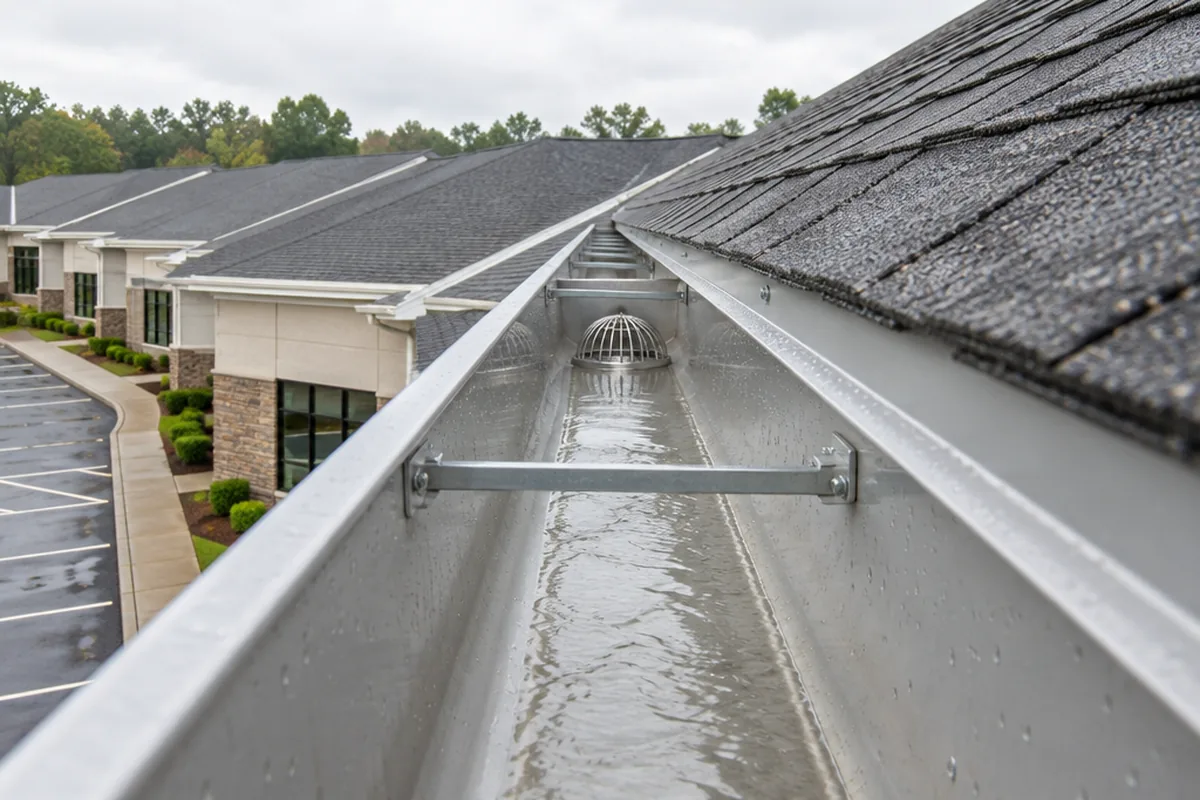
Kaminskiy Care and Repair provides commercial gutter cleaning on a schedule and downspout repair for multi-building properties. On a cadence set with the manager, technicians clear every gutter run, flush each downspout and clear the roof drains and scuppers they can reach safely, with before and after photos and a dated log per building. Gutter and downspout repairs are priced separately, with or without a program: crushed bottoms, loose straps, separated elbows, leaking seams and sagging runs. Roof defects go to a roofer. Both are part of our commercial exterior maintenance and repair services.
Garden communities are built among trees, and every building has four or more runs. Cleaning on complaint means the worst gutters overflow for months first. A program walks the whole site on set dates, in the same building order each time, so nothing is skipped and the log shows it.
Along a service wall the last few feet of every downspout live among hand trucks, pallets and bumpers. Once the outlet is flattened, water backs up the pipe and spills from the gutter joints above. We cut out the crushed length, fit a new section and elbow in the same size, anchor new straps and can add a steel guard where the lane will hit it again.
Attached homes share runs, and boards need proof that someone cleaned them. Office and retail roofs add scuppers that plug with litter and canopy gutters that drip on customers. We clean by building, photograph each run, clear the scuppers we can reach and note downspouts that empty against a foundation or across a walk. Roof-side problems are passed on with photos for small pitched roof repairs or your roofer.
We start with a site plan: buildings numbered, stories, linear feet of gutter, downspout count, tree cover and access limits. That count sets the crew size and days per round.
You choose the frequency and the months, based on leaf drop and rain season where you are. Dates go on the calendar for the year, with a notice template for residents and tenants.
Each run is cleared by hand, debris is bagged, downspouts are flushed until water runs free at the bottom, and the before and after photos are taken from the same spot.
After each round you receive the building log: date, runs cleaned, photos and an exceptions list of loose hangers, leaking seams, crushed downspouts or anything we could not reach, each repair with its own price to approve.
The International Property Maintenance Code, which many cities adopt as their upkeep standard for existing buildings, says roof drains, gutters and downspouts shall be maintained in good repair and free from obstructions, and that roof water shall not be discharged in a manner that creates a public nuisance (section 304.7). A dated log with photos is the simplest way to show a code officer, an insurer or a board that both halves were handled.
Where parapets can trap water, the International Building Code (section 1502.2) requires secondary overflow drains or scuppers in addition to the primary drains, and a scupper may not have an opening dimension under 4 inches (1502.3). A plugged scupper lets water pond on a roof that was designed to shed it, which is why reachable scuppers are on every round.
The International Building Code (section 1804.4), a model code that many jurisdictions adopt, slopes the ground beside a foundation away from the building at 5 percent for at least 10 feet, and paved surfaces in that zone at 2 percent. A downspout that empties onto soil tilted back toward the wall defeats that design. We aim each discharge onto a surface that carries the water off, and we tell you where the grade itself is the problem.
Sources for the rules on this page: 2021 International Property Maintenance Code, section 304.7; 2021 International Building Code, section 1502; 2021 International Building Code, section 1804.4; U.S. EPA, Stormwater Discharges from Municipal Sources; OSHA 29 CFR 1910.23.
Downspout repair replaces the part of the leader that no longer carries water: a bottom section crushed by carts or bumpers, an elbow that has pulled apart, straps torn off the wall. A flattened pipe cannot be opened back to full size, so we cut above the damage and fit a new length and elbow in the same size and metal, fastened and strapped to solid backing. For many commercial building types the International Building Code, section 1502.4, calls for exterior gutters and leaders of noncombustible material or Schedule 40 plastic pipe, so a lighter residential part is not a substitute. Each repair is hose tested and photographed.
A gutter that drips at a joint or holds a puddle days after rain needs repair, not another cleaning. Sectional gutters are joined with connectors and sealant that harden with age, and a run that sags between hangers keeps water standing against those joints. We clean each seam to bare metal, refasten and reseal it from the inside, add or reset hangers and bring the run back to a steady fall toward its outlet. Rotted wood behind the gutter is replaced first as fascia repair. A trough that is rusted through or creased along its length is replaced as a full run.
Where a downspout ends matters as much as whether it is clear. One that stops at the wall with no elbow, extension or splash block soaks the base of the building and washes out the planting bed. We add the missing pieces and turn the discharge onto ground or paving that drains away, off walkways and away from a neighbor's line. Water that keeps crossing a walk leaves algae and a slick patch, which is a matter for slip-resistant floor treatment. A buried line that will not take water goes to a drainage contractor.
A downspout in a delivery lane will be hit again, so the repair should come with protection. The options are a steel pipe guard bolted over the lowest four feet, a bollard in front of it, a heavier boot section at the bottom, or moving the downspout around the corner. We price the guard with the repair so the decision is made once. Bollards near the wall stay visible to drivers through curb and bollard painting.
The value of a program is the calendar and the proof. Gutters get cleaned before they overflow, and broken parts get fixed between rounds.
A round has four parts on every building. Gutters are emptied by hand from end to end. Downspouts are flushed from the top until the bottom runs clear. One photo before and one after are taken of each run. The building's log gets the date, the crew's notes and the exceptions, and the whole set is sent to you.
If two or three of these sound familiar, the gutters are being handled by reaction. Send a site map or the building count, with photos of anything broken, and we will propose a cadence and price the repairs. Many managers fold this into a scheduled maintenance program that covers other recurring items.

Send the site map or a building count, the number of stories and photos of any damaged downspouts.

We propose a cadence, a price per round and a separate price for each repair, in writing.

Each round is cleaned, photographed and logged by building, and the report reaches you afterward.
The work is backed in writing by our workmanship warranty and done by a Kaminskiy-certified, background checked technician.
Frequency follows trees and rain, not the calendar year. Sites with heavy leaf drop usually need a round after the leaves fall and another before the wet season. Pines shed year round and may need more. Open sites with few trees can go longer. We set the first year's cadence from the site walk and adjust it from what the logs show.
For each building: the date, which runs were cleaned, a before and an after photo of each run, the downspouts flushed and any exception. Exceptions matter most. A note such as north downspout crushed at grade, or rear run inaccessible, tells you what was not solved by cleaning and what to budget next.
Gutter work is ladder work, and OSHA's ladder rules (29 CFR 1910.23) require stable, level footing and side rails that extend at least 3 feet above an upper landing. Two-story eaves over sloped ground, pools or glazed canopies may need a lift or cannot be reached. We identify those runs on the site walk and price or exclude them openly.
Technicians see every foot of gutter on a round, so the program doubles as an inspection. Sagging sections, open seams, missing outlet strainers and downspouts that dump at the foundation go on the exceptions list with photos. You decide which to repair. Fixing them between rounds keeps the next cleaning from finding the same overflow.
Roof water takes four steps to leave a building. The gutter is hung with a slight fall toward an outlet. The outlet drops into the downspout, which drawings call a leader. The leader is strapped to the wall and turns out through an elbow. Then a splash block, an extension or a buried line moves the water off. A fault at any one step shows up as overflow at a different one, which is why we check all four.
The EPA notes that polluted runoff carried by municipal storm drain systems is often discharged untreated into local water bodies, and regulated cities must run programs that keep pollutants from being washed or dumped into those systems. So gutter debris is bagged for the property's green waste or trash, never hosed to the curb, and flush water runs through the downspout onto the ground it already drains to.
Can't find your answer? Call 855-695-1195 and ask us anything.
Call 855-695-1195It depends on tree cover and the local rain season. Many treed sites need two rounds a year, and some need more. We recommend a cadence after walking the site, put the dates in writing and adjust after the first year if the logs show gutters filling faster or slower than planned.
After each round you get a log for every building with the date, the runs cleaned, a before and an after photo of each run and a list of exceptions. Managers keep these for owners, boards, insurers and code officers who ask when maintenance was last done.
No. The program covers cleaning, flushing, photos and the log. Loose hangers, leaking seams and damaged downspouts are listed as exceptions with photos and a separate written price, so you can approve repairs one by one. Repairs can also be ordered on their own, without a program.
Where we can reach them safely. Scuppers through a parapet and drain strainers near a roof access point are cleared as part of the round. We do not walk membrane roofs beyond what the access allows, and we report what we could not reach.
Not in a way that lasts. Metal that has been flattened keeps its creases, stays narrower than the pipe above it and catches debris. We cut the downspout above the damage and install a new section and elbow of the same size. In a delivery lane we price a steel guard along with it.
Because the water cannot leave fast enough. Either the run has sagged and holds a pool at its low point, or the outlet or the downspout below it is crushed or too small. We check the fall with a level and the outlet with a hose, then re-hang the run or rebuild the downspout.
Onto something that carries the water away from the building: a splash block on soil that falls away from the wall, paving that drains to the street or an inlet, or a working underground line. The wrong places are the foot of the foundation, the middle of a walkway and the neighbor's side of the property line.
No. We flush each downspout from the top and tell you whether the buried line is taking the water. Jetting, repairing or replacing underground pipe, catch basins and site drains is a drainage contractor's work, and our report gives you the locations to hand over.
We give you a notice to send before each round with the dates and building order. Ladders are coned off, walkways under the work are watched, and patios are not entered without the notice period your community requires.
For a program: linear feet of gutter, the number of stories, how each roofline is reached, tree cover and rounds per year, quoted per round for the whole site. For repairs: the number of locations, the height, the gutter profile and metal, color matching and any guards. Both are priced in writing before work starts.
Tell us how many buildings, how many stories, what the trees are like and what is broken. We reply with a proposed cadence, a per-round scope and a repair list by location. Or call 855-695-1195.
Put the whole site on a calendar. Every round comes back with photos, a log for each building and a short list of repairs.
We answer in under three rings, 24/7.No price games. You get a clear written quote before any work begins, backed by our workmanship warranty.
