
 BBBAccredited Business

Kaminskiy Care and Repair provides fixture-level leak repair for commercial suites, common areas and rental units. A technician traces the water to the failed supply line, stop, trap joint or appliance connection, replaces it and names the source in writing. The service also covers shut-off valve replacement and slow sink drains cleared at the P-trap. Slab leaks, mains, water heaters, gas and sewer lines belong to a licensed plumbing contractor. Wet finishes are rebuilt as water damage drywall repair. It sits under our fixture-level plumbing repair for commercial property.
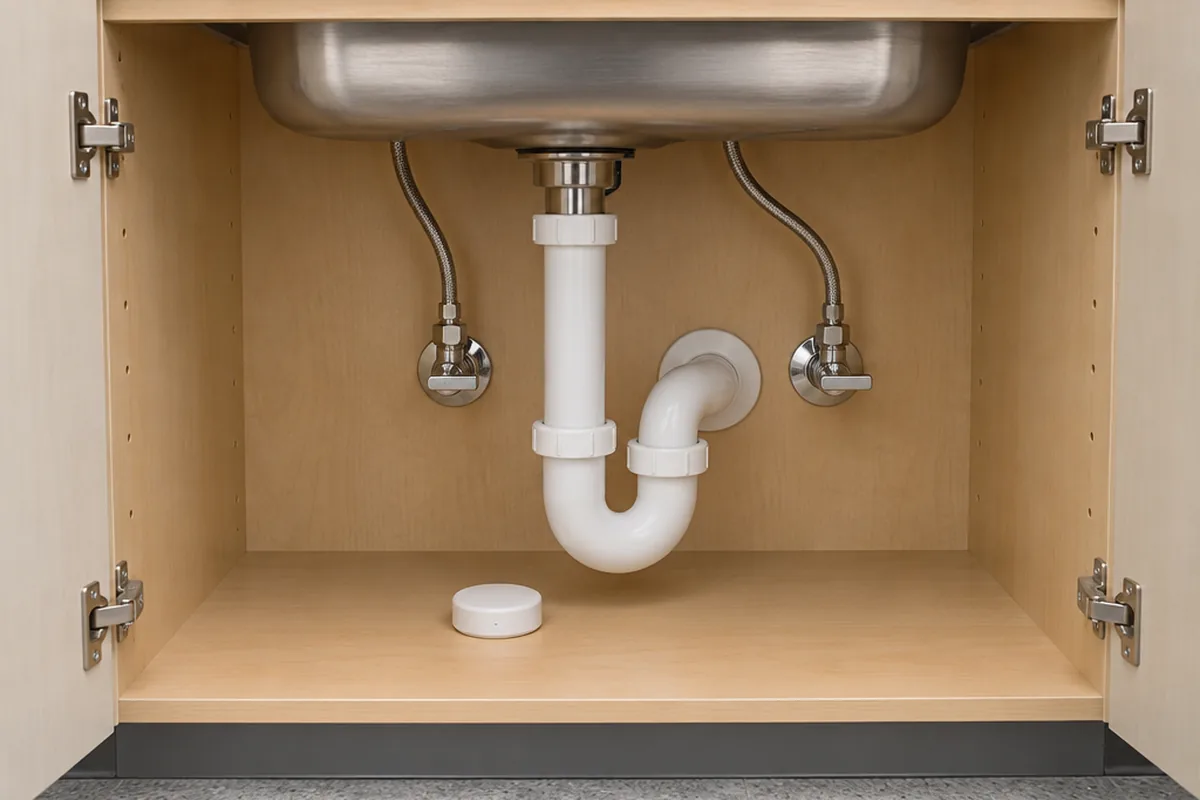
One sink base holds a faucet, a trap, two stops and often a disposal, a dishwasher hose and an ice maker tee. Any of those joints can weep, and a wet cabinet floor rarely says which one did. We dry every joint, run each connection in turn and replace the part that wets first. New appliance connections are covered under break room plumbing.
The complaint comes from the unit underneath. Before a ceiling is opened we test the fixtures above it: toilet supply and base, sink and tub traps, the stops. A fixture leak is repaired where it is found. At turnover the same unit can have every stop and supply line changed as one line item, described under shut-off valves. Water from inside a wall or floor goes to a licensed plumbing contractor.
Lavatories clog in the first bend of the trap, chrome traps pinhole along the bottom, and a floor drain that never sees water dries out and lets drain gas into the room. We pull and clear traps by hand, replace thin ones and refill dry floor drains. Flush valves, faucets and stalls in that room are handled as commercial restroom repair.
While you are on the phone, we guide whoever is on site to the fixture stop, or to the valve for the suite or unit. With that valve closed, the leak becomes work that can be scheduled.
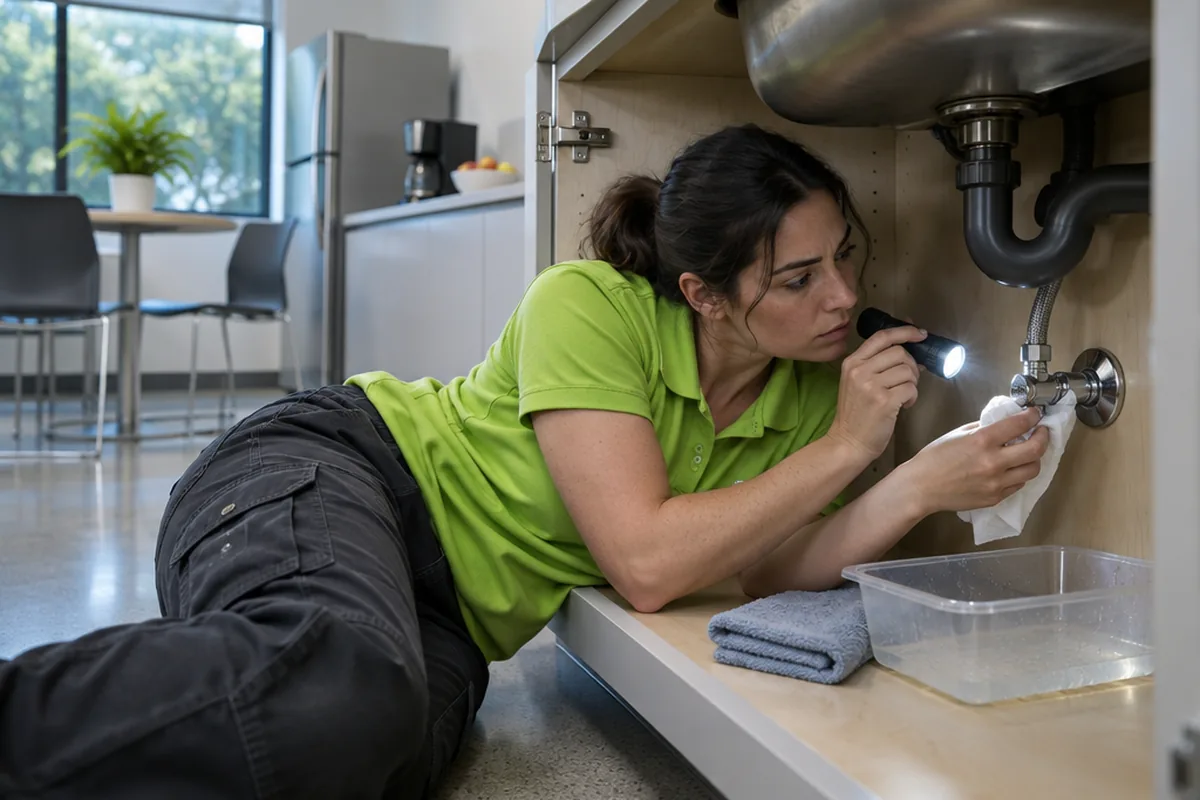
The technician wipes each joint dry and works down from the highest fitting with a paper towel and a light. Supply joints are checked under pressure, drains with the bowl filled and released.
The failed part is replaced, not just snugged: a supply line, a stop, a slip washer, a trap, an appliance tube. A stop that will not close is priced before anything else is opened.
We pressurize, run the fixture, recheck with a dry towel and photograph before and after. New valves are tagged. The report names the source, the part and what got wet.
Under section 606.2 of the International Plumbing Code, the supply to every plumbing fixture and every appliance gets its own shutoff valve; some tubs, showers and hotel sleeping units are excepted. Section 606.4 wants a valve that sits away from what it serves to be identified. Section 604.5 ends the fixed supply pipe within 30 inches of the fixture, with an approved flexible connector between. States adopt this model code with their own amendments, and the local official has the last word.
Every fixture trap is to hold a liquid seal 2 to 4 inches deep, under section 1002.4 of the same code. That water is the only thing between the drain and the room. S-traps and traps that depend on moving parts are prohibited (section 1002.3), and seals that can evaporate are to be protected by a listed method such as a trap seal primer (section 1002.4.1). Primers are installed and repaired by a licensed plumbing contractor. Topping up a dry trap is maintenance.
The U.S. EPA's mold guidance for commercial buildings says to clean and dry wet or damp spots within 48 hours, which is why even a small leak is shut off before anything else happens. On drinking water lines, the Safe Drinking Water Act (section 1417) sets lead free at a weighted average of 0.25 percent lead or less on the surfaces water touches. The stops and connectors we fit are parts marked to that standard.
Sources for the rules on this page: U.S. EPA, Mold Remediation in Schools and Commercial Buildings Guide, Chapter 2; 2021 International Plumbing Code, sections 604.5, 605.2.1, 606.2 and 606.4; 2021 International Plumbing Code, sections 1002.3, 1002.4 and 1002.4.1; U.S. EPA, Use of Lead Free Pipes, Fittings, Fixtures, Solder, and Flux for Drinking Water (Safe Drinking Water Act section 1417); U.S. EPA WaterSense, Fix a Leak Week; 2010 ADA Standards for Accessible Design, section 606.5.
Kaminskiy Care and Repair repairs the leaks a technician can see and reach without opening a wall, floor or slab. Braided supply lines split at the crimp or the cone washer. Stops weep at the stem. Faucet bases send water down the hoses, toilet supplies drip at the tank nut, and ice maker and dishwasher connections loosen behind the machine. We replace the failed part with a listed connector of the right length, test it dry under pressure and photograph it. EPA WaterSense figures a faucet dripping once a second can waste more than 3,000 gallons a year, so small leaks are worth a work order.
Shut-off valve replacement here means the small stops under sinks and behind toilets, not building valves. A multi-turn stop left open for years scales up and its washer hardens; try it during a leak and water beads at the stem, or the handle just turns. We take it off the stub-out, clean the pipe end and fit a quarter-turn stop with a new escutcheon and braided supply line, then tag and log it by unit and fixture. Water must be off upstream, so the shutdown window is agreed first. Mains, risers, zone valves, pressure regulators and a stub-out that breaks inside the wall are a licensed plumbing contractor's work.
A slow lavatory or break room sink is nearly always clogged in its own trap. We take the P-trap off, empty it, clear the trap arm to the wall fitting with a hand auger and reassemble it with new slip washers. Thin, pitted or cracked traps are replaced at the same size, and stuck pop-ups and strainers are repaired. Dry floor drain traps are refilled to end the odor. Under an accessible lavatory we refit protective covers on the trap and supplies, as section 606.5 of the 2010 ADA Standards describes. No chemical opener is used. A stoppage beyond the wall, or several fixtures slow together, is a licensed plumbing or drain contractor's job.
A leak call has an order to it, and most of the parts involved are small. Skipping a step is how the same cabinet gets wet twice.
Three parts cause most of the water we find. Supply lines fail at the crimp after years under pressure. Old multi-turn stops will not close when they are needed. Trap slip joints loosen when a trash can is shoved into the cabinet. We renew all three at the fixture, tag the new valves and leave the cabinet floor dry.
If water is running now, close the stop at the fixture and call. Two or more fixtures slow at once point down the line, to a licensed drain contractor. A ceiling that has already come down is rebuilt as commercial ceiling repair, and the claim side is explained under insurance restoration repairs.

Close the nearest stop, photograph the wet area or the slow sink, and call or message us.

A technician traces the source and gives you a written scope and price for each part.

We replace what failed, test it dry, tag new valves and send a report naming the source.
The work is backed in writing by our workmanship warranty and done by a Kaminskiy-certified, background checked technician.
A supply leak is under pressure around the clock, so it drips whether or not anyone uses the fixture. A drain leak shows only while water goes down. That sorts most calls. A cabinet that is wet on Monday morning after an empty weekend points at a supply line or a stop. One that is wet only after the lunch rush points at the trap, the strainer or the disposal connection.
A braided connector is a rubber tube inside a steel jacket. Vapors from bleach and cleaners stored in the cabinet corrode the jacket, strands break, the tube balloons and the line splits. Kinking it on installation does the same at the crimp. A stop fails differently: it is fine until someone turns it, and then the packing tears. Crust at a nut, green or white, is the early warning on both.
Inside a multi-turn stop, a threaded stem drives a rubber washer down against a brass seat. Leave it open for ten years and scale coats the threads while the washer bakes hard in place. A quarter-turn stop has a drilled ball turning between smooth seats: no washer to harden, no long thread to scale, and a handle that shows open or closed at a glance. Turn each one once a year and it stays free.
The bend under a sink holds a few inches of water after every use. Air cannot pass that water, so drain gas stays in the pipe, and a vent pipe behind the wall stops rushing water from sucking the bend dry. Under a floor drain nobody uses, the seal evaporates within weeks, and the room starts to smell of rotten eggs. A gallon of water poured into the drain restores the seal.
Shut every fixture, make sure no ice maker or flush valve is cycling, and read the water meter. Most meters carry a small indicator that spins on very low flow. If it turns, close the fixture stops one at a time. If it still turns with every stop closed, the leak is in the piping itself. That is a licensed plumbing contractor's call, and our report will say so.
Some stops do not come off cleanly. Galvanized nipples rust thin and can shear inside the wall. Old CPVC turns brittle and may split when the valve is unscrewed. A stub trimmed close to the wall gives a wrench nothing to hold. Copper, galvanized, CPVC and PEX each take a different connection, so one photo of the existing stop saves a trip. Where the pipe in the wall needs work, we stop and a licensed plumbing contractor takes over.
Can't find your answer? Call 855-695-1195 and ask us anything.
Call 855-695-1195A fixture-level leak is one at a part a technician can reach without opening a wall, floor or slab: a supply line, an angle stop, a trap, a faucet base, a toilet connection or an appliance hookup. Leaks in piping inside walls, under slabs or at the building's main valves are a licensed plumbing contractor's work.
Close the stop at the fixture by turning it clockwise. If it will not turn or does not stop the flow, close the valve for the suite or unit, or the building valve if staff know where it is. Move what can be damaged, take photos and call us. Shutting the water should never wait for the visit.
Often, yes. We start with the fixtures above the stain and test each one, the supply side under pressure and then the drains with water running. Most stains under restrooms and kitchens trace to a fixture. If every fixture tests dry, the leak is in concealed piping or the roof, and we tell you which trade to call.
A stop has one job, closing when something leaks, and a multi-turn stop that has sat for years often fails at it. The worst time to learn that is with water already spreading. Changing stops at turnover, with the unit empty and the cabinets clear, makes it planned work. New braided supply lines go on then too, since a line is as old as the valve it hangs from.
No, only the part fed by the nearest working valve upstream. Many apartments have a shutoff for each unit, and an office restroom or floor may have its own. If the building main is the only valve, the work is set for an hour when few people need water, and building staff or a licensed plumbing contractor operate and repair that main.
Our part is the drain that belongs to the sink: strainer or pop-up, tailpiece, trap and the short arm that enters the wall. When the stoppage sits farther along, or two fixtures are slow together, it is in the branch or main line. Cabling, camera work and jetting there are for a licensed plumbing or drain contractor.
Its floor drain or sink trap has dried out, and with no water in the bend, sewer gas rises straight into the room. Start by pouring roughly a gallon of water down each drain; that step does not need a licensed plumbing contractor. A smell that comes back within days, or a drain that will not hold water, means the trap or its primer needs a plumber.
A drip at a slip nut usually stops with a fresh washer and a nut turned hand tight. A trap that weeps through its own wall, shows pinholes or flakes apart when handled gets replaced. Thin chrome traps in public restrooms seldom repay a second resealing, so for those we usually quote a new trap.
Yes, as a separate scope once the leak is fixed and the area is dry. Stained ceiling tiles, wet drywall and swollen cabinet floors are replaced by our drywall and cabinet technicians. Keeping the two scopes apart shows an owner or insurer what the plumbing repair cost and what the rebuild cost.
Leak repair is priced by the part that failed and how easy it is to reach, with tracing time stated up front. Valves are priced per fixture, and a full unit or restroom brings the per-valve figure down. Drains are priced per sink. Every figure is in writing before work starts, and damage to finishes is quoted separately.
Send the address, where the water shows or which sinks are slow, whether a stop has been closed, a fixture count for valve work and any photos. A written scope follows. If water is running, call 855-695-1195.
Source named in writing. Quarter-turn stops, tagged. Traps cleared by hand.
We answer in under three rings, 24/7.No price games. You get a clear written quote before any work begins, backed by our workmanship warranty.
