 BBBAccredited Business

Kaminskiy Care and Repair installs corner guards, crash rails, bumper rails, FRP wall panels and door kick plates in commercial corridors, kitchens, restrooms and back-of-house areas. The damaged wall is repaired first, then each corner guard, rail or panel is fastened or bonded to a sound surface, usually after hours. We tell you where a rail would project too far into a walkway, and the local official decides what a wall needs. Wood trim on walls is chair rail and wainscot installation. Wall protection is the prevention side of our commercial drywall and ceiling work.
Luggage carts, hand trucks and cleaning carts clip every outside corner on their route, and paper-faced corner bead does not survive it. We rebuild the corner square, then cover it with a guard sized to the traffic: clear or colored vinyl where looks matter, stainless steel where pallets and steel carts run. Long stretches of wall get a crash rail at the height the carts strike.
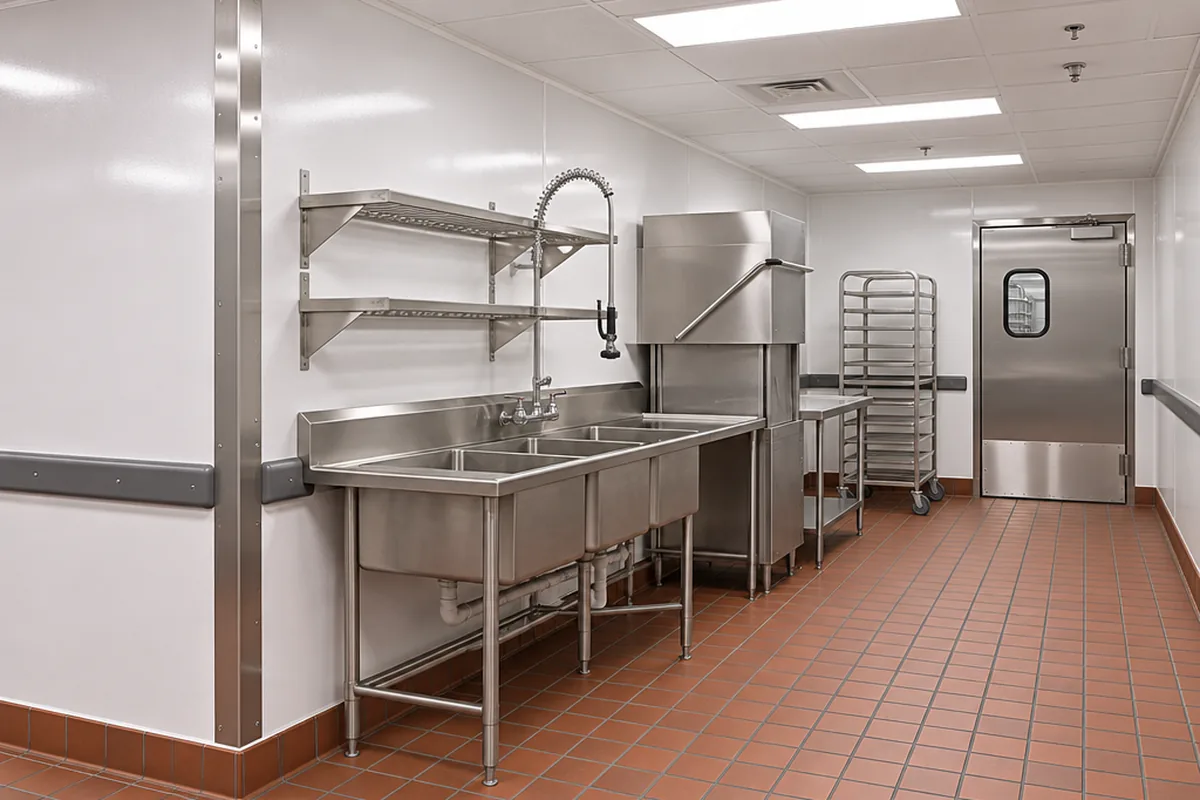
Painted drywall behind a dish machine or a mop sink stays damp, stains and sheds paint. Fiberglass reinforced plastic (FRP) panels give those walls a washable face. We bond the panels to a sound, flat wall, fit the trim pieces at seams and corners, and seal the edges so wash water cannot get behind them. Bun racks and carts get a bumper rail at their own height.
Janitor closets and restroom walls take water and chemicals low on the wall, and service doors get kicked open all day. Panels go on the wet walls, and stainless kick plates go on the push side of the doors. Where the finish is paint and the trouble is scuffing instead of impact, a scrubbable coating may be enough: see high-traffic area coatings.
We follow the path the carts take and mark every corner and wall that shows hits, noting the height of the damage. That height, not a catalog default, sets where a rail goes.
Crushed corner bead is replaced and holes are patched before anything is mounted. A guard over broken board has nothing to hold on to, and a panel over a soft wall will let go.
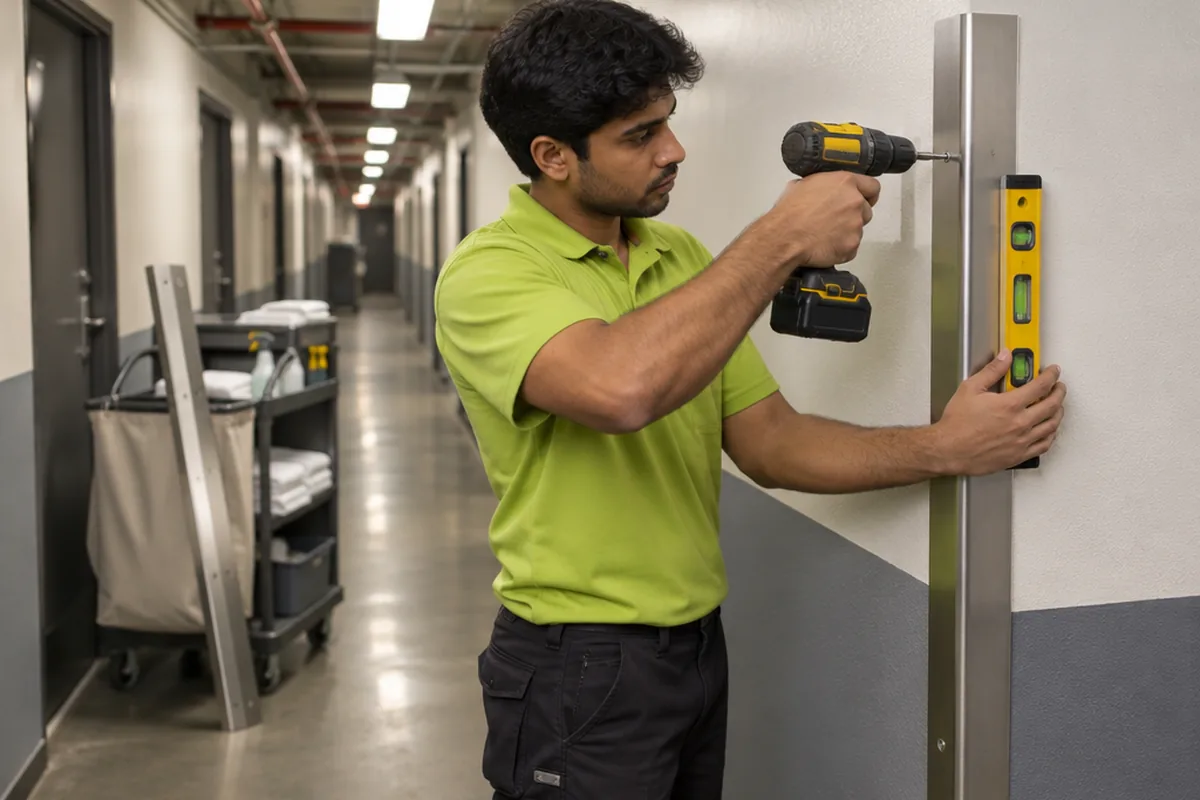
Guards and rails are screwed into studs or blocking, or set with anchors rated for the wall, and adhesive-mounted guards go on clean, primed surfaces. Panels are bonded with the adhesive their maker calls for.
Seams and top edges are sealed where water is present, end caps go on every rail, and adhesive is cleaned off the face. You get photos by location and a note of the product and color used.
The 2010 ADA Standards (section 307.2) limit objects with a leading edge more than 27 inches and not more than 80 inches above the floor to a 4 inch projection into a circulation path. Handrails may project 4 1/2 inches. Protruding objects also may not reduce the clear width an accessible route requires. A deep crash rail in a narrow corridor can break that limit, so we measure before we recommend one.
Model building codes treat wall panels and guards as interior finish. The International Building Code (Section 803.1.2) sorts finishes into Class A, B and C by flame spread and smoke-developed index under the ASTM E84 test, and its Table 803.13 sets the class by occupancy and location, with exit stairways and corridors generally held tighter than ordinary rooms. Ask for the product's classification before you buy. The local official decides what your corridor needs.
The FDA Food Code, a model that state and local health departments adopt in their own versions, calls for indoor wall surfaces that are smooth, durable and easily cleanable where food operations are conducted, and nonabsorbent in areas subject to moisture such as food preparation areas, warewashing areas and toilet rooms (section 6-101.11). FRP panels are a common way to provide that. Your health inspector has the final word on a given wall.
Sources for the rules on this page: 2010 ADA Standards for Accessible Design, section 307 (U.S. Access Board guide to protruding objects); 2021 International Building Code, Section 803.1.2 and Table 803.13; FDA Food Code 2022, section 6-101.11.
A corner patched three times has cost more than a guard would have. We fix the wall once, then put something harder between it and the traffic.
The standard job has two halves. First the crushed bead comes out, a new corner is set straight and plumb, and the wall is finished and primed. Then a guard goes over it, tall enough to cover the scar line the carts left, with a rail on the adjoining wall if the damage runs along it. Done in that order, the repair under the guard never has to be seen again.
Each of these is a wall asking for a harder surface. Send photos and tell us what rolls past. If the corner only needs repair, see patching in an occupied building.

Send photos of the damaged corners and walls and tell us what rolls past them.

We measure, recommend products and heights, and write a scope with the repairs listed separately.

The wall is repaired, the protection installed after hours, and photos sent by location.
The work is backed in writing by our workmanship warranty and done by a Kaminskiy-certified, background checked technician.
Rigid vinyl guards on an aluminum retainer absorb an impact and spring back, and they come in colors that suit a corridor. Stainless steel takes pallets and steel carts without cracking and suits kitchens, where it can be washed down. Rubber and flexible guards belong in parking and loading areas. The right pick depends on what strikes the corner and how hard, more than on how the corner looks.
Catalogs suggest standard mounting heights, but the wall already shows where it gets hit. A luggage cart strikes at one height, a rolling bed at another, a hand truck at a third. We measure the band of damage and center the rail on it. A guard that stops below the top of the scar line just moves the damage up the wall.
A panel wall fails at its edges. If the seam trim is skipped, or the top edge and the base are left open, wash water runs behind and the board rots unseen. Panels also grow and shrink with temperature, so they need a gap at each joint and trim that covers it. We lay out the wall so seams land away from sinks and sprayers where we can.
A guard is not the answer to every damaged wall. If a door swings into the wall, a door stop costs less than a rail. If pallets are staged against drywall, a floor-mounted stop keeps them off it. And if the corridor is already narrow, a deep rail may take width an accessible route needs. We say so when the fix is somewhere other than the wall.
Can't find your answer? Call 855-695-1195 and ask us anything.
Call 855-695-1195Tall enough to cover the damage the corner already shows, with some margin. Guards about four feet tall cover most cart traffic, and full-height guards make sense where tall racks or beds pass. We measure the scar line on your wall instead of assuming, and note the height in the scope.
Yes, always. Crushed bead is replaced and the board is patched and primed first. A guard needs a straight, solid corner to fasten to, and covering broken drywall only hides a repair that will loosen the guard later.
Usually not. FRP panels can be bonded over painted drywall that is flat, dry and sound, with the paint well bonded. Loose paint, soft board or any dampness has to be corrected first, because the panel adhesive only holds as well as the surface under it. Tile or heavily textured walls need a different approach.
No. A crash rail protects the wall. A handrail is something people grip, and accessibility standards set its height, shape and clearance. Some products combine the two, but they have to be chosen and mounted as handrails. Tell us which you need.
We cannot promise an outcome. Health departments look for smooth, cleanable, nonabsorbent walls in food and wet areas, and building codes set a fire classification for wall finishes. We install products that come with documentation for both, and the inspector decides.
The product, the length and number of corners, and how much wall repair comes first. Stainless costs more than vinyl. Long rail runs need layout and end caps. Panels need trim at every seam. The scope lists repair and protection as separate lines so you can see each.
It is usually scheduled after hours, since corridors and kitchens are in use all day and adhesive needs time to grab before a wall is bumped or washed. A long corridor is done in sections so one route always stays open.
Send the address, photos of the damaged corners and walls, and what kind of carts or equipment pass them. We reply with product options and a written scope. Or call 855-695-1195.
The wall repaired first. Guards, rails and panels installed after hours. Photos by location.
We answer in under three rings, 24/7.No price games. You get a clear written quote before any work begins, backed by our workmanship warranty.
