
 BBBAccredited Business

Kaminskiy Care and Repair installs ADA door hardware in offices, clinics and retail suites: round knobs replaced with lever sets, and pulls, latches and thumb turns corrected to work with one hand and no tight grasping, pinching or twisting, as the 2010 ADA Standards describe. Hardware is set 34 to 48 inches above the floor, each door's opening force is measured, and a narrow opening gets doorway widening to 32 inches clear. Work runs after hours. Fire doors keep the force their rating needs. Lever and hardware changeouts are a core part of our accessibility services for commercial property.
Patients arrive with canes, walkers and a weak grip. Restroom doors get privacy levers with a large turn or push button and an outside release, and pulls a hand can slip behind. We also time the closer, so the door does not shove a slow walker through the frame. A closer that will not hold its setting is replaced under door closer service.
Suites fitted out years ago have knob locksets on offices, conference rooms and supply rooms, and shops have thumb latches and slide bolts set high on fitting room and restroom doors. We change them to levers that keep the same lock function, so an office still locks with a key and a storeroom still locks itself. Many doors on one keyway are planned together with lock replacement and rekey prep.
Restrooms, exam rooms and stockrooms in older suites were built with 30 and 32 inch doors, and a door open at 90 degrees stands in its own opening. The tape reads 28 to 30 inches from door face to stop. Offset hinges win back the door's thickness. When that is not enough, we reframe the partition for a 36 inch door, as described under widening a doorway.
We walk the doors and note each lock's function, its backset, the door thickness and whether the door carries a fire label. Narrow openings are taped from door face to stop. That list becomes the hardware order.
Levers are ordered by function, finish and grade, with a returned lever end where the local code calls for one. Mismatched door preps are sorted out before installation night. Before a doorway is widened, we check what the wall is and what runs through it.
Each knob comes off, the latch and strike are checked, the lever goes on, and the door is cycled a dozen times. Hardware that sat too high or too low is remounted in range and the old holes are filled.
We read the opening force of each interior door with a door pressure gauge, time the closer, and give you a door-by-door sheet. A widened opening is taped again and photographed.
Section 404.2.7 of the 2010 ADA Standards sends door hardware to section 309.4: handles, pulls, latches and locks must work with one hand, without tight grasping, pinching or twisting of the wrist. The U.S. Access Board's guide to that section states that round door knobs do not comply, because they require twisting of the wrist. Operable parts belong 34 to 48 inches above the finish floor. In California, Title 24 section 11B-404.2.7 narrows the range to 34 to 44 inches, so we check which rule applies.
Section 404.2.9 limits interior hinged doors to 5 pounds of opening force, not counting the force to retract the latch. Fire doors use the minimum opening force the authority allows. The federal Standards set no figure for exterior hinged doors. Section 404.2.8.1 requires a closer to take at least 5 seconds to bring the door from 90 degrees open to 12 degrees from the latch.
Section 404.2.3 requires a door opening to give at least 32 inches of clear width, measured between the face of the door and the stop with the door open 90 degrees. An opening deeper than 24 inches needs 36. An altered doorway is allowed a latch side stop that intrudes up to 5/8 inch. The federal barrier removal rule, 28 CFR 36.304, expects a fix to meet the alteration requirements unless that is not readily achievable. Whether one doorway satisfies your duty is a judgment for the owner and their adviser.
Sources for the rules on this page: 2010 ADA Standards for Accessible Design, sections 309.4 and 404.2.7 (door hardware); 2010 ADA Standards for Accessible Design, sections 404.2.8.1 and 404.2.9 (closing speed and opening force); 2010 ADA Standards for Accessible Design, sections 404.2.3 and 404.2.4 (clear width and maneuvering clearance); U.S. Access Board, Guide to the ADA Standards, Chapter 4: Entrances, Doors, and Gates; 28 CFR 36.304(b) and (d), ADA Title III regulations; California Division of the State Architect, 2022 Access Compliance Advisory Reference Manual (Title 24, Chapter 11B).
Kaminskiy Care and Repair widens narrow interior doorways in non-bearing partitions, so the opening reaches the 32 inch clear width in section 404.2.3 of the 2010 ADA Standards, measured from the face of the open door to the stop. When hinges cannot find the missing width, we reframe: a new header and studs, a wider frame and door, then drywall, casing, paint and a floor patch, built over several evenings with the room lockable in between. The tactile room sign is reset beside the new latch. A bearing wall needs an engineer, and a fire-rated wall is rebuilt only as its listed assembly. Either one is permit work, and the building official has the final say.
Offset hinges are the small fix for a doorway that is an inch or two short. They carry the open door out of the frame, so its thickness no longer stands in the opening. With a 1 3/4 inch thick commercial door, the gain is a little under two inches. The federal barrier removal rule, 28 CFR 36.304(b), lists installing offset hinges to widen doorways among its examples. We swap the hinges on the existing door and frame, check the frame screws and the latch, and measure the result. If the tape would still read under 32 inches, we say so and price the reframe.
A wider door does not create the floor space a person needs to open it. Section 404.2.4 of the 2010 ADA Standards sets that space by approach. Pulling the door toward you from the front takes a space 60 inches deep, with 18 inches of clear wall past the latch. Pushing it open from the front takes 48 inches of depth, and 12 inches past the latch as well if the door carries both a closer and a latch. Shelving, a sink or a cabinet often sits in that space. We measure it along with the door, tell you what crowds it, and leave the layout decision to your access specialist or architect.
We change the part the hand touches, keep the lock doing its job, and write down what each door measures.
A lever lockset fits the same bored hole as most commercial knob locks, so the door is not cut. We match the function, whether passage, privacy, office or storeroom, reuse or replace the cylinder so your keys still work, set the lever level and check that the latch throws fully into the strike.
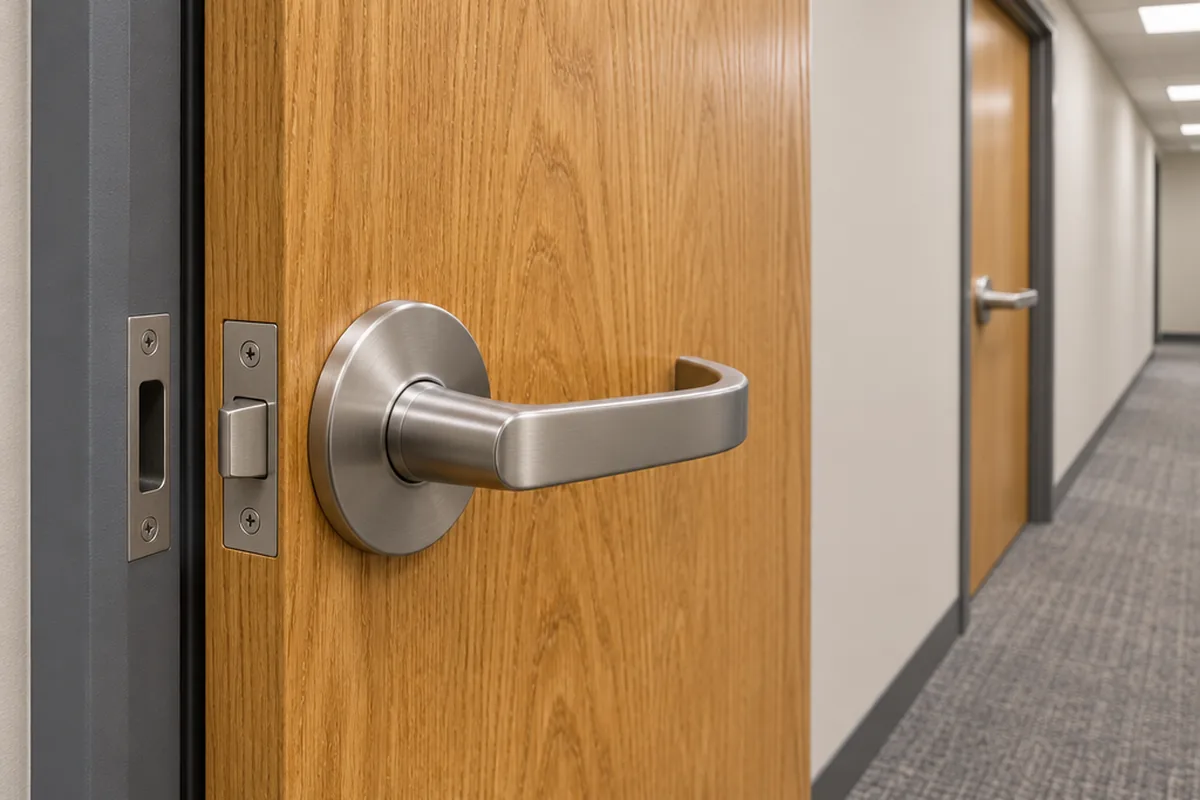
Most of these are fixed at the door with a screwdriver and the right parts. A narrow opening takes hinges or a carpenter. Count the doors, note which ones lock and which measure short, and we can scope the work from your list.

Send a door count with a photo of one knob, the door edge, any fire label and any doorway that measures short.

We write a scope listing hardware by door, function and finish, with the price.

Levers are fitted after hours, each door is force tested and timed, widened openings are measured again, and you get the log.
The work is backed in writing by our workmanship warranty and done by a Kaminskiy-certified, background checked technician.
Commercial locksets are sold by function. A passage set never locks. A privacy set locks from inside with a release outside. An office or entry set locks with a key outside and a button or turn inside. A storeroom set is always locked outside. Change a knob for a lever of the wrong function and someone gets locked out, or a room that must lock no longer does.
Hardware is graded for duty, and Grade 1 or Grade 2 cylindrical levers belong on doors that see daily traffic. Lighter residential levers sag and loosen after a few months of office use. Most commercial doors are bored for a cylindrical lock. Some older ones hold a mortise lock in a pocket cut into the door edge, and that takes mortise lever trim.
A door with a fire label needs latching hardware listed for fire doors, and it cannot be drilled or cut in the field beyond what its listing allows. We check the label on the hinge edge and on the frame before ordering. If a rated door needs more than a like-for-like trim change, it is handled as fire-rated door work, with the fire official's requirements in view.
A door that takes 10 or 12 pounds to open usually has a closer set too strong, a dragging hinge or tight weatherstrip. We free the door first, then back off the closer's spring until the door still latches unaided. A door pressure gauge held near the latch edge gives the reading. Some doors cannot reach 5 pounds and still latch against building air pressure, and those are noted for the owner.
A door sold as 32 inches does not give a 32 inch opening. On ordinary butt hinges the open door's own thickness stays in the doorway and the stop on the other jamb takes a bit more, so the passage ends up near 30 inches. A 36 inch door clears about 34. Offset hinges shift the pivot so the open door sits outside the frame. They cannot help a pocket door, a door blocked short of 90 degrees, or an opening three or more inches short.
The old frame comes out of the non-bearing stud partition, the drywall is cut back, the stud on the latch side moves over, and a new header, frame and wider door go in. Drywall, tape, texture, casing and paint follow, with dust held behind plastic and a filtered vacuum. Older walls are lab tested for asbestos and lead before they are cut, and a switch in the way is moved by a licensed electrician. Finish work follows our occupied-space drywall patching methods.
Can't find your answer? Call 855-695-1195 and ask us anything.
Call 855-695-1195Which doors are covered in your building is a question for your access report or an access specialist. In practice, managers usually change every knob a customer, patient, tenant or employee is expected to use, and start with entries and restrooms. We scope whatever list you send.
Usually. If the new lever takes the same cylinder or keyway, the existing cylinder is moved over or the new one is keyed to match. Where the keyway differs, a locksmith rekeys the new cylinders. We check this from a photo of your key and the door edge before ordering.
Between 34 and 48 inches above the finish floor, under section 404.2.7 of the 2010 ADA Standards. That covers the lever, the lock turn, pulls and any bolt a person has to operate. In California the upper limit under Title 24 is 44 inches. We hold California license #1106209.
Five pounds for an interior hinged door, under section 404.2.9 of the 2010 ADA Standards, measured as the steady push or pull to swing the door, not the force to release the latch. Fire doors follow the minimum the local authority allows, and the federal Standards set no number for exterior hinged doors. In California, Title 24 section 11B-404.2.9 applies 5 pounds to exterior hinged doors as well and caps required fire doors at 15 pounds.
At least 32 inches clear, under section 404.2.3 of the 2010 ADA Standards. The tape runs from the face of the door, open 90 degrees, to the stop on the latch side, so what counts is the measured opening and not the size of the door slab. A passage deeper than 24 inches needs 36 inches.
Often. Swing-clear hinges return roughly the thickness of the door, which is enough for many 32 and 34 inch doors that measure an inch or two short. We measure before ordering. If swing-clear hinges would still leave less than 32 inches, we price the reframe up front, so nobody pays for a fix that comes up short.
Not for a hinge swap. Cutting a wider opening is construction, so many cities ask for a permit, and a bearing or fire-rated wall also needs an engineer or the listed assembly. The local building official decides. You hear what kind of wall it is before any price is approved.
Yes, when the lever lockset is listed for use on fire doors and fits the existing prep without new cutting. The door must still latch every time it closes. We do not drill extra holes in a labeled door or remove its closer. Anything beyond a trim change is reviewed against the label first.
The number of doors, the grade and finish of the hardware, and how many functions and keyways are involved. Mortise locks, fire-rated openings, hardware remounted at a new height and doors that need closer work add to it. A widened doorway is priced by its wall: a hinge swap is small, a reframe is carpentry and finish. The written scope prices it door by door.
No. Low-energy operators and their wall buttons are installed and serviced by automatic door companies, and the wiring is theirs. If a door cannot be brought to an acceptable opening force with hardware and closer adjustment, we say so, and that is when an operator is worth pricing.
Send the address, the number of doors, which ones lock, any doorway that measures short, and a photo of one knob and door edge. We reply with a written scope by door. Or call 855-695-1195.
Functions matched. Heights and widths checked. Force and closing time on record.
We answer in under three rings, 24/7.No price games. You get a clear written quote before any work begins, backed by our workmanship warranty.
