 BBBAccredited Business

Kaminskiy Care and Repair does curb painting and bollard painting on commercial sites, renewing the safety markings a lot already has: red fire lane and loading curbs, yellow bollards, wheel stops, speed bumps, stair nosings and stenciled lettering. Surfaces are cleaned and scraped, then coated with traffic-grade paint a section at a time so parking stays open. Fire lane color and wording come from your local fire authority. We do not lay out parking or design accessible stalls; a striping contractor does. Safety paint is a small part of our commercial property painting services.
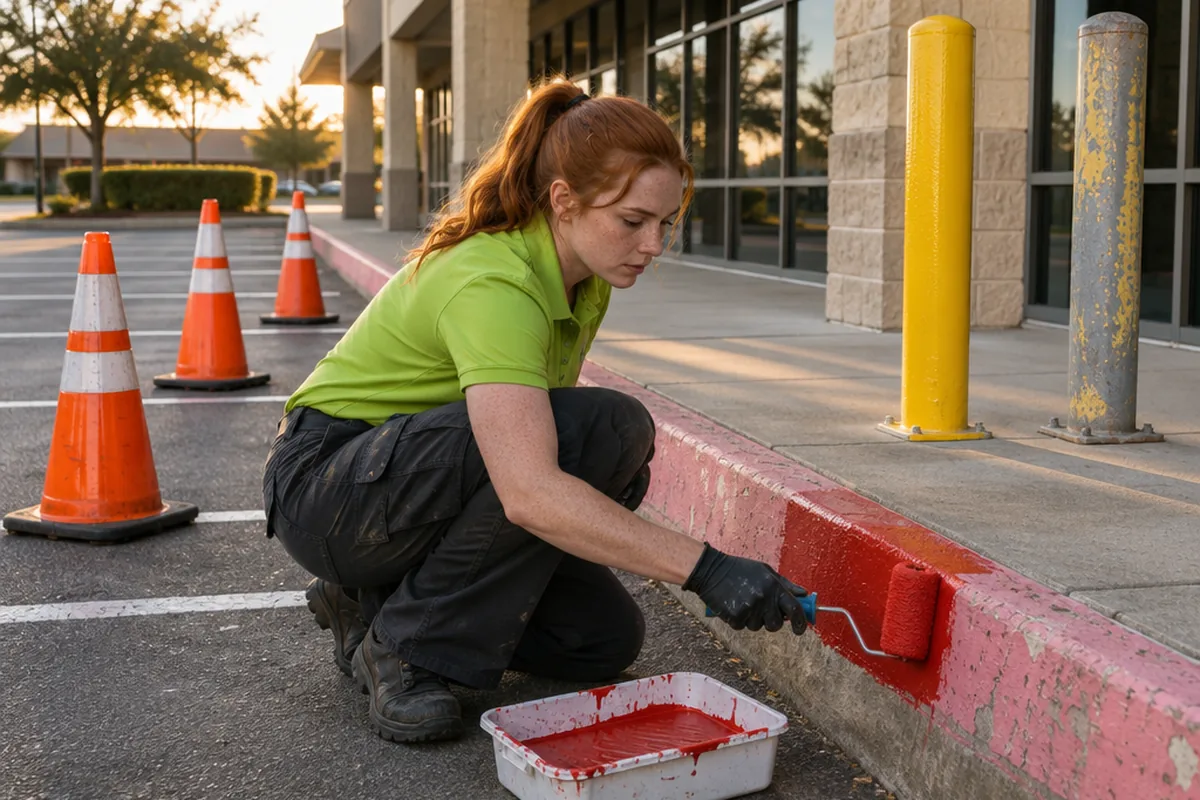
Red fades faster than any other curb color, and the stenciled lettering goes with it. We scrape the loose layers, clean the face and top of the curb, repaint in the red your fire authority specifies and re-stencil the wording that was there, at the spacing that was there. If no marking exists today, the fire marshal decides whether one is required and what it says.
Bollards in front of a store take bumper hits and cart scrapes down to bare steel. Wheel stops and speed bumps turn the color of the asphalt. Steel bollards are wire-brushed, spot-primed and finished in safety yellow, and concrete wheel stops and bumps get traffic paint. A bollard that is bent or loose at the base is a repair first; at the trash yard that is dumpster enclosure repair.
Painted stripes on exterior stair nosings, curb ramp flares and the lip of a raised walk tell a foot where the edge is. They wear off in the walking line first. We renew the stripes that exist, and because plain paint is slick when wet, a grit additive or a traction product is the better answer on a walking surface: see slip-resistant treatments.
We walk the lot and photograph each marking: curb runs by color, stencils and their wording, bollards, wheel stops, bumps and stair edges, with rough lengths and counts.
For fire lanes, you or we check the fire authority's current requirement for color, wording and letter size, so the repaint follows today's rule and not a faded guess.
Work is coned off a few stalls or one curb run at a time, early in the day, with deliveries and trash pickup kept clear.
Cones stay until the paint can take tires and shoes. You get before and after photos by location, useful when an inspector or insurer asks.
Section 503.3 of the International Fire Code, a model code many jurisdictions adopt, says that where the fire code official requires it, fire apparatus access roads are marked with approved signs or markings that include the words NO PARKING FIRE LANE. It also says the marking must be kept clean and legible and be repaired or replaced when needed for visibility. Color, letter height and spacing are local. Faded fire lane paint is therefore a maintenance item with a rule behind it.
The 2010 ADA Standards, section 502, set accessible car spaces at 96 inches wide minimum with an access aisle at least 60 inches wide, and require the aisle to be marked so people do not park in it. The Standards do not choose a paint color. Whether a lot has the right number, size and location of spaces is a layout question for a striping contractor and, where needed, an access specialist. We refresh faded paint on existing markings and do not survey or certify a lot.
OSHA's safety color code, 29 CFR 1910.144, makes red the basic color for danger and stop and yellow the basic color for caution and for marking physical hazards such as striking against, stumbling, falling and tripping. That is why bollards, column corners and low edges are yellow. On curbs, the meaning comes from state and local traffic rules. In California, Vehicle Code section 21458 assigns red to no stopping, yellow and white to loading, green to time limits and blue to disabled parking.
Sources for the rules on this page: 2021 International Fire Code, Section 503.3; U.S. Access Board, Guide to the ADA Accessibility Standards, Chapter 5: Parking Spaces (2010 ADA Standards 502); OSHA, 29 CFR 1910.144, Safety color code for marking physical hazards; California Vehicle Code, Section 21458.
We renew the red, the yellow and the lettering your site already has, in sections, with the lot open.
The usual job covers every red curb run with its stencils, each bollard at the storefronts and the dock, and the wheel stops and speed bumps between them. Loose paint is scraped so new coats do not peel off with the old, steel is primed where it is bare, and traffic paint goes on in two coats. Lettering is re-cut with stencils matched to the existing size.
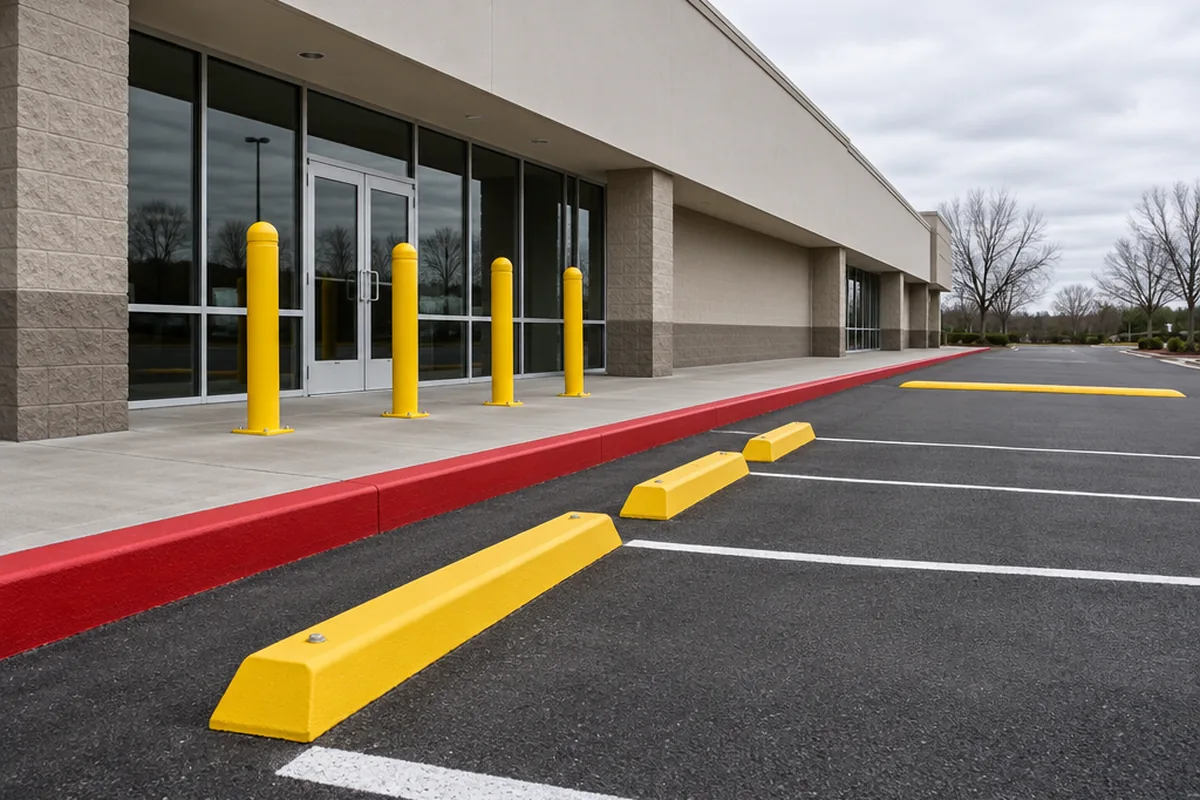
All of these are repaint items when the marking already exists. Send photos and rough lengths. If the report asks for a new fire lane or a new accessible stall, we tell you who decides that and who installs it.

Send photos of the curbs, bollards and stencils, with rough lengths and counts if you have them.

Approve the written scope listing each marking, its color and wording, and the order sections close.

We prep and paint by section with the lot open, then send before and after photos.
The work is backed in writing by our workmanship warranty and done by a Kaminskiy-certified, background checked technician.
A curb repainted every year or two for decades carries a thick shell of paint. Each new coat bonds only to the one below, and when the bottom layer lets go the whole shell comes off in plates. Before repainting we scrape and wire-brush everything that is loose. On curbs with heavy build-up, stripping the worst runs to concrete once makes every later repaint last longer.
Curbs collect tire rubber, oil drips, irrigation minerals and dirt. Paint sticks to that film, not to the concrete, and wears off with it. Washing or degreasing, then letting the curb dry fully, matters more than which paint is chosen. Sprinklers are the usual spoiler: we ask that irrigation zones along the work be shut off the night before and through the day of painting.
Markings get a waterborne traffic coating made to bond to concrete and asphalt and to stand up to tires. Leftover exterior wall paint on a curb looks fine for a month and then scuffs away. Steel bollards are different again: they want a rust-inhibiting primer on bare spots and an enamel made for metal. Plastic bollard sleeves are an option where repainting has become a monthly chore.
Refreshing a mark where it lies is maintenance. Changing where stalls, aisles or arrows go is design, and it can carry accessibility and fire access consequences. The U.S. Access Board's guide treats resurfacing or resealing a lot, or adding spaces, as alterations that bring the accessible parking requirements with them. That is why we keep to the existing marks and send layout questions to a striping contractor before paint is involved.
Can't find your answer? Call 855-695-1195 and ask us anything.
Call 855-695-1195Whatever your local fire authority specifies. Red with white lettering is common, but the color, the wording, the letter height and the spacing between stencils are local requirements. We check the current standard with the fire prevention office, or work from the one you give us, before repainting.
A waterborne traffic coating made to bond to concrete and asphalt and to take tire contact, applied in two coats over a curb that has been scraped, cleaned and left to dry. Leftover wall paint scuffs away within weeks. Steel bollards get a rust-inhibiting primer on bare spots and a metal enamel instead.
We can refresh faded paint on existing markings when the layout is not changing. We do not lay out, resize, relocate or add accessible spaces, access aisles or signs, and we do not judge whether a lot meets the 2010 ADA Standards. That work belongs to a striping contractor and the local code.
Yes. We close one curb run or a few stalls at a time with cones, usually early in the morning, and reopen each section when its paint can take traffic. Fire lanes, deliveries and trash pickup are kept passable throughout.
It depends on sun, tire contact, sprinklers and how well the surface was cleaned. Red fades faster than other colors. Curbs that vehicles rub and curbs that get watered daily need repainting sooner. Many properties put fire lane curbs on a yearly check and repaint as needed.
Yellow is the basic color for caution and for marking physical hazards under OSHA's safety color code, 29 CFR 1910.144. A bollard is something a driver or a cart can strike, so yellow makes it stand out. Some sites use other colors for appearance, and a bright sleeve can do the same job.
Cost follows the linear feet of curb, the number of bollards, wheel stops and stencils, how much scraping the old paint needs and how many sections the lot must be split into to stay open. We price each group of markings in writing from photos or a site walk.
If the write-up is that existing markings are faded or illegible, repainting them to the fire authority's standard addresses that item, and we give you photos to send back. The inspector decides whether it is cleared. If the report calls for new markings, the fire official defines them first.
Send the property address, photos of the curbs, bollards and lettering, and any inspection report that mentions markings. We reply with a written scope by marking. Prefer to talk? Call 855-695-1195.
Existing markings renewed. Sections closed one at a time. Photos by location.
We answer in under three rings, 24/7.No price games. You get a clear written quote before any work begins, backed by our workmanship warranty.
