 BBBAccredited Business

Kaminskiy Care and Repair repairs wood subfloor and underlayment in apartment buildings and wood-framed commercial buildings. Soft spots at toilets, tubs and entry doors are cut out to the joists, delaminated plywood and swollen particleboard are replaced, squeaks are fastened down, and a decayed joist end is sistered. Work is done in vacant units or after hours. Framing damage beyond a local repair goes to a structural engineer first. Then the finish goes back, often as new vinyl plank. Subfloor work is the hidden half of our commercial floor repair services.
A weeping wax ring or a failed tub edge wets the subfloor for months before anyone notices. The toilet rocks, the vinyl darkens, the floor gives underfoot. With the leak stopped, we pull the toilet, cut the soft section back to solid wood over the joists, add blocking and fit new plywood. Resetting or rebuilding the fixture is toilet repair.
Dishwashers, ice maker lines and washing machines leak slowly at their connections. Particleboard underlayment swells into a hump and crumbles. We remove it to the edge of the damage, check the structural layer beneath, and lay new plywood underlayment flush with the surrounding floor. The source is traced under plumbing leak repair.
Rain driven under an exterior door rots the subfloor just inside the sill. In upstairs corridors and offices the complaint is noise: boards rubbing on nails as the framing dried. Rotted sections at the door are replaced and sealed at the edge. Squeaks are located from above and screwed to the joists before new flooring goes on.
We ask what leaked and whether it has been fixed. A subfloor repair made over an active leak is wasted, so the plumbing or door repair is confirmed before we cut.
The technician probes the soft area, lifts the finish floor and cuts an inspection opening. The damage is marked out to the centers of the nearest sound joists.
Rotted material is removed. Framing is checked and left to dry, and wet insulation comes out. Blocking is added, and new subfloor is glued and screwed down flush.
The patch is leveled to the old floor and made ready for finish flooring. You receive photos of the open floor, the framing and the completed repair.
OSHA's rule for walking-working surfaces in workplaces, 29 CFR 1910.22, says a surface must support the maximum load intended for it, and that when a repair involves the structural integrity of the surface, a qualified person performs or supervises it. In practice a sheet of subfloor is routine carpentry. A floor system that has lost strength is an engineer's question, and the local building department decides whether the fix needs a permit.
EPA's guide for schools and commercial buildings says to dry wet or damp materials within 48 hours to head off growth. A subfloor that stayed wet longer may be moldy on its underside. EPA scales the response by area and recommends limited containment once the affected area is between 10 and 100 square feet. Small spots leave with the rotted wood; larger areas go to a licensed remediation company.
Reaching the subfloor often means lifting old sheet vinyl and its felt backing. EPA lists vinyl floor tiles, the backing on vinyl sheet flooring and adhesives among materials that may contain asbestos, and OSHA treats such flooring installed by 1980 as containing it until tested. So in older buildings a sample goes to a lab before we cut, and a licensed abatement company removes anything positive.
Sources for the rules on this page: OSHA, 29 CFR 1910.22, Walking-Working Surfaces; U.S. EPA, Mold Remediation in Schools and Commercial Buildings Guide, Chapter 2; U.S. EPA, Mold Remediation in Schools and Commercial Buildings Guide, Chapter 3; U.S. EPA, Learn About Asbestos; OSHA asbestos standard for construction, 29 CFR 1926.1101(g)(8) and (k)(1).
New flooring over a soft subfloor does not last. We open the floor, find the edge of the damage and rebuild from the joists up.
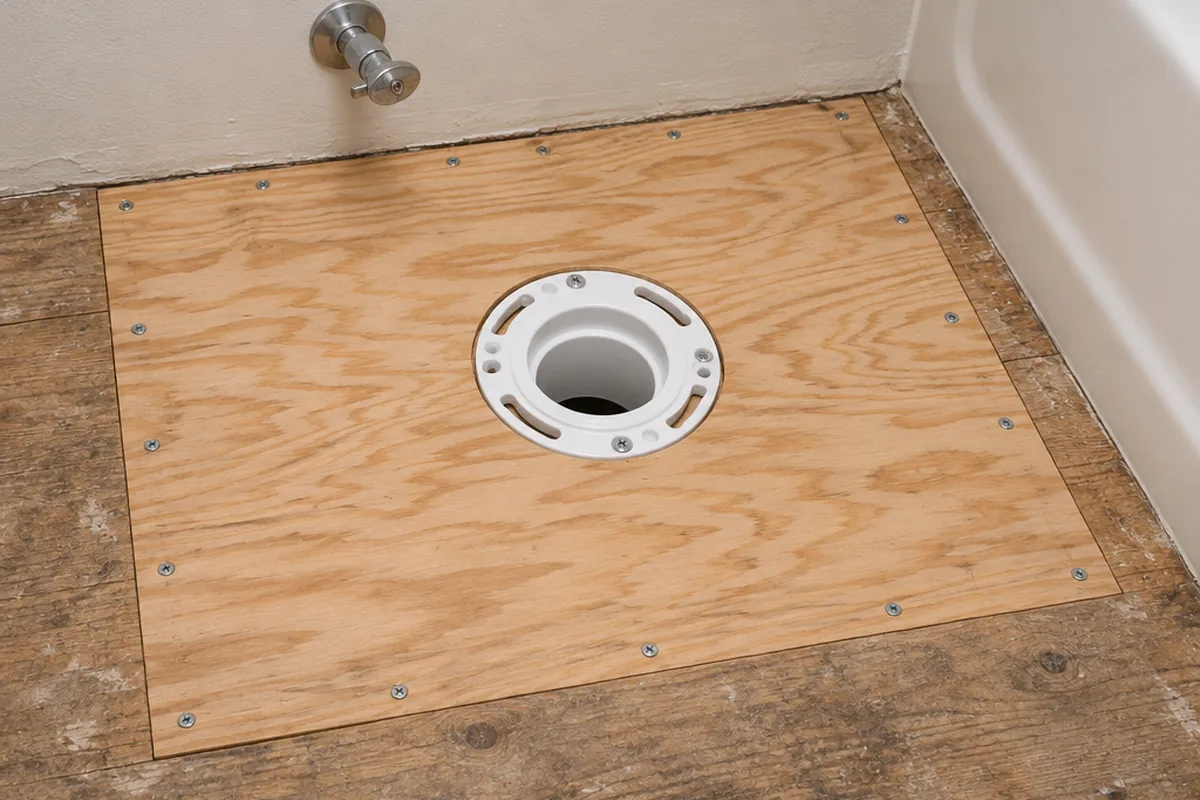
A subfloor repair we meet again and again in rental housing is the floor around a toilet. We pull the fixture, cut out the stained plywood to the middle of the joists on each side, add blocking around the drain, fit new exterior-grade plywood tight to the pipe, and set the flange at finished floor height so the new wax ring seals.
Press down with a heel near the fixture or the door. Movement, a crunch or a musty smell means the wood under the finish has been wet. Do not lay new flooring over it. Have it opened first.

Tell us where the floor is soft, what leaked and whether the leak has been repaired.

We probe and open the area, then send photos and a written price for the rebuild.

Damaged subfloor is cut out and replaced, and the floor is left flush and ready for its finish.
The work is backed in writing by our workmanship warranty and done by a Kaminskiy-certified, background checked technician.
The subfloor is the structural sheet, plywood or oriented strand board, fastened to the joists. Older buildings may have diagonal boards instead. Underlayment is a thinner, smoother layer on top that the finish floor is glued or laid on. Damage to underlayment alone is a simpler repair. Damage to the structural layer means cutting back to framing and adding support at the edges of the patch.
Particleboard underlayment was used widely under sheet vinyl and carpet. It is stable when dry and swells permanently when wet, then crumbles. Once it has swollen there is no flattening it. We replace it with plywood underlayment rated for the purpose. In buildings where it runs under every kitchen and bath, expect to find more of it at each turnover.
A squeak is wood sliding on a nail or on another piece of wood. From above, with the finish floor up, we walk the floor to find each spot, then drive screws through the subfloor into the joist to pull the layers tight. Where the gap is between joist and subfloor, shims and construction adhesive from below are the cure, if there is access.
If the subfloor has rotted, check the top of the joists under it. A darkened surface that is still hard is fine once dry. A joist end that a screwdriver sinks into has lost strength. One short decayed end can be sistered with new lumber fastened alongside. Several, or any that carry a wall above, call for an engineer's detail before work goes on.
Can't find your answer? Call 855-695-1195 and ask us anything.
Call 855-695-1195Finish flooring damage is visible on the surface. Subfloor damage is felt: sponginess, a dip, a hump, movement at a toilet, or a crunch underfoot. A stain on the ceiling below or a musty smell supports it. The only sure way to know the extent is to lift the finish floor and probe.
The toilet has to come out, because the damage is almost always under and around it. Cabinets usually stay. We cut the subfloor along the cabinet toe kick and support the new edge with blocking. If rot runs under a cabinet base, we tell you before going further.
Fixture-level leaks, yes: a wax ring, a supply line, a tub or shower caulk joint, an appliance connection. Leaks inside walls, drain lines and anything in the building's piping go to a licensed plumbing contractor. Either way the leak is repaired and tested before the floor is closed.
Small spots on the wood being removed leave with that wood, and the surrounding framing is cleaned and dried. If growth covers a larger area or extends into walls, we stop, and a licensed remediation company takes over where the state requires one. We then return for the rebuild.
When the problem is in the framing, not the sheathing: joists that are cracked, notched, sagging or decayed over a length, damaged beams or trusses, or a floor that bounces across the whole room. We can make a local repair such as sistering one joist end. Beyond that we ask for an engineer's direction.
Replacing a section of subfloor in kind is generally treated as repair. Structural framing repairs often do need a permit, and rules differ between cities. The local building department decides. Our scope separates sheathing repair from any framing work so the question can be put to them clearly.
It depends on the size of the cut-out, how many layers are damaged, what has to be removed to reach it, and whether framing needs work. Because the full extent is hidden, we price the repair we can see and price any added area in writing, with photos, once the floor is open.
Send photos of the floor, the room it is in and what leaked. Say whether the unit is vacant. We arrange to open it up and follow with a written scope. Call 855-695-1195.
Leak confirmed fixed. Rot cut out. New subfloor flush and photographed.
We answer in under three rings, 24/7.No price games. You get a clear written quote before any work begins, backed by our workmanship warranty.
