 BBBAccredited Business

Kaminskiy Care and Repair handles break room plumbing in offices, shared kitchens and rental units: garbage disposal installation as a like-for-like swap on the existing sink, drain and outlet, and water connections for ice makers, coffee brewers, refrigerators, water coolers and residential-style dishwashers. Each appliance gets its own shut-off and braided line. Visits avoid the lunch hour. Backflow devices, new piping in walls and commercial kitchen grinders are a licensed plumbing contractor's work; a new outlet is a licensed electrician's. Break room work is one branch of our plumbing repairs for commercial buildings.
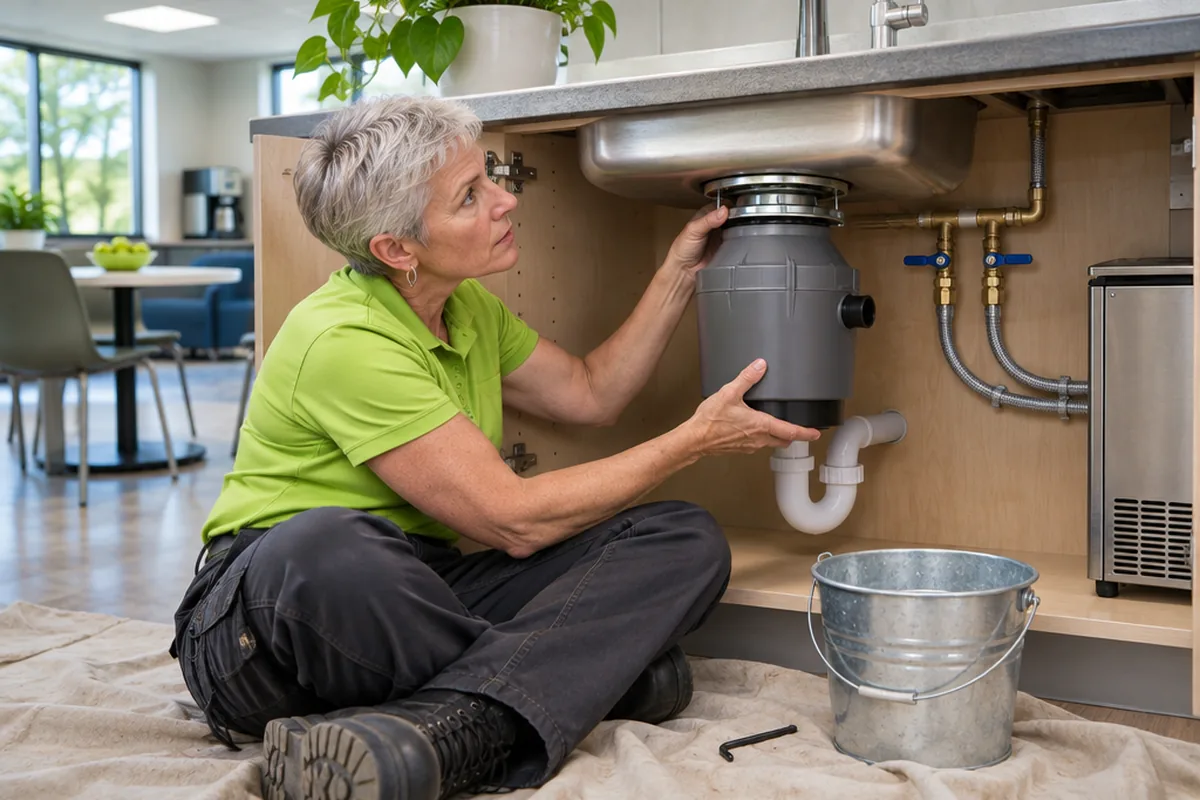
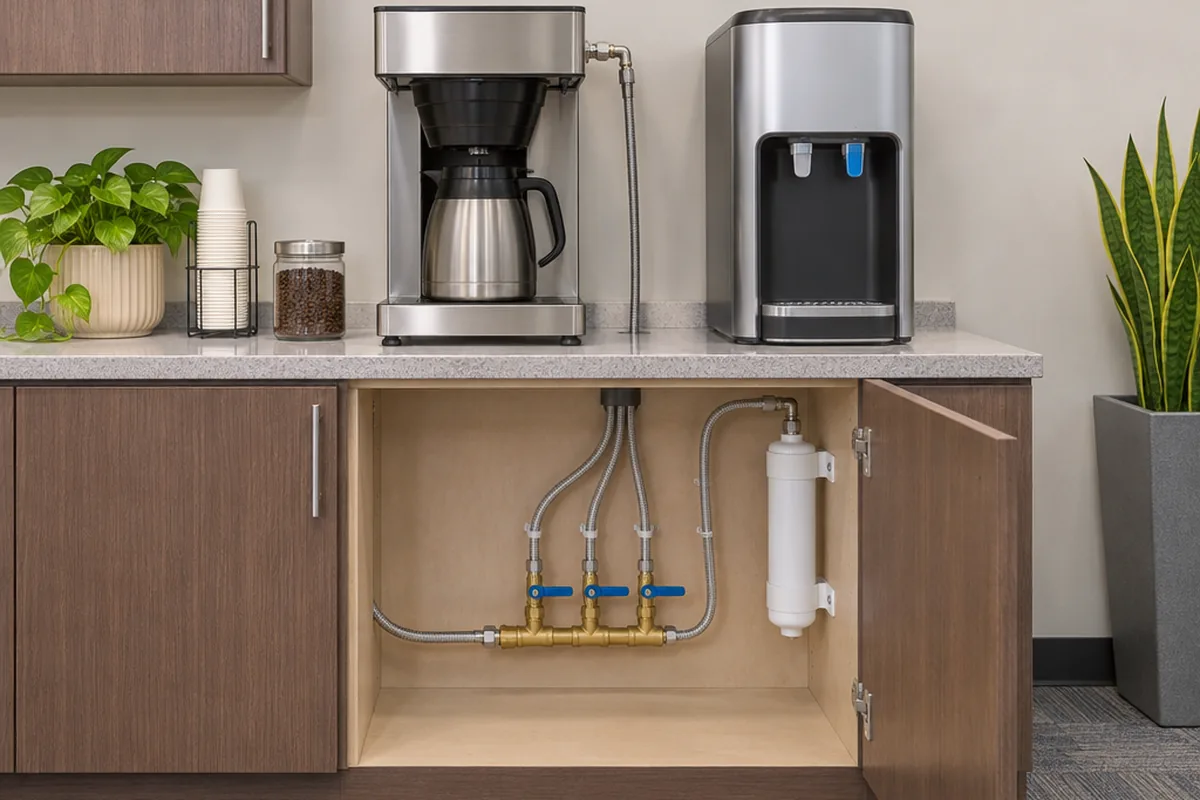
The disposal hums and trips its reset the same month a plumbed brewer and an ice maker arrive on a pallet. We swap the disposal on its existing mount and plug, add a tee with a separate quarter-turn valve for each machine, and run braided lines with slack to pull the appliances out. Cabinets and counters around them are break room remodel and cabinet work.
Point-of-use coolers trade delivered bottles for a filter and a line from the nearest cold supply. The run is often long and hidden behind millwork. We route it where it cannot be pinched, clip it, label the valve and set a leak sensor at the low point. Clinical and dental equipment stays with its own specialists.
At turnover a new refrigerator, dishwasher or disposal has to be tied in. Old plastic ice maker tubing and any saddle valve come out, and a real stop and a braided line go in. We connect the dishwasher supply and drain, open the disposal's dishwasher inlet where one is used, and confirm the stops close. Seized ones are changed as angle stop replacement.
For a disposal we need the label, the plug or switch and the pipes beside it. For an appliance, the install sheet and a picture of the nearest sink cabinet. The sheet states line size, pressure range, filter and drain needs.
The technician picks the cold supply to tee from, places each valve and filter where staff can reach them, and marks any hole through a cabinet side. The visit is set away from lunch.
A disposal is unplugged or switched off and confirmed dead before it is touched, then exchanged on the same mount. Appliance lines are cut with slack, clipped and flushed into a bucket before the final connection.
We run the disposal with cold water, fill and release both bowls, start a dishwasher drain or a brew cycle, wipe and watch every joint, test the leak sensor and photograph the cabinet.
The International Plumbing Code (section 608.17.1.2) says the water connection to each coffee machine and noncarbonated beverage dispenser must be protected by a backflow preventer conforming to ASSE 1022 or ASSE 1024, or by an air gap. Carbonated dispensers have their own rule (608.17.1.1). Whether a machine's built-in protection satisfies that is the local official's call, and in food service the health department's. A separate device is fitted by a licensed plumbing contractor.
Under section 416 of the same code, a domestic food waste disposer conforms to ASSE 1008, carries a UL 430 listing and label, discharges to a drain of at least 1 1/2 inches and has cold water supplied at the sink. Commercial disposers are a separate class, connected and trapped apart from any other fixture (section 416.3). An in-kind replacement leaves the listing, the drain size and the connection the way they were approved. Many jurisdictions adopt the code with changes.
Section 606.2 lists the supply to each appliance among the places a shutoff valve is required, and 606.4 has valves that are not beside what they serve identified. A residential dishwasher may drain to a wye on the sink tailpiece or to the disposal's inlet, with the hose raised and fastened under the counter (section 409.4). Jurisdictions on the Uniform Plumbing Code (section 807.3) may want an air gap fitting at the sink. We ask before we connect.
Sources for the rules on this page: 2021 International Plumbing Code, sections 606.2, 606.4, 608.17.1.1 and 608.17.1.2; 2021 International Plumbing Code, sections 409.2, 409.4 and 416; Uniform Plumbing Code, section 807.3, as adopted in Minnesota Rules 4714.0807.
Garbage disposal installation on this page means replacing a failed unit in kind. Kaminskiy Care and Repair removes the jammed, leaking or burnt-out disposal from its mounting ring, sets a fresh sink flange in putty where the old seal leaked, and hangs a unit of matching size and power on the existing drain and the existing outlet or switch. A new gasket goes on the discharge elbow, a new splash guard in the sink opening, and the dishwasher knockout is removed only where a dishwasher drains through the unit. A jam is freed from below with a hex wrench first, because a hum is often not a dead motor. Adding a disposal where no outlet exists needs a licensed electrician first.
An ice maker water line is the thinnest pipe in a suite and stays under pressure all night with nobody there. We replace thin plastic tubing and clamp-on saddle valves with a tee, a quarter-turn stop and a braided or reinforced line rated for drinking water, left long enough to slide the machine out. An undercounter ice maker also needs a drain, and we route it properly to the existing one. A puck leak sensor or a small automatic shut-off can sit on the appliance side of the stop. Running new supply piping inside a wall to reach the machine is a licensed plumbing contractor's work.
Plumbed brewers and point-of-use coolers connect to the nearest cold supply through their own valve and, where the maker asks for one, an inline filter mounted upright and dated. The line is flushed before the final connection so grit never reaches the inlet valve. Model plumbing codes call for backflow protection on coffee machines and beverage dispensers, by a listed device or an air gap. What satisfies that for your machine is the local official's decision. When a separate device is required, a licensed plumbing contractor installs it, and we complete the remainder of the hookup.
We connect residential-style dishwashers in break rooms, staff kitchens and rental units: the supply through its own stop and braided line, and the drain hose to the sink tailpiece or the disposal inlet, raised and fastened below the countertop. Where the local code calls for an air gap fitting at the sink, the hose goes through it. A dishwasher that empties into the sink bowl usually means the knockout plug inside a new disposal was never removed. Commercial dish machines in food service are outside this service.
The vendor delivers the machine and the disposal comes in a box. Someone still has to connect both to the building properly.
The failed disposal twists off its ring and a matching unit locks on, with a new discharge gasket and splash guard. At the cold stop we add a tee and a dedicated quarter-turn valve for each appliance, then run braided lines through a filter where the maker asks. Every line is clipped and labeled, and the sink and dishwasher are run before the cabinet is closed.
Humming usually means a jam, and jams can be freed; a housing that drips from underneath means a new unit. The appliance lines on that list are not leaking yet. If one is, close its valve and see our leak and shut-off valve repair.

Send a photo of the disposal label and plug, or the appliance model, plus the nearest sink cabinet.

We write the scope: the matching unit, the route, each valve and filter, and the price.

The technician swaps, connects, flushes and tests, labels each line and shows staff the reset and the valves.
The work is backed in writing by our workmanship warranty and done by a Kaminskiy-certified, background checked technician.
A disposal has no blades. A motor spins a plate carrying two swiveling lugs that throw food against a fixed shredder ring until the pieces are small enough to wash through. That explains its habits. A spoon or a bottle cap jams the plate solid, fibrous peels wrap around it, and the unit needs cold water running the whole time to carry the grindings on to the trap.
Listen and look before calling. Humming with no grinding: power is reaching the motor but the plate cannot turn. No sound at all: a tripped overload, a pulled plug or a failed switch. A leak at the sink opening is flange putty. Water on the side comes from the discharge elbow or a loose dishwasher hose clamp. Water under the housing got past the seal around the motor shaft, and no repair brings that unit back.
The dishwasher inlet on a new disposal is sealed at the factory by a molded plastic plug. Where a dishwasher will drain through the unit, that plug has to be punched out and fished from the grinding chamber before the hose is clamped on. With no dishwasher attached, it stays put. A flooded sink after a fresh installation is nearly always this plug, forgotten.
Appliances have been fed by thin plastic tube, soft copper and braided lines. Plastic is the first to split or get nicked by a stored box. Copper kinks when the machine is pushed back. Braided stainless or reinforced polymer with factory ends tolerates movement. A saddle valve, which clamps on a pipe and pierces it with a needle, clogs with scale, weeps at its rubber pad and cannot be trusted to close. A tee and a quarter-turn stop replace it.
Brewers and ice makers scale up long before they wear out. The maker's sheet gives the filter type and the inlet pressure range. We mount the filter where the cartridge can be twisted out, write the date on it and put the change interval on the valve tag. If building pressure exceeds the appliance's limit, a pressure-reducing fitting is a question for a licensed plumbing contractor.
A break room unit starts more often in a day than a household unit does in a week. Match the old motor size or go one step up, pick stainless grinding parts, and stay inside what the cabinet and the circuit can take. Then tape three rules by the switch: run cold water first, keep filter-loads of coffee grounds out, and feed it food only. If the building is on a septic system, or the lease limits disposers, ask before replacing one.
Can't find your answer? Call 855-695-1195 and ask us anything.
Call 855-695-1195Some faults are repairs: a jam is cleared, a reset is pressed, a torn splash guard or a weeping sink flange is renewed. The motor seal, the bearings and the grinding parts cannot practically be serviced. Once a unit drips from underneath, stays locked after it is freed, or keeps tripping its overload, it is replaced.
Yes, or we install a disposal you provide. Mounting, motor size and power connection are matched to the unit coming out, which means the sink, the drain and the wiring stay untouched. Valves, braided lines, filters and sensors come with us. Properties that standardize on one model get that model.
Only if the cabinet already holds a usable outlet or switched connection, and the drain can accept a disposer. Where there is no power under the sink, a licensed electrical contractor adds it first. We also ask about the lease and the building rules, since disposers are not allowed in every building or on every septic system.
Plumbed coffee brewers, undercounter and freestanding ice makers, refrigerators with ice and water, bottle-less water coolers and residential-style dishwashers, in break rooms, staff kitchens and rental units. Each connects to an existing cold supply through its own valve. Food service equipment, soda systems and medical devices are outside this service.
Model plumbing codes require backflow protection on the water connection to coffee machines and beverage dispensers, by a listed device or an air gap. What satisfies that for your machine is decided by the local official, and in food service by the health department. When a separate device is called for, a licensed plumbing contractor installs it and we finish the connection around it.
We can extend from an existing supply through cabinets or along a wall in exposed, serviceable runs. Opening walls or ceilings to install new supply piping is a licensed plumbing contractor's work and may need a permit. Often the simpler answer is to move the machine a few feet to the cabinet run that already has water.
Yes. The drain hose goes to the sink tailpiece or the disposal inlet and is raised and fastened under the countertop, or routed through an air gap fitting where the local code calls for one. We reconnect to the method the sink was built for and tell you if it looks wrong for your jurisdiction.
No. A commercial kitchen disposer or pulper is a bigger machine, plumbed with a pre-rinse sink and a grease interceptor under health department rules, and it belongs to a licensed plumbing contractor. What we replace are household-class units under break room, staff kitchen and apartment sinks.
Follow the interval the appliance maker or the filter maker states, given in months or in gallons. We write the installation date on the cartridge and the due date on the valve tag. For buildings on a maintenance plan, filter changes can be added to the standing round.
For a disposal, the price is the new unit and the labor; a larger motor, a leaking flange or a tired drain connection raises it. An appliance connection depends on the distance from the water supply, the cabinets to pass through, and any filter or sensor. The written scope names the model and gives the price before we schedule.
Send the address, a photo of the disposal label and plug or the appliance model and delivery date, and a picture of the nearest sink cabinet. A written scope comes back. Phone works too: 855-695-1195.
Matched disposal. A valve on every line. Tested with the dishwasher running.
We answer in under three rings, 24/7.No price games. You get a clear written quote before any work begins, backed by our workmanship warranty.
