 BBBAccredited Business

Kaminskiy Care and Repair provides commercial plumbing repair at the fixture level for offices, retail, restaurants and multi-unit property: commercial restroom repair, leak, shut-off valve and drain repair, and break room disposals and appliance lines. Work is scoped in writing and scheduled around tenants. Mains, slab leaks, water heaters, gas, sewer, backflow devices and permit work are a licensed plumbing contractor's. Florida and North Carolina license plumbing separately, so there the state's rule decides what a technician may do. Plumbing is one trade within our commercial handyman services.
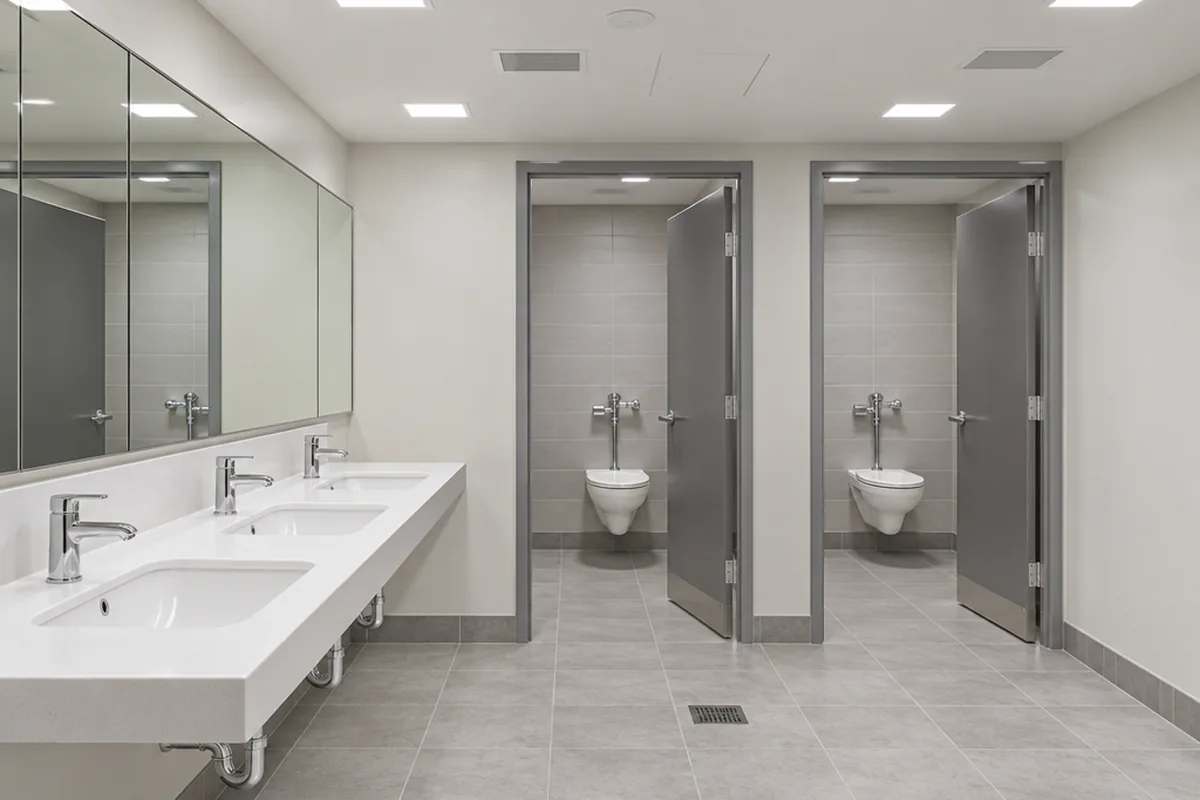
A restroom is a row of matching fixtures wearing out together: flushometers, metering faucets, stall doors, dispensers. We service them as a row, with the room closed and signed, on one work order. The most common request is flush valve and toilet repair. When the room is past repairing, the planned refit is a commercial restroom upgrade, and an access report's list is worked as ADA restroom updates.
One sink cabinet holds a faucet, a disposal, a dishwasher hose, an ice maker tee and a brewer feed, which makes it the likeliest spot in an office for a slow leak. We replace dead disposals in kind and connect appliances to the water already there, each on its own valve. Both jobs are described under break room disposal replacement.
Turnover is the moment to bring unit plumbing to a standard with nobody living there. Every stop and supply line is changed, slow traps are cleared or replaced, fill valves and flappers are renewed and tubs resealed. The valve work is laid out under shut-off valve replacement, and the next resident starts with valves that close.
Send what you have: a tenant complaint, an inspection list or a count of fixtures by room. We sort it into fixture work and work for a licensed trade before pricing anything.
The written scope names each fixture, the repair and the price. Any item that falls to a licensed plumbing contractor under your state's rule is marked on it, not quietly left off.
Restrooms are closed one at a time, break rooms are done outside lunch, and units are entered with notice or while vacant. Water is shut off only at the fixture where that is possible.
Every repaired fixture is run and checked dry. You receive photos and a list by room, suite or unit that shows the part replaced and anything we recommend watching.
Contractor licensing is state law, and states draw the plumbing line differently. Many exempt minor repair and replacement of fixtures and their parts, often within a job-size limit. Florida and North Carolina license plumbing as its own trade. We read the rule where your property is and tell you, before any work, whether a job is ours or a licensed plumbing contractor's.
Several items an access survey measures are plumbing parts. Under the 2010 ADA Standards a lavatory rim is no higher than 34 inches (section 606.3), pipes beneath it are insulated or guarded (606.5), an accessible toilet seat is 17 to 19 inches high (604.4) and its flush control is on the open side (604.6). When we replace a fixture or a valve we keep those dimensions. We do not survey or certify.
The U.S. EPA puts a single leaky or running toilet at as much as 200 gallons a day, and a faucet dripping once a second at more than 3,000 gallons a year. A building has dozens of each. A scheduled round that listens for running valves and looks under every sink is how those leaks get found before the water bill shows them, along with the supply line that is about to fail.
Sources for the rules on this page: 2010 ADA Standards for Accessible Design, sections 604.4, 604.6, 606.3 and 606.5; U.S. EPA, How to Care for Your Septic System; U.S. EPA WaterSense, Fix a Leak Week; N.C. General Statutes 87-21(c); 21 NCAC 50 .0506; Florida Statutes 489.105.
Each page below covers one group of fixture repairs in depth and names what belongs to a licensed plumbing contractor.
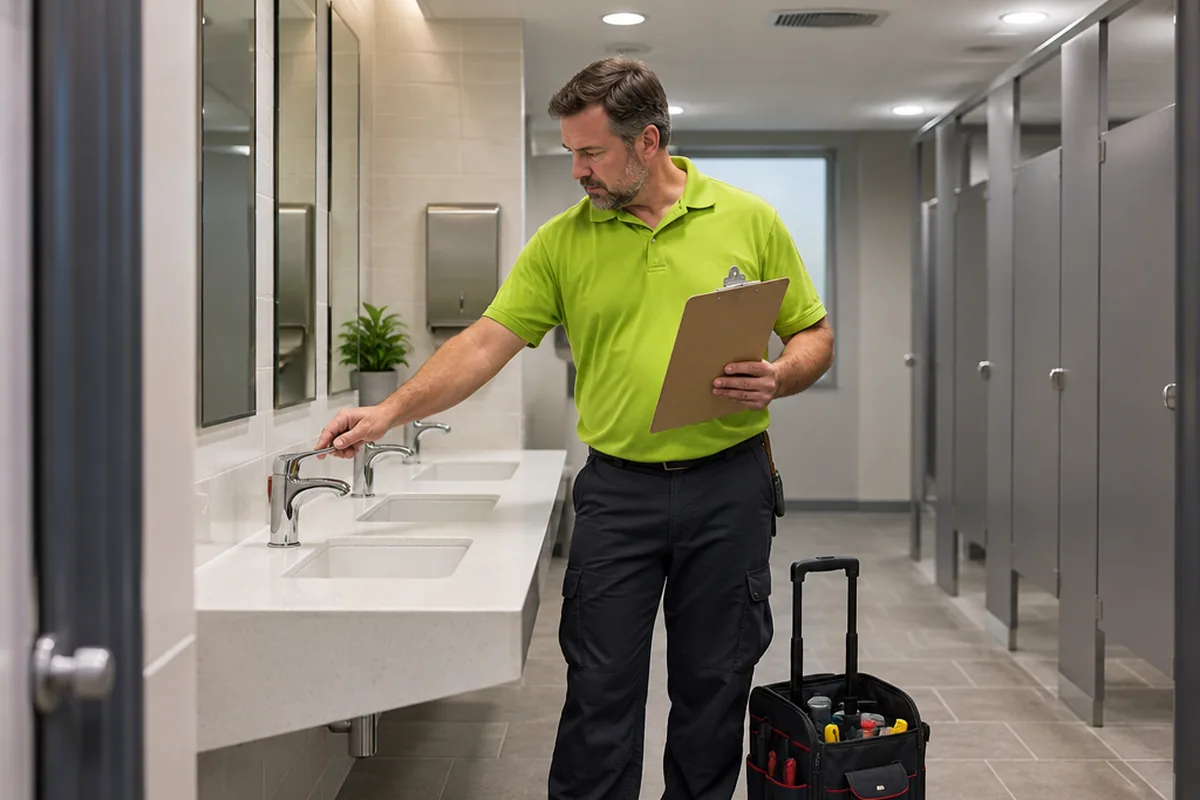
A technician walks every restroom and break room with a flashlight and a list. Each faucet, flush valve, stop, trap and sealant joint is tried, looked at and noted. You get the findings by room with a price for each repair, and the items that need a licensed trade set apart.
Every line above is fixture work that one of the pages below covers. Signs that point past the fixture, such as several drains backing up together or water rising through a floor, mean a licensed plumbing contractor, and we will say so on the first call.

Send the list or the fixture count, the property type and the hours each area is free.

We return a written scope by fixture with prices and any licensed-trade items marked.

Technicians complete the fixture work around occupants and send photos by room.
The work is backed in writing by our workmanship warranty and done by a Kaminskiy-certified, background checked technician.
Ask one question: is the trouble at a single fixture, or at several? One slow sink is a trap. Three slow sinks on a wall is the line behind them. One running toilet is a valve kit. Low pressure across a floor is the building supply. Single-fixture trouble is repair work. Anything shared by fixtures is the plumbing system, and the system belongs to a licensed plumbing contractor.
Start with the room. Trouble inside a restroom, whether a valve, a faucet, a stall door or a dispenser, is on the restroom repair page. Water where it should not be, a valve that will not close, a slow sink or a drain odor is on the leak, valve and drain page, whatever the room. A disposal or an appliance that needs water is on the break room page. Each one states its own limits.
Three kinds of restroom work look alike and are scoped differently. Repair returns what is there to working order. An upgrade replaces dated fixtures, partitions and finishes in place, and alterations can bring accessibility requirements that the building official decides. An access correction works through the items a survey or report lists, to the dimensions of the 2010 ADA Standards. Tell us which one you have, and the scope is written to match.
Three facts save a second trip: the type of fixture, what it is doing and where its shut-off is. Add a photo of the fixture and one of the pipes beneath it. For flush valves, note whether there is a handle or a sensor. For sinks, say whether a disposal or a dishwasher is attached. For rental units, include whether the unit is vacant.
Properties that fight the same leak in every unit usually lack a standard. Pick one faucet, one fill valve, one quarter-turn stop and one supply line for the whole property, and have them fitted at every turnover or on a floor-by-floor schedule. Spares fit everywhere, staff learn one part, and the record shows which units are done.
Most fixture repairs need water off only at the stop serving the fixture. When that stop is seized, the next valve upstream serves a unit, a restroom or the whole building. Know where those valves are before the repair is scheduled and who is allowed to operate them. Tenants and residents need notice, and medical and food tenants may need a time that suits their operation.
Can't find your answer? Call 855-695-1195 and ask us anything.
Call 855-695-1195Fixture-level repair and replacement in restrooms, break rooms, common areas and rental units: flushometers and tank toilet parts, faucets, stall partitions and accessories, fixture leaks, shut-off valves and supply lines, sink drains and traps, break room disposals, appliance water connections and caulk. All of it is work on fixtures you can reach without opening the building.
Water mains, risers and building valves, slab leaks, water heaters, gas piping, sewer and main drain lines, backflow prevention devices, grease interceptors, new piping in walls and any work that needs a plumbing permit. We identify those items in the written scope so you can send them to a plumbing contractor without paying us to find out twice.
It depends on the state and sometimes the city. Many states let a repair company replace fixture parts and fixtures in kind, often within a size limit, and reserve everything else for licensed plumbers. Florida and North Carolina license plumbing as a separate trade. We check the rule that applies to your property and tell you before work starts if a job is not ours to do.
Yes. Commercial restroom repair covers the whole room on one work order: flush valves and toilets, faucets, stall partitions, dispensers, mirrors, hand dryers and caulk. Leaks, seized shut-off valves and slow sink drains have a page of their own, and so do break room disposals and appliance water lines.
Repair puts the existing fixtures, stalls and accessories back in working order. An upgrade replaces dated ones in place without re-plumbing the room. ADA restroom updates correct the items an access report lists, to the dimensions of the 2010 ADA Standards. We do not survey or certify. All three are listed on this page so the right one is easy to pick.
Yes. Many managers book a recurring round: each restroom and break room is walked, running valves and drips are fixed from stocked parts, and larger items are priced for approval. The round produces a dated record by fixture, which is useful for budgeting and for showing an owner where the water bill went.
Yes, that is the normal case. Restroom work is done one room at a time, usually early, late or on a weekend. Break rooms are scheduled away from lunch. Occupied units are entered with the notice your lease and state require, arranged through the manager. Water is shut off at the fixture wherever the stop still works.
By the fixture and the repair, in writing, before the work is scheduled. A list of many small repairs is priced line by line so you can approve all or part of it. What moves the price is the type of fixture, the parts, access and whether the work has to be done after hours.
A list by room, suite or unit showing each fixture, what was wrong, the part replaced and a photo after the repair. Items we could not do because they belong to a licensed trade are listed separately with what we observed. Managers file it with the work order and use it at budget time.
Send the property address, the list or a fixture count, and the hours each area can be worked on. You get a written scope by fixture. To go through it by phone, call 855-695-1195.
Scoped by the fixture. Honest about the license line. Recorded room by room.
We answer in under three rings, 24/7.No price games. You get a clear written quote before any work begins, backed by our workmanship warranty.
