
 BBBAccredited Business

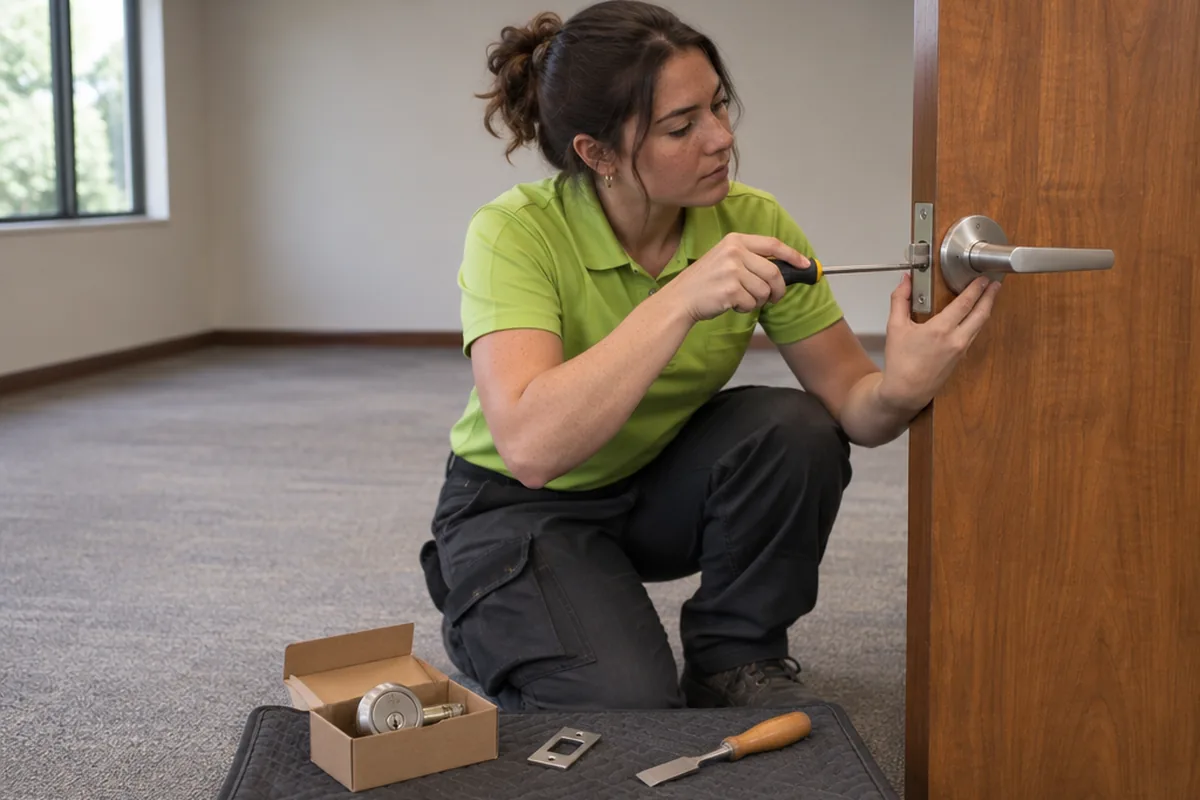
Kaminskiy Care and Repair handles lock replacement and keyless entry for commercial and rental property. A technician replaces locksets, deadbolts, levers and cylinders on suite and unit doors at tenant turnover, fits each latch and strike so the bolt throws fully, and installs standalone battery keypad locks, programmed with you. Cutting keys, pinning cylinders and master key systems belong to a locksmith, licensed where the state licenses the trade. Wired access control belongs to a licensed low-voltage contractor. Lock and keypad work is one of several hardware services under our commercial doors category.
Shared rooms wear out locks faster than any unit door and often carry the lightest hardware in the building. We replace them with heavy-duty lever sets in a storeroom or passage function to suit the room, so the door cannot be left unlocked by accident, and align the latch so residents stop slamming it. Where cleaning crews and vendors need in, a keypad lever replaces the loose key.
The outgoing tenant leaves a mix of hardware: a residential knob on the server room, a lever that droops, a deadbolt somebody added. We bring the suite back to one grade and finish, replace failed locksets and fit cylinders in the keyway your locksmith or key system uses. Where codes should replace keys, see the section on standalone keypad locks.
At a move-out the manager needs the old keys dead and the door secure before the next showing. We replace or swap the lockset and deadbolt, check the bolt throw into the jamb and reinforce the strike. The rekey is then done by the property's locksmith or its own rekey method. Damaged doors and frames go to tenant unit door replacement.
List each door by suite or unit with what is on it now: knob or lever, deadbolt or not, finish and keyway if you know it. Photos of the latch edge help. For a keypad lock, add the door thickness.
The written scope names the lock function, grade and finish for each door, keyed or keypad, and who supplies the cylinders: us, your locksmith or your key system vendor.
Old hardware is removed, the bore, latch pocket and strike are corrected, and the new lock is installed. The technician throws each bolt with the door closed to confirm full travel. A motorized keypad bolt that rubs drains its batteries within weeks.
Keyed doors are left on construction cores or temporary keys as agreed, with a sheet listing each door and its hardware, ready for your locksmith. On a keypad lock the factory master code is replaced while you watch.
In California, Civil Code section 1941.3 has a residential landlord install and maintain an operable dead bolt lock on each main swinging entry door of a dwelling unit, with a bolt that extends at least 13/16 of an inch beyond the strike edge of the door and into the jamb. Existing bolts of one-half inch can remain until the lock needs repair or replacement. Other states set their own rules.
In California, the Business and Professions Code (sections 6980 and 6980.10) requires a locksmith license from the Bureau of Security and Investigative Services for a business that rekeys, installs, repairs, opens or modifies locks or originates keys. On California properties we settle before scheduling which part of the list a licensed locksmith company must handle. Other states draw the line differently, and some do not license the trade at all.
The International Building Code (2021, section 1010.2.4, item 3) lets the main door of many business, mercantile and storage occupancies carry a key-operated lock on the egress side, provided the lock is readily distinguishable as locked and a sign reads THIS DOOR TO REMAIN UNLOCKED WHEN THIS SPACE IS OCCUPIED in letters 1 inch high. The building official can revoke that allowance. That is model code language; your jurisdiction's adopted version and its official decide.
Sources for the rules on this page: California Civil Code, section 1941.3(a)(1); California Business and Professions Code, sections 6980(j) and 6980.10; International Building Code (2021), sections 1010.2, 1010.2.1 and 1010.2.4, item 3; 2010 ADA Standards for Accessible Design, sections 404.2.7 and 309.4; California Bureau of Security and Investigative Services, Locksmith Company and Locksmith Employee Fact Sheet; Builders Hardware Manufacturers Association (BHMA), Product Grade Levels.
Kaminskiy Care and Repair installs standalone, battery-powered keypad and smart locks on suite, office, storage room and rental unit doors. A standalone lock holds its codes, its clock and its batteries inside the lock body, so nothing runs through the wall. The usual job swaps a keyed knob or lever for a keypad lever in the same bore, with no new holes, and keeps a key override for the manager. Card readers, magnetic locks, electric strikes and anything wired to a controller or a fire alarm belong to a licensed low-voltage contractor. In California, the Business and Professions Code decides who may install or rekey a lock for hire, and on a California job we settle who does which part before it is scheduled.
You control the codes, and we keep no copy of them. Each employee, cleaning crew or vendor gets a code that can be deleted at the door in a minute, and a scheduled or temporary code covers the contractor who needs in one morning a week. Models with an audit trail record which code opened the door and when. On rental units the manager changes the code between residents instead of changing the cylinder, and a key override stays for lockouts. We set the lock to relock by itself, check that the door closes hard enough to latch every time, and leave the programming sheet and the override keys with the office.
A keypad lock may decide who comes in, never who gets out. The International Building Code (2021, section 1010.2) has egress doors open from inside without a key or special knowledge, and section 1010.2.1 limits unlatching to one motion, so the keypad goes outside and the inside stays a plain lever. The 2010 ADA Standards (sections 404.2.7 and 309.4) place operable hardware 34 to 48 inches above the floor, usable with one hand and without tight grasping or pinching. A labeled fire door takes only locks listed for fire doors, in preparations its label allows, which our fire-rated door page explains. The IBC is adopted locally with amendments, and the building official decides.
A rekey on a door whose bolt does not throw is money spent twice. We fix the fit first, then hand the door to whoever keys or codes it.
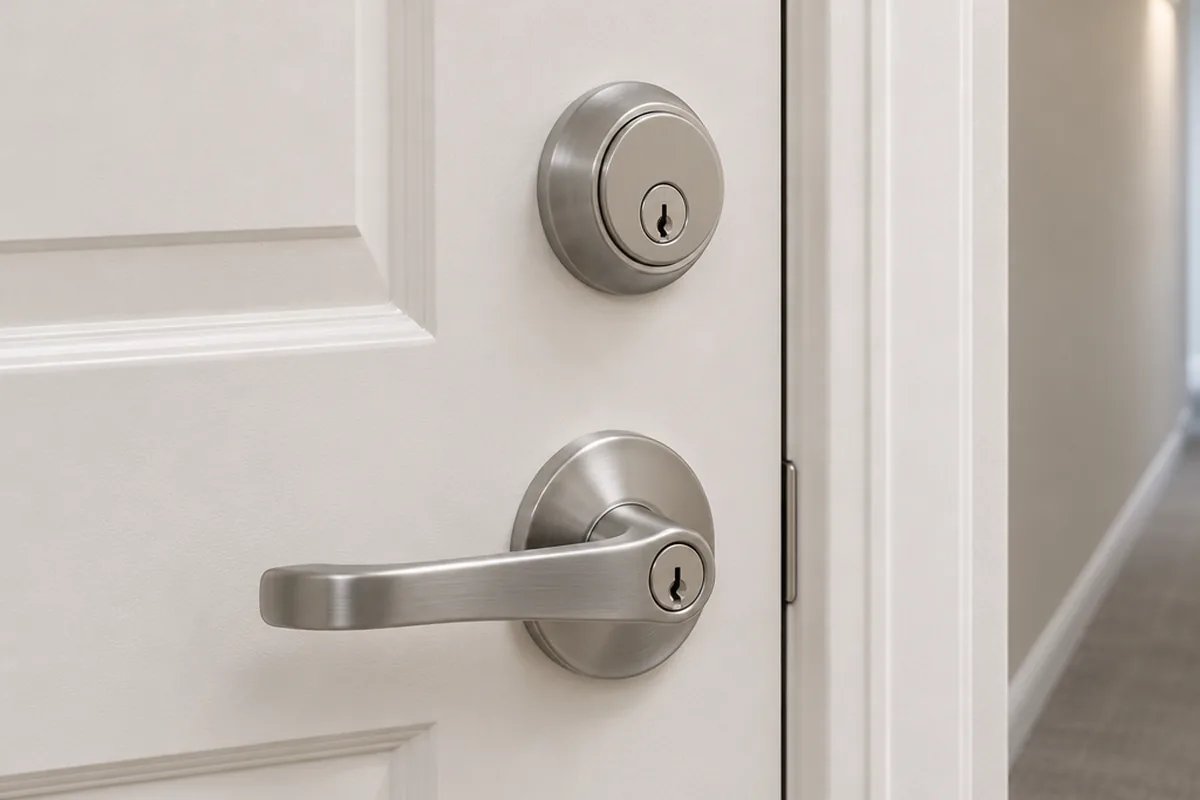
The usual order is a lever or knob set and a deadbolt on the entry door, replaced as a pair. We check the backset and bore, deepen the bolt hole in the jamb so the deadbolt extends fully, fasten the strike with long screws into the framing and confirm the door locks without lifting or pushing. The cylinders are then ready for your locksmith.
A missing key is a keying matter, or a reason to move that door to a code. The rest are hardware and fit, which is our part. If the door or frame is the damaged piece, a replacement entry door may be the better spend.

Send the list of doors by suite or unit and the date the space changes hands.

We return a written scope with the lock type, keyed or keypad, the grade, the finish and the price for each door.

Hardware is replaced and fitted, each bolt is tested, and the door schedule goes to you and your locksmith.
The work is backed in writing by our workmanship warranty and done by a Kaminskiy-certified, background checked technician.
A cylindrical lock fits through a round hole in the door face and is what most suites and units have. A mortise lock is a steel case set into a pocket in the door edge, common in older and higher-end buildings. A deadbolt is a separate bolt with no spring, thrown by a key or thumbturn. The three are not interchangeable without reworking the door, so we replace like with like.
Lock function describes what each side does. Passage never locks. Privacy locks from inside with a button. Entry or office locks by key outside and button or turn inside. Classroom locks only by key. Storeroom is always locked outside and always free inside. Putting the right function on each door prevents the supply room left open and the tenant locked out of a restroom.
If the lock body works smoothly, only the keying needs to change, and a locksmith rekeys it or swaps the core. If the cylinder is worn or the keyway is wrong for your system, the cylinder is replaced. If the lever sags, the latch sticks or the lock is the wrong grade or function, the whole lock is replaced. We sort each door into one of those three.
ANSI/BHMA standards grade locks 1, 2 or 3, and the lowest number is the toughest. A suite entry, a common laundry room or any door used all day earns a higher grade than a closet. Light residential hardware on a commercial door loosens within months. Spending on grade where the traffic is, and saving where it is not, is how a hardware budget lasts.
A standalone lock is one self-contained unit on one door. Wired access control puts a reader at the door and the decisions in a controller somewhere else, with a power supply and usually a tie to the fire alarm, and a licensed low-voltage contractor installs it. Standalone suits a handful of doors whose users keep changing. A whole building run on badges and schedules is a system, and we say so before you buy locks that would be replaced.
A keypad-only lock is programmed at the door with a master code: simple, nothing to reach remotely, but every change is a walk. App-managed locks add codes, schedules and a log from a phone or the building's wireless network, and ask more of the batteries. Either kind warns for weeks before the batteries die. Change them on a calendar anyway, keep the override keys labeled in the office, and never leave the factory master code in place.
Can't find your answer? Call 855-695-1195 and ask us anything.
Call 855-695-1195No. We replace and fit the hardware and leave the doors ready. Rekeying, key cutting and master keying are done by a locksmith or through the property's own key system, and some states require a license for that work. We coordinate timing so the locksmith can follow straight after us.
Making sure each lock is the right type and in working order, the latch and bolt line up with their strikes and throw fully, the door closes without force, and the cylinders or cores are the format your locksmith needs. It ends with a door-by-door sheet so keying can be done without surprises.
If the hardware is sound and of the right grade, rekeying is enough. Replace when levers sag, latches stick, finishes are mismatched or residential hardware is on a commercial door. Many managers replace on the first turnover to set a standard, then rekey on later ones.
Yes. We record the maker's keyway format, the function, the finish and the lever style and order to match, so new locks accept the building's keys once pinned. If the existing line is discontinued, we propose the closest current equivalent for your approval.
It depends on the state and on whether the door serves a dwelling. California's Civil Code, for one, sets a minimum bolt projection for the deadbolt on a rental unit's main entry door. Building codes also limit where a keyed lock may be used on the inside of an exit. We raise both points when the list is reviewed.
The grade and function of each lock, the finish, the number of doors, and how much door or frame correction is needed for the bolts to throw. A keypad lock costs more than a keyed lever, and cylinders or cores supplied by your key system vendor change the hardware cost. Everything is priced per door in writing.
Usually, yes. Most suite and unit doors are bored to a standard pattern, and many keypad levers drop into it without new holes. We need the door thickness, the backset and photos of the door edge. Narrow-stile aluminum doors, mortise locks and doors with exit devices take specific models, and we tell you if yours is one of those.
No. The keypad locks we install run on batteries inside the lock and have no connection to building power. Readers, magnetic locks and doors that unlock from a desk are wired access control, which a licensed low-voltage contractor installs.
People can always get out. The inside lever retracts the latch mechanically, with no code and no power, and we test that before leaving. From outside, the key override opens the door, and some models accept a jump from a small battery held to outside contacts. Low-battery warnings give weeks of notice.
You do. The master code is set by the person you name, and nobody on our side records it. The programming sheet we leave covers adding, deleting and scheduling users. If the property changes hands, the new manager can reset the lock and start again.
List each door, what hardware is on it, which doors should move to codes and the turnover date, and add your locksmith's contact if you have one. A written scope per door comes back. Questions first? Call 855-695-1195.
Hardware replaced, bolts fitted, keypads programmed, and a door schedule your locksmith can key from.
We answer in under three rings, 24/7.No price games. You get a clear written quote before any work begins, backed by our workmanship warranty.
