 BBBAccredited Business

Kaminskiy Care and Repair installs and corrects accessibility features at places of public accommodation and workplaces: grab bars, handrails, ramps, threshold ramps, lever hardware, accessible-height fixtures, restroom accessories and tactile signs. We work from your access report, install to the dimensions of the 2010 ADA Standards, schedule around business hours and return measured photos. We do not survey buildings, issue certifications or promise a legal outcome. Alterations that move walls or plumbing need plans and a permit. Most lists begin with restroom corrections. This category is one part of our commercial handyman services.
A CASp inspection or an access survey returns dozens of lines with measurements. Many are small: a bar, a lever, a mirror, a sign, a lip at a door. We price the lines that are installation work, mark the ones that need a designer or a licensed trade, and close ours with photos. No line is dropped without a note saying who should handle it.
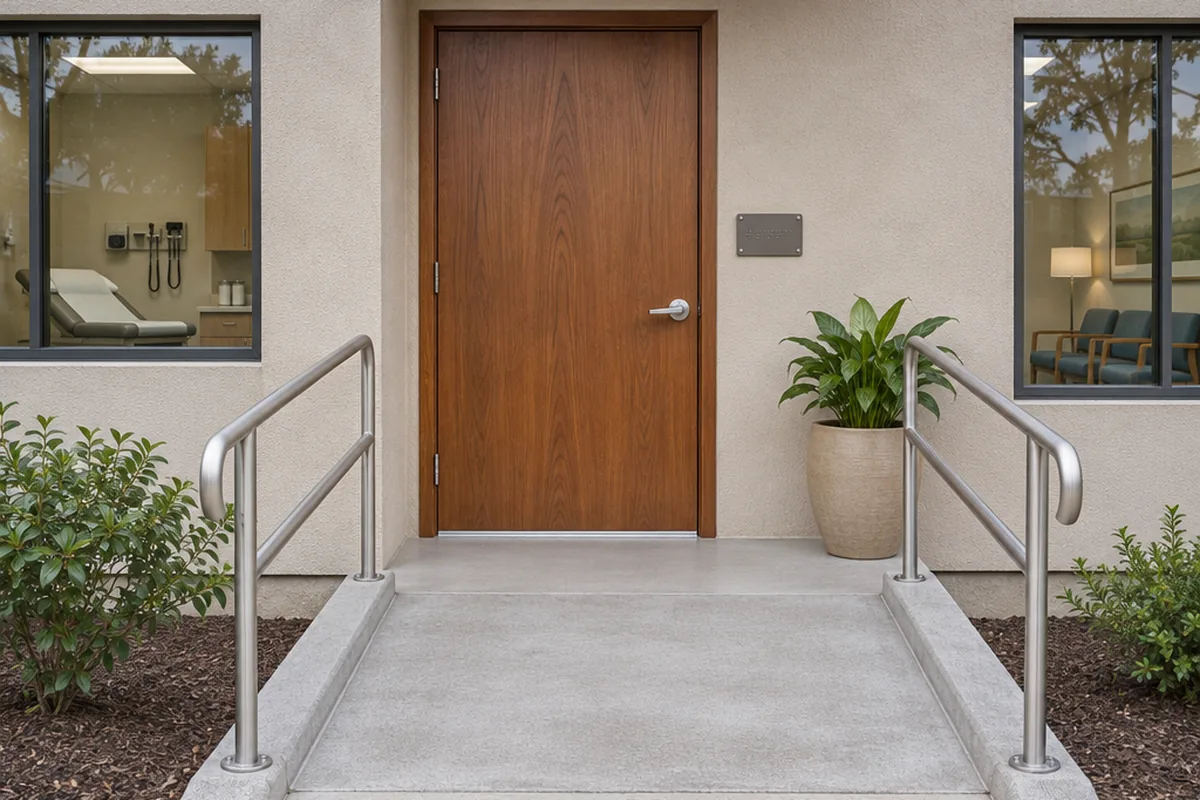
The federal rule puts getting in the door first. That can mean a ramp at a stepped entry, a threshold ramp at a raised sill, a second handrail on the entry stairs, or lever hardware on a door that opens with less effort. Inside, a narrow opening may call for doorway widening.
Restrooms carry the longest part of most reports. Grab bars go on the side and rear walls, low toilets are changed for accessible-height fixtures, and mirrors, dispensers, hooks and pipe covers are set to their heights. The tactile sign goes on the wall beside the latch.
Send the report, the complaint letter or your own walk-through notes, with photos. We sort every line into installation work, licensed trade work and design work.
You receive one written scope that keeps the report's item numbers, with a price for each line we can do and a note on each line we cannot.
Entrances, restrooms and corridors are done before opening, after closing or on weekends, one area at a time, so the building stays in use.
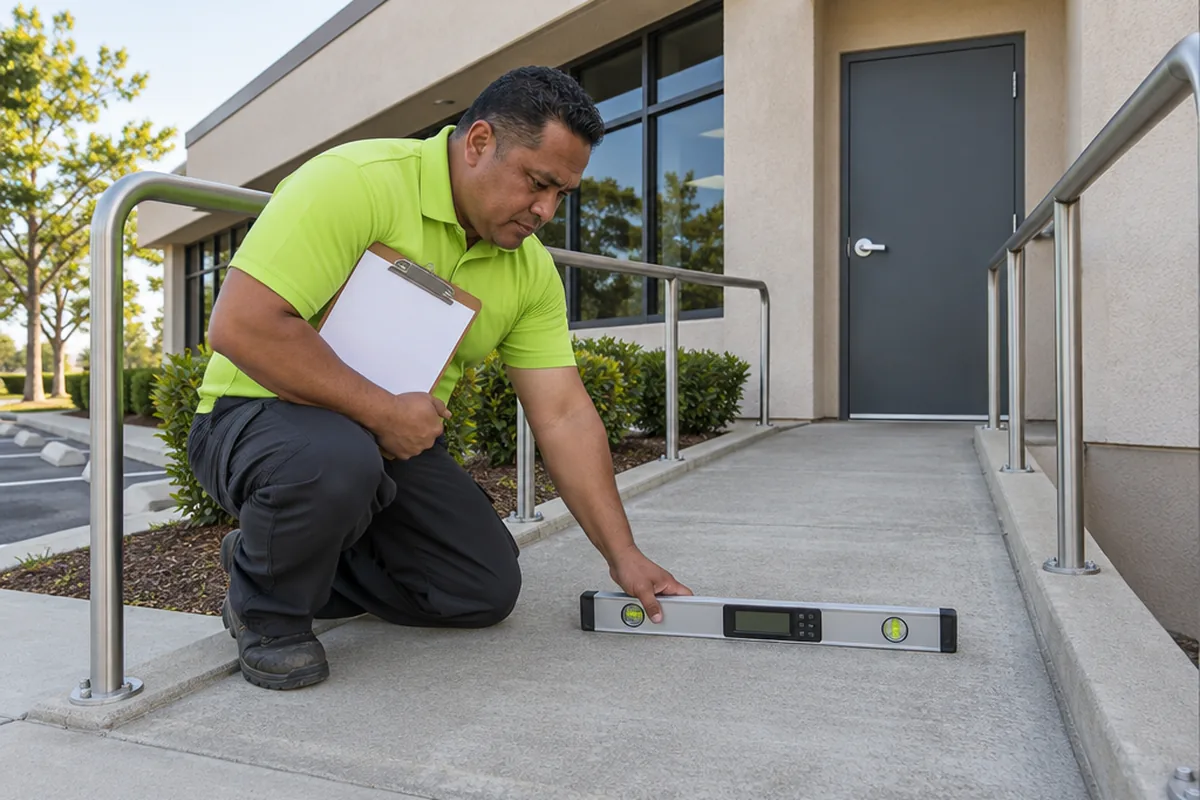
Each finished item is photographed with a tape, level or gauge in the frame. The set goes to you, ready for the owner, the tenant or the specialist who wrote the report.
For existing places of public accommodation, 28 CFR 36.304 requires removing architectural barriers where that is readily achievable, meaning easily accomplishable without much difficulty or expense. The rule urges an order: first, access from the sidewalk, parking and entrance; second, access to the goods and services; third, restrooms; fourth, everything else. Its own examples include ramps, grab bars, accessible door hardware, offset hinges and repositioned dispensers.
When an element is altered, section 202.3 of the 2010 ADA Standards requires the altered element to meet the Standards. Under section 202.4, altering an area that holds a primary function also brings in the path of travel to it, including restrooms and drinking fountains, up to a cost limit set by the Attorney General. Elements that already met the 1991 Standards and have not been altered keep a safe harbor under 36.304(d)(2).
Under 28 CFR 36.201(b), both the landlord who owns the building and the tenant who operates the business are responsible, and a lease may divide the work between them. Section 36.211 requires accessible features to be kept in working order. A grab bar that has pulled loose, a door that has grown heavy and a sign that fell off are maintenance items, and they belong on the standing list.
Sources for the rules on this page: 28 CFR 36.304(a), (b), (c), (d)(2), ADA Title III regulations; 28 CFR 36.201(b) and 36.211, ADA Title III regulations; 2010 ADA Standards for Accessible Design, 202.3 and 202.4; California Department of General Services, Division of the State Architect: CASp Property Inspection.
Each of the six pages below covers one kind of item. Send the whole list and we sort it for you.
Bring us the report. A technician walks the property with it, confirms each measurement that is ours to fix, and notes what is hidden behind the wall or under the fixture. You get a scope in the report's own order, split into work we do, work for licensed trades and work that needs a plan.
Whatever started it, the next step is the same: a list with measurements. If you have a demand letter, talk to your attorney first. Then send us the list and we will show you which lines are ours. Lists that mix access items with general repairs run as property punch lists.

Send the report or your list, with the property address and your business hours.

We sort it and send one written scope, priced by item, with other trades' items marked.

The work is done area by area around your hours, and you receive measured photos of every item.
The work is backed in writing by our workmanship warranty and done by a Kaminskiy-certified, background checked technician.
A contractor's opinion is not a survey. The findings should come from someone qualified to measure a building against the standard that applies to it, which depends on when it was built and altered. In California that is a Certified Access Specialist, and the state notes that only a CASp's services can give an owner qualified defendant status if a claim is filed later. Then the list goes to installers.
A large share of a typical list is hardware and mounting: bars, rails, levers, signs, accessories, small ramps. The rest involves space: a restroom too small to turn in, a counter too high, a route with stairs only, parking slopes. Those need drawings, permits and other trades. Separating the two early lets the simple items be closed while the larger ones are designed.
A dated photo with a tape measure in it is the record that an item was corrected and what it measured. We name each photo with the report's item number. Keep the set with the report and the schedule. If a feature is later damaged or removed, the record shows it was right when installed, and the fix goes on the maintenance round.
Accessible features wear like anything else. Closers drift heavier, bars loosen, signs get painted over, threshold ramps creep. Federal rules require these features to be maintained in operable condition. Add them to the checklist on your scheduled maintenance program, so they are tested on every round and not found again on the next report.
Can't find your answer? Call 855-695-1195 and ask us anything.
Call 855-695-1195No. That is a survey, and it is done by a Certified Access Specialist in California or by an architect or access consultant elsewhere. We install to the dimensions in the 2010 ADA Standards and correct the items a report lists. We do not issue certifications, and no installer can promise how an inspector or a court will read a building.
We are the installing contractor, not the judge of compliance. Kaminskiy Care and Repair installs and corrects accessibility features to the dimensions of the 2010 ADA Standards, working from a specialist's report. Whether a building complies is decided by a Certified Access Specialist, an architect, a building official or a court, never by the installer.
Grab bars, new handrails, wood and modular aluminum ramps, threshold ramps and bevels, lever locksets and door hardware, accessible-height toilets and lavatories on existing plumbing, restroom accessory corrections, doorway widening in non-bearing partitions, and mounting tactile signs. The six pages of this section give the dimensions we work to.
Poured concrete ramps and curb ramps, parking striping, moving drains or supply lines, added electrical circuits, power door operators, lifts and elevators, sign fabrication, and any work on a bearing or fire-rated wall that needs engineering. We mark these in the scope so you can price them with the right licensed contractor.
Under the federal rule both are: the owner of the building and the business that operates in it. The lease can assign who pays for and arranges which items, but it does not remove either party's duty. We work for whichever party holds the item, and for both when a list is split.
Mounting bars, levers, signs and accessories normally does not. A new ramp, a widened doorway, a moved fixture or a reconfigured restroom often does, and alterations can bring path-of-travel requirements with them. Permit rules are local. We say when a line looks like permit work, and the building official decides.
It is planned so you stay open. Restrooms are closed one at a time, entrances are worked before opening or after closing, and corridor work such as signs and levers is done in the evening. Tell us your hours and any days that are off limits when you send the list.
By item, in writing, before anything is scheduled. The price of a line depends on what is behind the wall, what the fixture connects to and how many of the same item there are across the property. Pricing by report item lets you approve the whole list or phase it over a budget year.
Yes. In California we work from the CASp report and its schedule of corrections, and return photos by item number. The inspection and the report stay with the Certified Access Specialist. Our California work is performed under contractor license #1106209.
Send the property address, the report or list, a few photos and your business hours. We reply with one written scope sorted by item. Or call 855-695-1195.
One scope, by item. Work around your hours. Measured photos for the file.
We answer in under three rings, 24/7.No price games. You get a clear written quote before any work begins, backed by our workmanship warranty.
