 BBBAccredited Business

Kaminskiy Care and Repair provides commercial drywall repair for offices, stores, clinics and rental units: holes and dents, move-out damage, cuts other trades left open, cracked or sagging drywall ceilings, texture matching and paint-ready prep. Occupied suites are worked after hours with dust contained, and vacant units ahead of the painter. Fire-rated walls go back as their listed assembly, and older materials are tested before cutting. A corner that carts keep hitting calls for corner guards and wall protection. Wall and lid repair is the core of our commercial drywall and ceiling services.
Chair backs scar conference rooms, carts open up corners, a store reset leaves sign anchors at eye level, and plumbers and cable installers cut squares they never close. This is drywall patching around people: done once the floor empties, contained, primed and matched for sheen, so the wall reads as one surface when the doors open.
Leases end together, so several units come back in one week with the same damage: TV mount anchors, a knob hole behind the bedroom door, a dented hall corner. We work one turnover list per unit in the order the paint crew needs, finish each wall to primer and photograph it before and after. Turnover painting then starts on a sealed, dry wall.
A drywall lid cracks at its joints, sags after a leak and gets cut by every trade working above it, and it is repaired from a scaffold after closing. Textured surfaces need the pattern rebuilt across the patch. Pre-war buildings have plaster on lath, which is patched in coats and not with joint compound. A suspended grid is different work: see drop ceiling tile replacement.
Send the list by suite or unit with a photo of each spot, the hours the space is empty or the painter's date, and whether a wall borders a corridor, a shaft or another tenant.
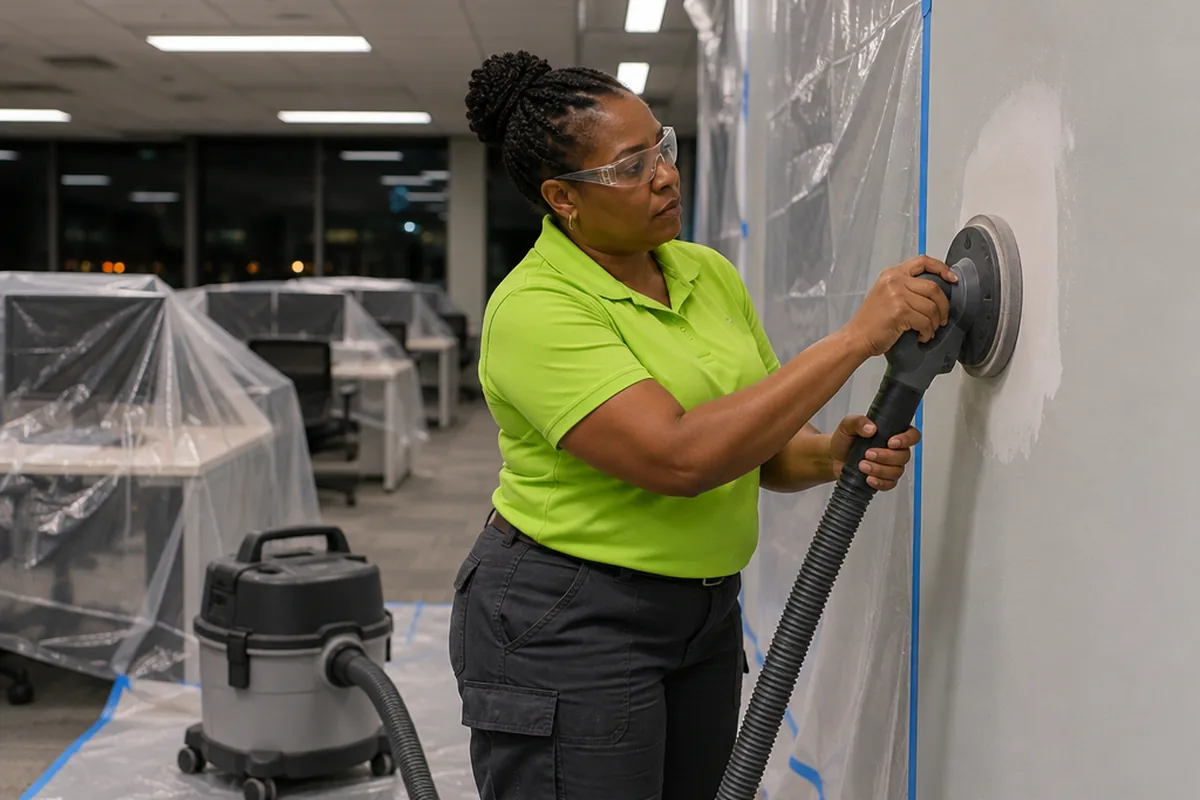
Floors and furniture near the work are covered, plastic goes up where sanding will happen, and return air grilles close by are masked so dust does not ride the air system.
Deep fills use setting-type compound so coats can follow each other the same night. Sanding is done with a vacuum sander or a damp sponge, and cut edges are cleaned up before the finish coats.
Each repair is primed and, where the scope includes it, textured and painted to the nearest break in the wall. The area is vacuumed and wiped, coverings come down and photos go to your contact.
The International Building Code, a model code many jurisdictions adopt, rates a wall or ceiling by fire test of the whole assembly (Section 703.2.1) and lists corridor walls and walls between tenant spaces in malls among its fire partitions (Section 708.1). In a rated gypsum assembly the joints and fasteners are treated too (Section 2508.5). A repair there rebuilds the listed assembly: same board, same layers, sealed penetrations. Your building engineer or official says which walls those are.
EPA's asbestos rules under the Clean Air Act require a thorough inspection before renovation in institutional, commercial and industrial buildings, and OSHA's construction standard (29 CFR 1926.1101) presumes that sprayed or troweled-on surfacing in buildings constructed no later than 1980 contains asbestos until it is tested. So we ask for the building's survey before a wall, a popcorn ceiling or old plaster is cut. Where no survey covers it, a sample is tested first.
EPA's Renovation, Repair and Painting rule covers paid work that disturbs paint in housing and child-occupied facilities built before 1978, apartments and their shared hallways included. Its minor repair line is 6 square feet of painted surface per room (40 CFR 745.83). Turnover patching and sanding for repaint pass that quickly, so in those buildings we work lead-safe. An office or a store is outside the rule unless a child care space sits inside it.
Sources for the rules on this page: 2021 International Building Code, Sections 703.2.1, 708.1, 712.1.13.2 and 714; EPA, Asbestos National Emission Standards for Hazardous Air Pollutants (NESHAP); OSHA asbestos standard for construction, 29 CFR 1926.1101(b); EPA Renovation, Repair and Painting Program: Contractors; California Civil Code section 1950.5, subdivisions (g) and (h); Gypsum Association, GA-214 Recommended Levels of Finish for Gypsum Panel Products, Quick Reference Guide (2022).
Yes, we patch move-out wall damage in apartments, rental houses and leased suites, one list per unit, ahead of the painter. The usual list is anchor and TV mount holes, a door-knob hole behind each door, dented corners and paper torn off by adhesive hooks. Knob holes get a backed piece of board, not filler. Every wall is photographed before and after. In California, Civil Code section 1950.5 requires a landlord to photograph the unit before and after repairs charged to the deposit and to send the itemized statement no later than 21 calendar days after move-out, and our photos are taken to support that file. Units built before 1978 get lead-safe practices.
We repair hard-lid drywall ceilings: joints that have cracked or ridged, board that hangs after a leak, soffit and bulkhead corners clipped by ladders, and the square holes plumbers and electricians leave. Sagging board is screwed back to the framing or replaced, openings are backed and closed, and the plane is finished under a light held flat to it. The work is done from a rolling scaffold or a lift after closing, with the room below covered. OSHA's construction standard (29 CFR 1926.1101) presumes sprayed acoustic texture in buildings constructed no later than 1980 contains asbestos, so a popcorn ceiling is tested before it is scraped. A crack that keeps growing goes to an engineer first.
Texture matching means rebuilding the wall's pattern across a patch so the repair cannot be picked out: orange peel, knockdown, skip trowel, or a smooth finish under hard side light. We read the existing pattern, make a test patch for your approval, then blend the texture well past the repair, corner to corner on short walls, and prime it. The Gypsum Association's GA-214 guide ties the joint finish to what covers it: Level 3 under heavy or medium texture, Level 4 under light texture. So a fine orange peel needs a flatter patch beneath it than a heavy knockdown does. For apartment communities we record one texture standard per property, so every unit matches the last.
Paint-ready prep is everything between a damaged wall and the first coat, handed to our painter or yours. Hardware and dead anchors come off, holes are filled, rough areas skimmed, the wall sanded with a vacuum sander, gaps at trim caulked and every repair spot primed. The scope names the finish level. In the Gypsum Association's GA-214, Level 4 is taped joints with further coats over joints, corners and fasteners, typically for flat paint. Level 5 adds a thin skim coat over the entire surface, and the guide points to it for paints with sheen, dark or deep colors and critical lighting. If the new color is dark or glossy, ask for Level 5 by name.
We install access panels and doors in walls and ceilings so a shut-off valve, cleanout, damper or junction box can be reached without a saw. The opening is framed, a plastic, steel or flush paintable panel is set, and the inside is labeled. The International Plumbing Code, a model code many jurisdictions adopt, requires access to shutoff valves (Section 606.3) and keeps required cleanouts out of concealed locations (Section 708.1.11). In a fire-rated ceiling the International Building Code allows only an access door tested and labeled for that use (Section 712.1.13.2), and a rated wall takes a rated panel as well. We never cut a rated assembly for a plain one, and the local official decides.
We repair interior plaster in older commercial buildings and make small stucco patches at entries, columns and soffits. Loose plaster that is still whole is re-secured to its lath, crumbling areas are cut out, and the patch is rebuilt in coats with setting materials, since premixed joint compound cracks at the edge of old plaster. A stucco patch is three coats, and the International Building Code's Table 2512.6 lists 48 hours of moist curing for each base coat and 7 days before the finish, so we give a sequence of visits and never a speed promise. Old plaster and its paint are tested for asbestos and lead before cutting. Stucco across a whole building wall is exterior stucco repair.
A patch in a working building is half drywall and half logistics: when the room is empty, where the dust goes, how the wall looks at opening.
Most accounts save up their wall damage and have it cleared in one round. In an office that is a night shift: the technician contains each spot, patches, primes and touches up where paint is in the scope. In a vacant unit it is the move-out list, worked room by room ahead of the painter. Spots that need another coat are finished on the return trip, and the list is closed with a photo of each wall.
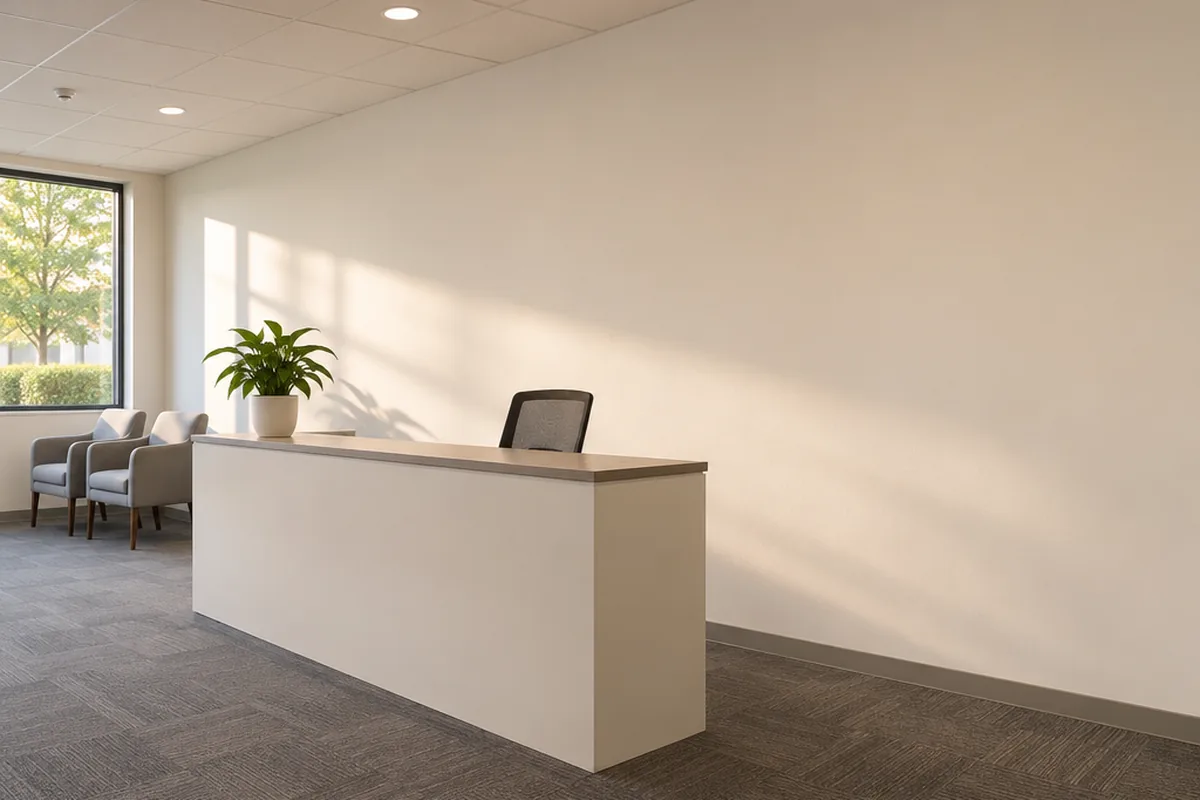
None of these needs a room closed during business hours. Send photos and the hours the space is empty. If the mark turns out to be a paint problem, our paint color and sheen matching covers it.

Send photos of each spot, the suite hours or the painter's date, and what you know about the wall.

You receive a written scope and price, including containment, primer, texture and any paint to a break line.

We repair after hours or ahead of the painter, clean the area and send photos of every wall.
The work is backed in writing by our workmanship warranty and done by a Kaminskiy-certified, background checked technician.
A patch painted in the right color can still show as a dull or shiny window. Fresh compound and old paint absorb differently, so the same eggshell dries to two sheens. Primer evens out the suction. Even then, touch-up in the middle of a wall often shows at a low angle, which is why we paint to a corner, a door frame or another natural break when the wall sits in raking light.
Compound over a patch stands a little proud of the wall. If it stops four inches past the tape, the eye catches the ridge. Each coat has to run wider than the one before, often a foot or more beyond the patch on a smooth wall, and the last coat is sanded to nothing at its edge. A wide feather takes more time than the patch itself.
Most commercial partitions are steel studs, often spaced wider than wood framing, with board that may be 5/8 inch thick instead of 1/2. A patch cut from the wrong thickness sits low and telegraphs through paint. We measure the board at the hole, match it, and fasten backing with fine-thread screws made for steel, because coarse drywall screws strip out of a light-gauge stud.
Filler only works where there is drywall behind it. A hole the size of a door knob or a fist has nothing to hold spackle, so a plug of filler cracks loose in months. The lasting repair is a new piece of board fastened to a backer strip or clips, taped on every edge and coated three times. In a rental unit the job ends with a door stop on the baseboard, because the knob will find that wall again.
Premixed joint compound hardens by drying, and a deep fill in a cool, closed room can stay soft for a day. Setting-type compound hardens chemically in a known number of minutes, so we use it for the first fills and coats can follow each other in the same shift. Paint over damp compound dries blotchy. That is why drywall goes ahead of paint in every turnover and office schedule.
Two dates matter. Paint applied before 1978 may contain lead, which changes how sanding is done in housing and child care spaces. Sprayed texture and troweled plaster in buildings through 1980 are presumed by OSHA to contain asbestos until a lab says otherwise, and old joint compound is suspect too. None of it can be judged by eye. Tell us the year the building went up and which surveys are on file.
Can't find your answer? Call 855-695-1195 and ask us anything.
Call 855-695-1195Yes. Commercial drywall repair in an occupied space is scheduled for evenings, early mornings or weekends. The area is covered and contained, sanding is done with a vacuum sander or a damp sponge, and everything is cleaned before staff return. The only trace in the morning should be a faint smell of primer.
By catching it where it is made. Cuts are made with a vacuum at the blade, sanding heads are connected to a vacuum, plastic isolates larger repairs and nearby return air grilles are masked. OSHA's 2019 interpretation of its silica standard notes that dry sanding joint compound can raise heavy nuisance dust that employers must control, and this is how we control it.
Not if it is feathered wide, primed and painted to a natural break. Spot touch-up in the middle of a wall may show at a low angle or under strong side light. We tell you which approach the wall needs before you approve the scope.
Then it is repaired with the listed assembly for that wall: the same type and thickness of board, the same layers, treated joints and sealed penetrations. We do not decide the rating. The building engineer or the local official confirms it, and we hold the work until someone has.
It depends on the damage per unit and the days between move-out and paint. Send the unit count and the paint date together. We answer with what fits and in what order, and say so early if one unit needs a larger repair that should be scheduled apart from the routine list.
Yes. Every damaged area is photographed before repair and again after, labeled by unit and room. In California the landlord has a photo duty of its own under Civil Code section 1950.5, and our set is meant to support that file, not replace your move-out inspection.
Level 5 has a skim coat over the whole wall and Level 4 does not. In the Gypsum Association's GA-214, Level 4 is taped joints with additional coats over joints, corners and fasteners. Level 5 adds a thin skim across the entire surface, and the guide points to it for paints with sheen, dark or deep colors and critical lighting.
Usually, yes. Texture matching for orange peel, knockdown, skip trowel and smooth walls is routine, and unusual hand finishes take more test patches. We show you a sample against the wall before working on the visible area, and where a perfect match is not realistic we say so and offer to re-texture corner to corner.
Only in fire-rated walls and ceilings, and there they must be. The panel has to carry a label and a rating suited to the assembly. We ask the building engineer or the local official whether the wall or ceiling is rated before we cut, and we order the panel to match.
The price follows the number of spots, their size, the height, texture, how much containment the room needs and whether paint to a break line is included. After-hours scheduling is part of the scope, not a surprise added later. Everything is written and approved before the first night of work.
Send the address, the suite hours or the painter's date, a photo of each spot and anything you know about the wall, the texture and the paint. We reply with a written scope. Or call 855-695-1195.
After-hours work. Dust contained. Repairs primed, textured and matched for sheen.
We answer in under three rings, 24/7.No price games. You get a clear written quote before any work begins, backed by our workmanship warranty.
