 BBBAccredited Business

Kaminskiy Care and Repair does commercial roof repair on pitched roofs only: missing or slipped shingles and tiles, flashing at walls and vents, sealant at penetrations and minor leak tracing. Many commercial buildings have flat membrane roofs, and we do not repair those. A TPO, EPDM or built-up roof, above all one under a manufacturer warranty, belongs to your roofing contractor. We do not re-roof. Where a state licenses roofing, as Florida does, a licensed roofing contractor does the work. Roof work is one of the services on our exterior and construction repair hub for commercial property.
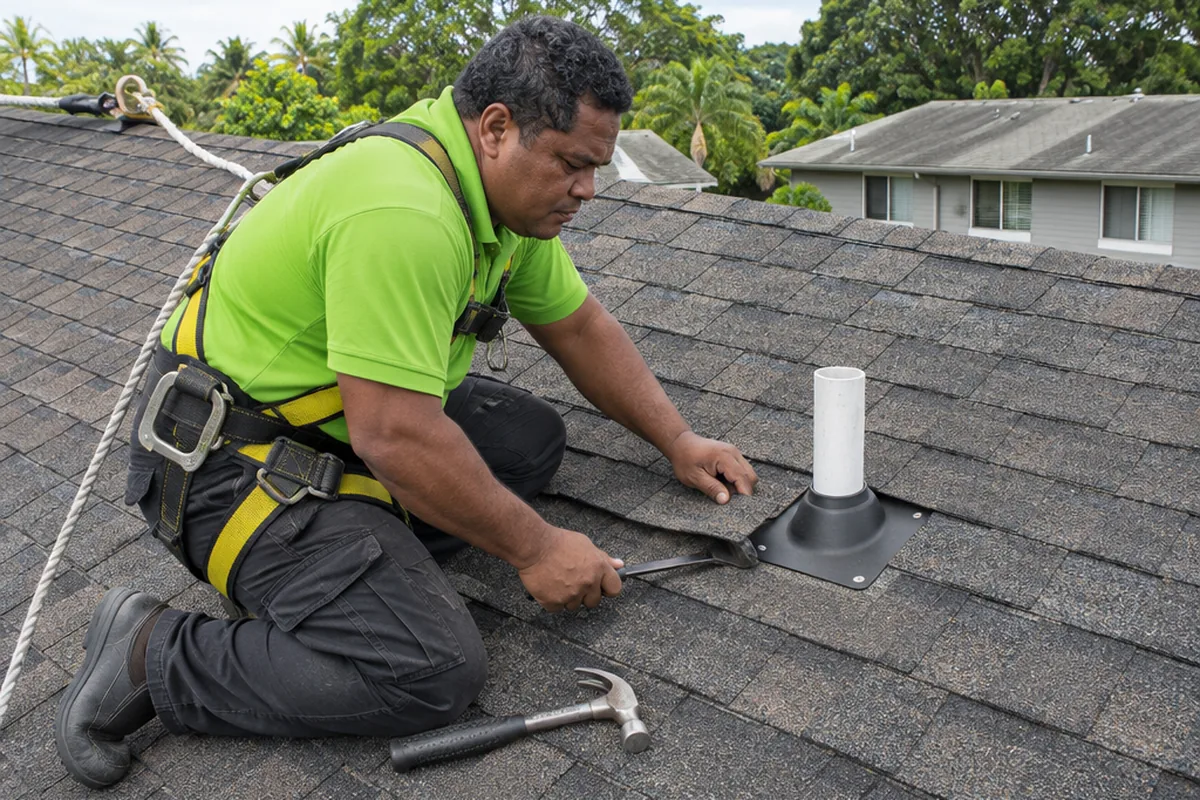
Every unit sends plumbing vents, bath fans and flues through the roof. The rubber collar around a pipe cracks in the sun years before the shingles wear out, and the stain shows up on a top-floor ceiling. We replace the boot, reset the surrounding shingles and seal the fastener heads. The stained ceiling is a separate job, commercial ceiling repair.
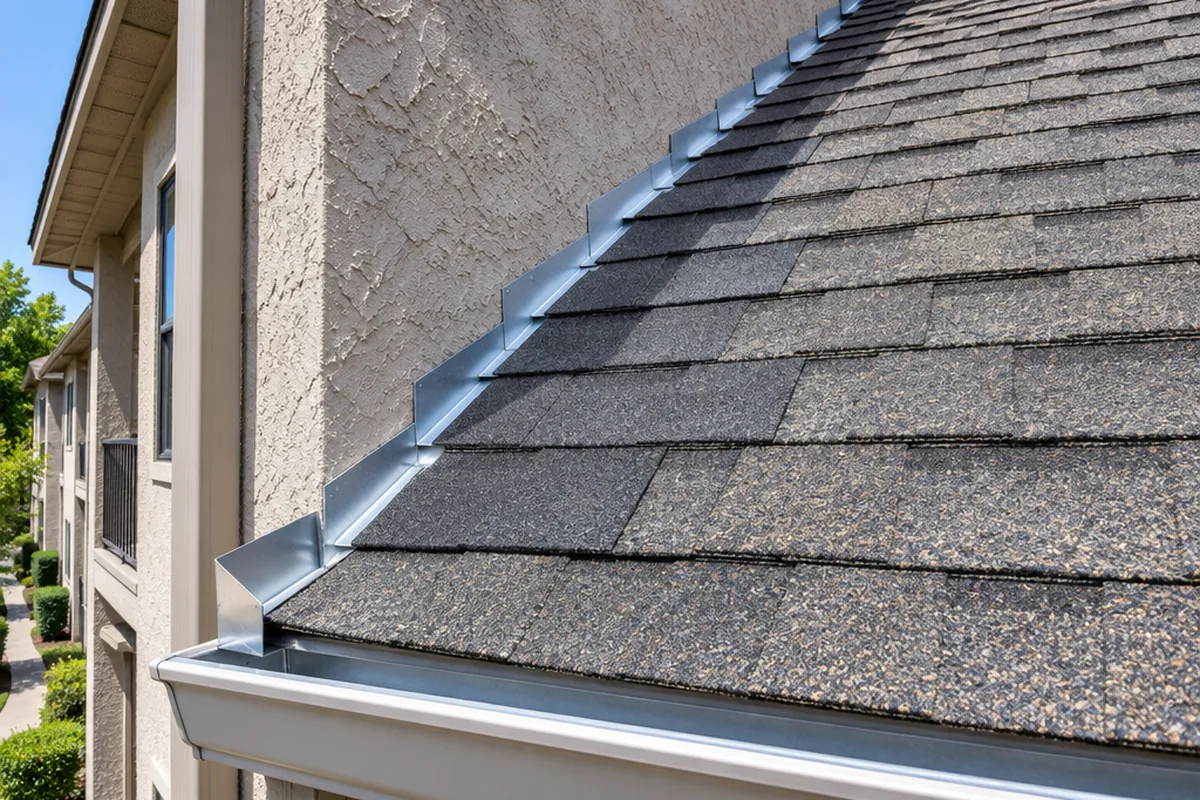
Mansard fronts and upper-story walls meet the roof at step flashing and counterflashing. Sealant smeared over that joint is a temporary patch that hides the real gap. We lift the shingles, replace missing or rusted flashing pieces, add a kick-out at the bottom and put the roofing back.
Concrete and clay tiles shed most of the water, and the underlayment beneath does the rest. A slipped tile exposes that underlayment to sun, and it breaks down. We reset slipped tiles, replace broken ones with matching profiles and patch small areas of underlayment. Widespread underlayment failure is a re-roof for a roofing contractor.
Tell us which unit or suite has the stain, how soon after rain it appears and the roof type. Photos of the ceiling and of the roof from the ground help.
Where there is attic access, the technician follows the water marks on the sheathing back uphill, then inspects the matching spot on the roof. Leaks seldom sit directly over the stain.
Damaged shingles or tiles are replaced, flashing is renewed, boots are swapped and exposed fasteners are sealed. Work stops if the surface is wet or wind makes the slope unsafe.
You get before and after photos of every repair with its location on the building, plus notes on anything that needs a roofing contractor.
The International Building Code, a model code adopted in many jurisdictions, requires flashing at wall and roof intersections, at gutters, at changes in roof slope or direction and around roof openings (section 1503.2.1). Metal flashing must be corrosion resistant and at least 0.019 inch thick. Those four locations are where we look first on a leak call.
Under section 1507.2.2 of that code, asphalt shingles may be used only on slopes of 2 in 12 or steeper, with doubled underlayment up to 4 in 12, and each strip shingle takes at least four fasteners (1507.2.6). A replaced shingle is nailed and sealed the same way. Roofs flatter than that are membrane roofs, outside this page.
Florida Statutes section 489.105(3)(e) defines a roofing contractor and includes the repair of roofing in that licensed scope. So in Florida this work is done by a licensed roofing contractor. Other states draw the line by job size or trade, and the local building official decides whether a repair needs a permit. We tell you which applies before any work is scheduled.
Sources for the rules on this page: 2021 International Building Code, sections 1503.2 and 1503.2.1; 2021 International Building Code, section 1507.2; Florida Statutes section 489.105(3)(e).
A small roof repair is mostly detective work. We trace the water to where it gets in and repair that detail, not the stain.
Most leaks we trace end at a penetration or a wall. The fix is mechanical, not a tube of sealant: lift the shingles, replace the cracked pipe boot or the rusted step flashing, lap each piece over the one below, nail high, and bed the shingles back down. Sealant goes on exposed fastener heads only.
Catch these while they are small. Put a bucket under the drip, note the unit and send photos. A stain that has already damaged drywall can be repaired after the roof is tight: see water damage drywall repair.

Tell us where the stain is, the roof type and how the roof can be reached.

We trace the leak and send photos with a written scope and price for the repair.

The repair is made in dry weather and documented with before and after photos.
The work is backed in writing by our workmanship warranty and done by a Kaminskiy-certified, background checked technician.
Shingles and tiles work by overlapping downhill, like scales. Underlayment below them is the backup. Flashing bridges every place the layers are interrupted. Water that gets under one layer should land on the next and keep running down. A leak means the overlap is broken somewhere above the stain, sometimes many feet above.
A repair makes sense when the roof covering is generally sound and the problem is local: a few tabs, a boot, a flashing run. Call a roofing contractor for an evaluation when shingles are brittle and losing granules across whole slopes, when tile underlayment is failing in many places, or when leaks keep appearing at new locations each winter.
Roof cement and caulk over a joint buy a season. Sun dries them, the joint moves and the crack reopens, now hidden under a black smear. Proper repairs replace the failed part and rely on overlap, with sealant only as a secondary line. If we find old patches, we photograph them and tell you what is underneath.
Check the roof's paperwork. A roof under warranty may require that the installing contractor make repairs. Know how the roof is reached, whether there are anchor points and which units have attic access. Share any earlier leak reports. This saves a second trip and keeps a small repair from voiding a larger warranty.
A low-slope roof is covered by one continuous membrane, not by overlapping pieces, and a patch has to suit that membrane and be bonded the way its maker specifies. Start with the roof file: find the warranty, the installer and the leak-call procedure. Photograph the stain and the roof area above it, then call that roofing contractor. What we can do on those buildings is the work below the deck, such as stained ceiling tile replacement once the roof is tight.
Plenty of leak calls end at the eave, not out in the field of the roof. A gutter packed with leaves pushes water back under the first course. A missing drip edge lets it run down the fascia. Rafter tails and fascia that stayed wet go soft. We look at all three while we are up there, and soft wood at the edge is rebuilt as fascia and soffit repair, so the new shingles have something solid under them.
Can't find your answer? Call 855-695-1195 and ask us anything.
Call 855-695-1195No. Kaminskiy Care and Repair repairs pitched roofs covered with shingles or tiles. TPO, EPDM, modified bitumen and built-up roofs are membrane systems, usually covered by a manufacturer warranty that names who may repair them. If the leak is on a flat section, call the roofing contractor in your roof file. We can still repair the ceiling below once the roof is tight.
Usually, for minor leaks on pitched roofs. We start at the stain, follow the water marks through the attic where there is access and inspect penetrations and flashing uphill from that point. If the source cannot be confirmed in dry conditions, we say so instead of guessing.
No. Re-roofing and roof recover are a roofing contractor's work and need a permit in most places. Our service covers small repairs: replacing damaged shingles or tiles, renewing flashing, swapping vent boots and sealing fasteners.
Florida licenses roofing as its own trade, and repairing a roof falls inside that license. Roof repairs on Florida properties are done by a licensed roofing contractor. Tell us the property location when you call and we will say plainly whether this service applies there.
We match type, size and color as closely as stock allows. Shingles fade, so a repair on an older roof may be visible up close for a while. On slopes that face the street or the entry, we tell you what to expect before starting.
Roof height and pitch, the safety setup needed, the covering material, how many locations and whether flashing has to be rebuilt or only a boot replaced. Tile takes longer than shingle because tiles must be lifted and reset. The scope and price are written before the repair.
Only if attic access is inside a unit and we need it to trace the leak. Otherwise the work is outside. Residents get notice of the date, and the area below the work is coned off while materials are moved.
Call the roofing contractor named in the warranty, or the membrane maker's warranty service if the installer is gone. Send the leak location, photos and the date in writing, and read the warranty's notice and repair terms before anyone cuts or patches the membrane. Our part on those buildings is inside: ceilings and drywall after the roof is tight.
Yes, when the leak is on a pitched roof and the cause is local. Most trace to a cracked pipe boot, missing step flashing, a slipped tile or a few lifted shingles, and each of those is a small repair. A slope that leaks because the roofing itself is worn out needs a roofing contractor's evaluation, and we tell you that with photos.
Send the address, the roof type, the unit or suite with the stain and any photos. We reply with a plan to trace it. Raining now? Call 855-695-1195.
We trace it to the roof detail that failed, repair that detail and send the photos.
We answer in under three rings, 24/7.No price games. You get a clear written quote before any work begins, backed by our workmanship warranty.
