 BBBAccredited Business

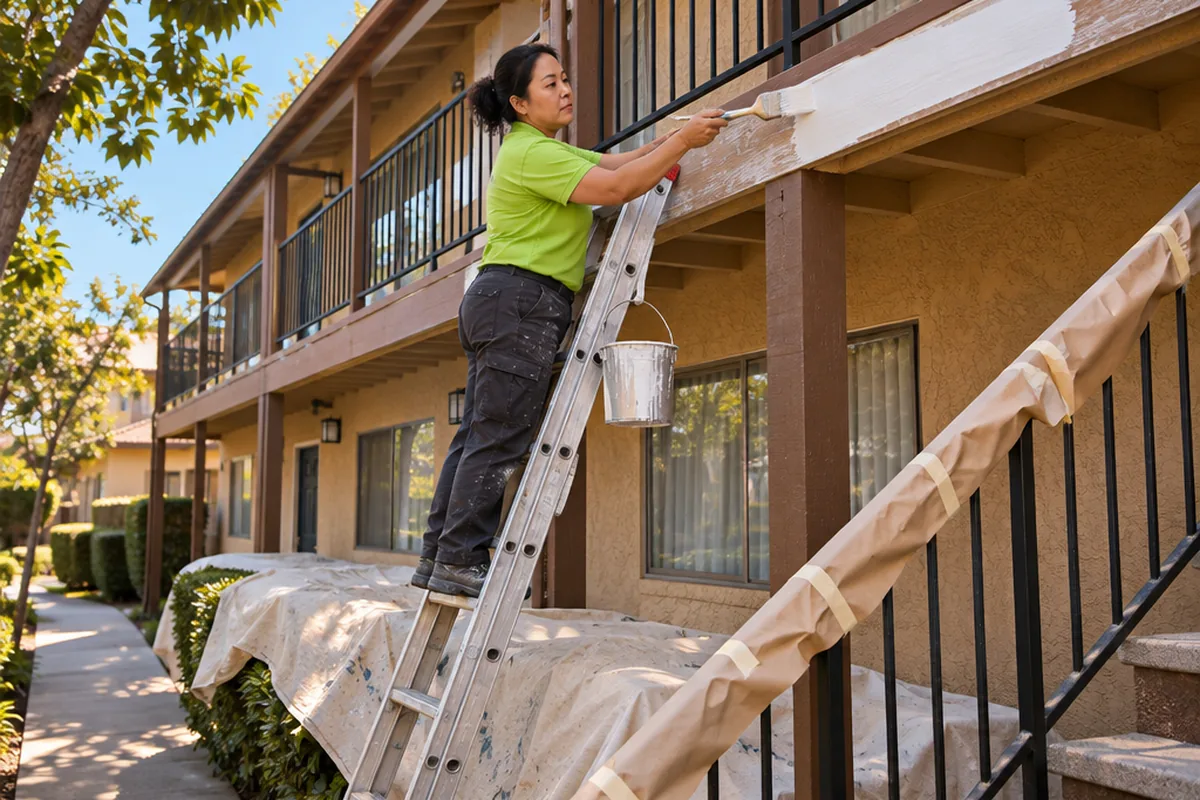
Kaminskiy Care and Repair provides commercial exterior painting for low-rise commercial and multi-unit buildings: stucco, siding, trim, fascia and doors, plus the steel railings and fence around them. The job is mostly preparation: washing, scraping, rust removal, priming and caulking before two finish coats suited to each surface. Work is staged one elevation at a time so tenants keep an open entrance. We do not do high-rise or swing-stage painting. Damaged boards are replaced first under siding and fascia repair. Exterior repaints belong to our painting services for commercial buildings.
A strip center shows its age on the sign band, the canopy fascia and the columns customers walk past. Stucco chalks and hairline cracks open. We wash off the chalk, bridge fine cracks with a flexible patch or an elastomeric coating where it suits, and paint one bay at a time before stores open, so no tenant's door is ever behind a barricade. Larger cracks and loose areas get commercial stucco repair first.
Garden-style buildings have wood trim, fascia, stair stringers, steel stair rails and a front door for every unit. South and west faces peel first, and rails rust first at the base plates. Each building is posted in advance, residents get notice for their door, and stairs are closed one flight at a time. The rails are coated in the same job, as set out under railing and metal fence painting below.
A freestanding office or clinic usually has mixed surfaces: stucco or siding walls, a metal service door, wood trim, a ramp handrail and a painted downspout or two. Each gets its own primer and finish. The entry side is painted on a day the business is closed, and the accessible route to the door stays clear of ladders and hoses throughout.
We walk all sides, rub the wall for chalk, probe trim for soft wood, grade the rust on rails and fence, and write up what each face and each run needs.
Tenants get a posted schedule by building and elevation. The plan shows which entrance and which stair stay open, where the lift sits and which cars need to move.
Surfaces are washed and left to dry. Loose paint and rust are scraped, edges feathered, bare wood and metal spot-primed and open joints caulked before any finish goes on.
Two finish coats go on by brush, roller or spray with back-rolling. You receive photos by elevation and the colors, sheens and product types used.
On housing built before 1978 and on child-occupied facilities, EPA's Renovation, Repair and Painting rule treats exterior work that disturbs more than 20 square feet of painted surface as a renovation. That requires a certified firm and lead-safe work practices. A scrape-and-paint of a whole apartment building passes that threshold on the first wall, so such jobs are done by an RRP-certified firm.
Ordinary offices and stores are outside the EPA rule, but old wall paint and old metal primers on them can still contain lead. OSHA's lead standard for construction, 29 CFR 1926.62, applies to repair and renovation work where employees may be exposed, and its definition of construction work includes painting. Our practice is to have suspect coatings on walls, railings and fence tested before any sanding or power tool cleaning, and to change the method if the result is positive.
Paint slows rust. It does not put steel back. The International Building Code, a model code many jurisdictions adopt, has handrails and guards designed to resist a load of 50 pounds per linear foot (Section 1607.9.1), and the local official applies it. When scale flakes off in layers or a base plate has lost thickness, the rail may no longer do that. We stop and report a rail in that condition instead of painting over it.
Sources for the rules on this page: U.S. EPA, Frequent Questions About Renovations Covered by the RRP Rule; U.S. EPA, Lead Renovation, Repair and Painting Program; OSHA, 29 CFR 1926.62(a), Lead in Construction; 2021 International Building Code, Section 1607.9.1.
Kaminskiy Care and Repair recoats steel stair rails, balcony guards, ramp rails and ornamental fence where they stand. Rust starts where water rests: base plates, welds, picket ends and the underside of the top rail. Loose rust and failed paint come off with scrapers, wire wheels and sanding, bare steel gets a rust-inhibiting primer before the shift ends so it cannot flash rust, and two coats of a direct-to-metal finish are brushed and rolled into the joints. Each flight stays taped off until the coating is dry to the touch, and where a building has two stairs we alternate them. We do not powder coat or galvanize; those are shop processes.
Wood perimeter fence and enclosure slats on commercial property are washed, left to dry and finished with a penetrating stain or a solid-color coating. A penetrating stain soaks in and wears away gradually, so the next round is a wash and one more coat. A solid stain or paint hides gray wood and mismatched repairs, which some communities require, but it can peel where sprinklers keep the boards wet. New pressure-treated lumber needs time to dry before either. Broken pickets and leaning posts are fixed first as commercial fence repair.
Stucco is painted with a breathable masonry finish once the chalk is washed off and new patches are sealed with an alkali-tolerant primer. Where hairline cracking is widespread and the wall is otherwise dry, a high-build elastomeric coating can bridge the cracks. It is not a cure for a wet wall: weep screeds and drainage gaps stay open so the wall can shed water, and wide or stepped cracks are patched before paint, or they print straight through the new finish.
Unit entry doors, steel service doors and their frames are repainted in an enamel made for the material: a direct-to-metal coating on steel, an exterior acrylic enamel on wood. Residents get notice for their door, which is painted early in the day and left ajar so the fresh film does not bond to the weatherstrip. Locks, viewers and closers are masked or removed, never painted over. A steel door that is dented or dragging gets service door repair ahead of the paint.
Washing, scraping, priming and caulking take most of the hours. The finish coats are the short part at the end.
Chalk is washed off, because paint will not bond to powder. Loose and peeling film is scraped back to a firm edge and feathered. Bare wood gets primer, rusty nail heads and metal get a rust-inhibiting one, and new stucco patches get a masonry primer that tolerates alkali. Joints at trim and windows are caulked, but weep screeds and drainage gaps are left open so the wall can still shed water.
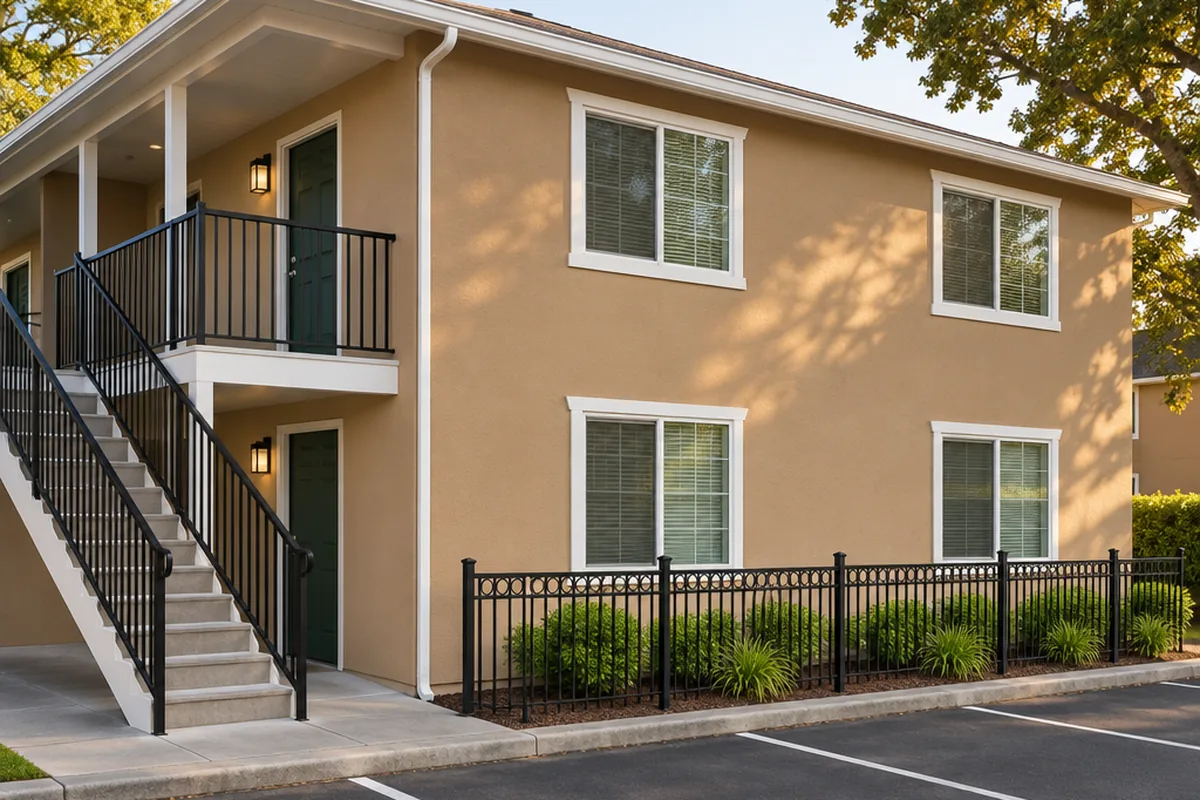
Chalking, peeling, open caulk and surface rust are the stage where paint still protects the building. Wait longer and the job turns into carpentry or metal repair. Faded curbs and bollards in the same lot are handled as curb and safety paint.

Send the address, the number of buildings and stories, and photos of the worst elevation and the worst rail.

Approve the written scope by elevation and run: prep, primers, coats, colors and the access plan.

We wash, prep and paint in stages, then send photos and the color record.
The work is backed in writing by our workmanship warranty and done by a Kaminskiy-certified, background checked technician.
Rub a dark cloth or your palm on the wall. A light dusting is normal weathering. A heavy white smear means the binder in the old paint has broken down and left loose pigment on the surface. Fresh paint over that layer peels with it. Heavy chalk has to be washed off, and stubborn surfaces get a penetrating or bonding primer before the finish.
Wood moves with moisture, and paint fails at end grain, joints and horizontal edges where water gets behind the film. That is a caulk and primer problem before it is a paint problem. Stucco is rigid, so it cracks at corners of openings and along control lines. Hairline cracks can be bridged by a high-build flexible coating. Wider or stepped cracks need a patch, or they print straight through.
Stucco wants a breathable masonry finish. Wood and fiber cement take an acrylic exterior paint over primed bare spots. Steel doors, frames and rails get a direct-to-metal enamel over a rust-inhibiting primer. Galvanized metal is its own case: ordinary oil-based enamels react with the zinc and let go in sheets, so it is cleaned and primed with a product labeled for galvanized surfaces. One bucket for everything is how a building ends up with peeling doors and blistered stucco.
Look where water rests: base plates and the grout under them, the joint where pickets meet the bottom rail, weld beads and the underside of horizontal rails. Brown streaks from a pinhole mean a hollow picket is rusting from inside. Rust on a broad, exposed face is usually cosmetic and a coating job. Scale that flakes in layers, or metal a screwdriver can dent, is a repair, and paint will not hold it together.
Every exterior coating has a minimum application temperature and a time it must stay dry, both printed on its data sheet. Paint applied late on a cool afternoon can be hit by dew before it sets, which leaves it streaked or dull. Washed stucco and wood also need to dry out before primer. This is why exterior work is scheduled by forecast and by which wall is in sun, not only by the calendar.
Work is staged by elevation and by entrance. A storefront is painted before opening and dry to the touch by the time the door unlocks. Apartment doors are done in a morning with notice. Lifts and ladders are set outside the accessible route, wet areas are coned and posted, and near parked cars, pool decks and windows the work is brushed and rolled, with spray kept for open runs in calm air.
Can't find your answer? Call 855-695-1195 and ask us anything.
Call 855-695-1195We paint low-rise buildings that are reachable from ladders and small lifts, which covers most garden apartments, strip centers and small office buildings. If any face of your building needs a swing stage, rope access or a large boom, that portion belongs to a commercial painting contractor with that equipment.
Yes. The building is painted one elevation or one bay at a time. Storefronts are done before opening hours, an entrance always stays in service, and the accessible route is kept free of equipment. Tenants receive a posted schedule in advance.
Wash a test area. If the color underneath is even and the film is intact, washing may be enough for now. If you find heavy chalk, peeling, bare wood or split caulk, the coating has stopped protecting the surface and repainting is due.
Yes, within repair scope. Soft or split trim and siding boards are replaced, and stucco cracks and small holes are patched and primed. Each repair is listed as its own line in the written scope so you can see what is paint and what is carpentry or patching.
Not directly. Paint laid over loose rust comes off with it, usually within a season. The rust and failed coating are removed to firm metal with scrapers, wire wheels and sanding, bare steel is primed with a rust-inhibiting primer that day, and then two finish coats go on.
No. Powder coating is baked on in a shop and galvanizing is a factory dip, so the metal has to be taken down and transported. We apply liquid coatings to rails and fence in place. For a shop finish, a metal fabricator handles the removal, the coating and the reinstallation.
A penetrating stain is the easier one to live with, because it fades instead of peeling. A solid stain or paint gives one uniform color and hides repairs, but needs dry, sound boards. We recommend one after looking at the wood, the sprinkler pattern and any color rule the property has.
It can be. For housing built before 1978 and child-occupied facilities, EPA's rule covers exterior work that disturbs more than 20 square feet of paint, and that work is done by an RRP-certified firm. On other old buildings, suspect coatings are tested before scraping or sanding.
The amount of prep more than anything: how much scraping, rust removal, priming, caulking and repair the walls and rails need. After that come the wall area, the height and access, the number of colors and how many separate mobilizations the tenants' hours require. The scope prices each elevation and each run in writing.
Whenever the surface can be dry and within the temperature range on the coating's data sheet through application and the hours after it. In practice that means avoiding rain, heavy dew and very cold or very hot walls. We watch the forecast and move elevations around to follow the sun.
Send the address, the number of buildings and stories, the surface types if you know them and a few photos, including the railings and fence. We walk the site and return a written scope by elevation. Questions first? Call 855-695-1195.
Prep listed line by line. Entrances kept open. Colors recorded at the end.
We answer in under three rings, 24/7.No price games. You get a clear written quote before any work begins, backed by our workmanship warranty.
