
 BBBAccredited Business

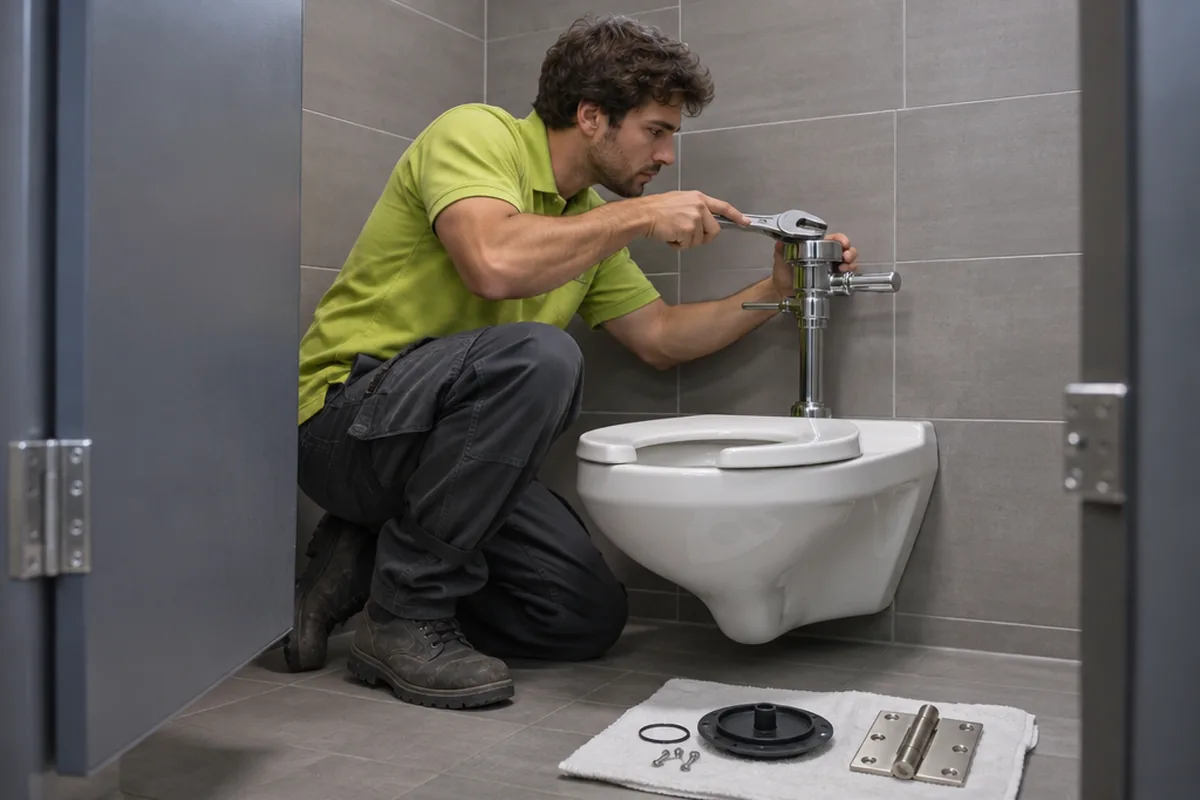
Kaminskiy Care and Repair handles commercial restroom repair for offices, stores, restaurants, clinics and apartment common areas: flush valves and toilets, faucets, stall partitions, wall accessories and failed caulk, on one written scope. A technician works with the room closed, usually before opening or after closing. The work stays at the fixture. Clogs past the fixture, piping inside walls and permit work go to a licensed plumbing contractor, and a full refit is our restroom upgrade work. It is the restroom side of our commercial plumbing repair services.
One flushometer that will not stop running takes a stall out of use and wastes water by the hour. Sensor faucets on the same floor blink and give nothing. We rebuild the valve with the kit that suits the bowl, test the faucet's battery, solenoid and strainer in turn, and reopen the room before the workday. The detail is under flushometer and toilet repair.
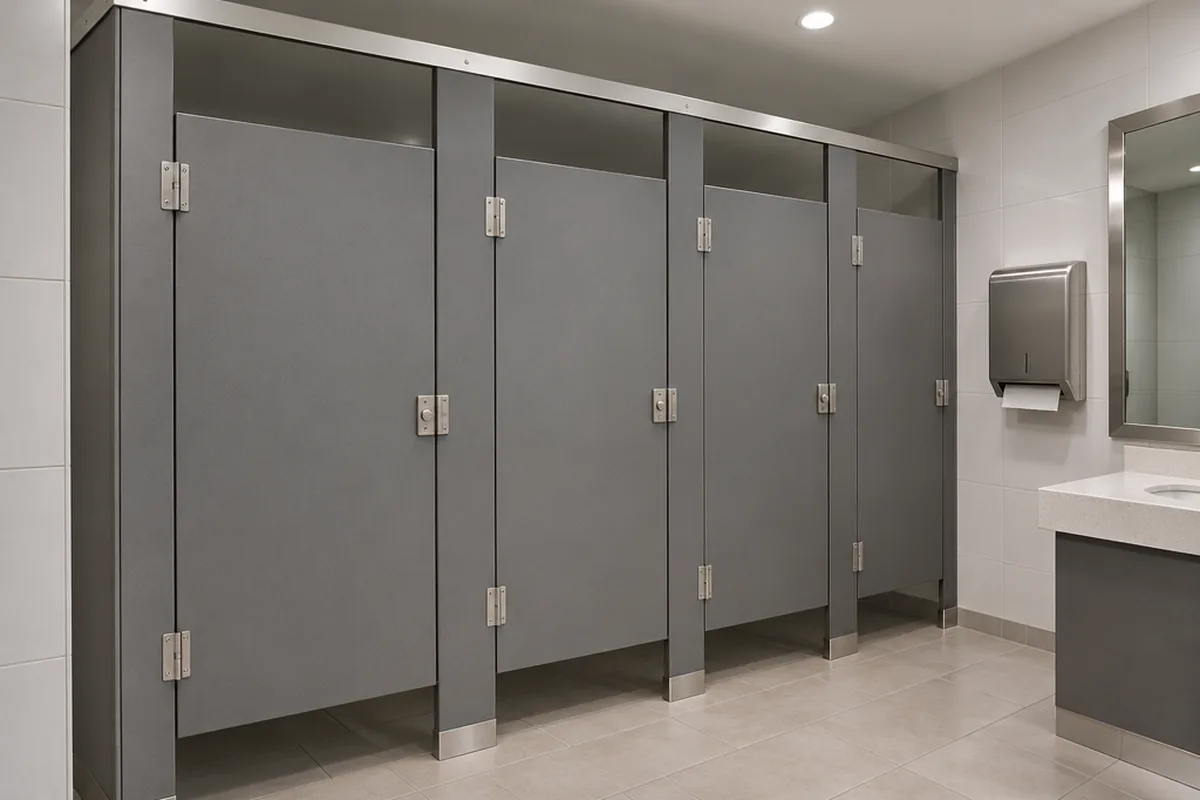
Stall doors in guest restrooms drop on stripped hinge screws until the latch misses its keeper. Dispensers get pulled off drywall anchors, and the caulk at the counter turns black. We through-bolt the hinges, reset latch and keeper, remount accessories into solid backing and recaulk the wet joints. Kicked and gouged walls can take corner guards and wall panels.
Common-area restrooms get heavy use and little attention between inspections. Tank toilets refill all night, lavatory faucets drip, posts rust at the floor and hooks go missing. We take the room as a single list, fixture by fixture and stall by stall. Where an access report drives that list, the corrections are handled as ADA restroom updates.
Send the restroom count and a photo of each problem: the valve, the faucet and the stops below it, the hinge and latch, the wall where a dispenser hung. Photos decide which kits and hardware ride on the truck.
The room is signed and closed while we work, most often outside business hours. Where a floor has two restrooms, one stays open. Water is shut at the control stop or the fixture stop, not at the building.
Valves and faucets are rebuilt or replaced, bowls reset and seats changed. Then doors are rehung and posts plumbed, accessories go back on solid backing, and old caulk is cut out and replaced last.
Every repaired toilet is flushed several times, each faucet run and timed, each door swung and latched. You receive a list by fixture and stall with photos, and the hour the fresh sealant may get wet.
Federal standards set 1.6 gallons per flush as the ceiling for toilets and 1.0 for urinals. The International Plumbing Code (Table 604.4) repeats those limits and caps public lavatory faucets at 0.5 gallons a minute, measured at 60 psi. Many jurisdictions adopt that code with changes, and the local official decides. The rebuild kit and the aerator set these numbers, so we match both to the marking on the fixture.
In a wheelchair accessible compartment, the 2010 ADA Standards call for a self-closing door with a pull on both sides near the latch (section 604.8.1.2), a toilet seat set between 17 and 19 inches high (604.4) and a flush control mounted on the bowl's open side (604.6). Hand-operated parts must work with one hand, without tight grasping, pinching or twisting, at no more than 5 pounds of force (309.4). Our repairs keep those dimensions. They are not a survey or a certification.
The International Plumbing Code (section 405.6) says joints formed where fixtures meet walls or floors shall be sealed, which covers a toilet at the floor and a lavatory or urinal at the wall. The U.S. EPA's guidance for commercial buildings gives the reason: mold and mildew are controlled by controlling moisture, and wet or damp spots should be cleaned and dried within 48 hours. Black caulk means water has sat behind the bead far longer than that.
Sources for the rules on this page: 2010 ADA Standards for Accessible Design, sections 308, 309.4, 603.3, 604.4, 604.6, 604.7, 604.8.1.2 and 606.4; 2010 ADA Standards for Accessible Design, section 307.2 (protruding objects); 2021 International Plumbing Code, Table 604.4 (maximum flow rates and consumption); 2021 International Plumbing Code, sections 405.6, 415.2, 419.5 and 425.3; U.S. EPA, How to Care for Your Septic System; U.S. EPA WaterSense, Commercial Toilets.
Flush valve repair is the most common request on this page. Kaminskiy Care and Repair rebuilds manual and sensor flushometers on toilets and urinals with the diaphragm or piston kit that matches the fixture's flush volume, and replaces handle seals, vacuum breakers and control stop parts. On tank toilets we change fill valves, flappers and supply lines. Seats are replaced in kind, and a bowl that rocks is pulled and reset on a new wax ring. A stoppage is cleared at the fixture with a closet auger. When several fixtures back up together the trouble is in the building drain, and that goes to a licensed plumbing or drain contractor.
Most restroom faucets can be repaired where they sit. We fit new cartridges in manual and metering faucets, reset the metering run time, clear or swap aerators at the same flow rating, and renew the braided supply lines under the sink. Battery sensor faucets are tested part by part: battery pack, solenoid, sensor lens, inlet strainer. Only the failed part is changed. A pitted or cracked body, or one whose cartridge is no longer made, is swapped for a new faucet sized to the holes already in the deck. Choosing or installing thermostatic mixing valves and running new piping are a licensed plumbing contractor's work.
Bathroom partition repair is mostly hardware. Stall doors sag when hinge screws strip out of the panel edge, so we refasten hinges with through-bolts, renew worn cams and set the latch to meet its keeper. Swaying rows get their floor anchors reset in sound concrete, posts leveled, and wall and headrail brackets tightened. Rusted shoes are replaced. We work on steel, laminate, solid plastic and phenolic panels and replace single doors or posts where a match exists. We do not fabricate panels. A row too rusted or swollen to hold hardware is priced as a replacement.
Restroom accessories fail at the wall, seldom at the unit. Soap and towel dispensers, seat cover boxes, framed mirrors, coat hooks and baby changing stations are remounted into blocking, studs or rated toggles, and the old holes are patched. Hand dryers are replaced on the existing circuit and box. Heights follow the dimensions in the 2010 ADA Standards, or your access report where there is one. A dryer where no wiring exists needs a licensed electrical contractor first. Cutting mirror glass or setting large plate mirrors is a glazier's work.
Failed caulk is cut out completely, never covered. Fresh sealant will not grip old caulk, soap film or mildew, so each joint is stripped, scraped, dried and resealed in a single bead: silicone at sinks, counters, toilet and urinal bases and the tub or shower surrounds in units, paintable acrylic where a backsplash meets a painted wall. Nobody uses the fixture until the cure time printed on the product has passed, and that hour goes on the door. Soft wall or cabinet material behind a joint is a leak to fix first. Exterior building joints and window perimeters belong to a waterproofing or glazing contractor.
A restroom is a set of small machines and a row of doors. Most of it can be repaired in place with the right kit and hardware.
A technician takes the room fixture by fixture. Running valves get the matching kit. Faucets are rebuilt and timed. Doors come off, hinges are through-bolted and latches set. Dispensers go back on solid backing, and the black caulk is cut out and replaced last so nothing disturbs it. The room reopens with a list of what was done at each stall and sink.
Each of these is a part, a fastener or a bead of sealant. A puddle nobody can explain is a different job, traced through our leak, valve and drain repair.

Send photos of each valve, faucet, stall hinge and loose accessory, plus the hours the restroom can close.

We return a written scope by fixture and stall with a price for each line, and you choose what to approve.

The technician repairs, tests and photographs every item, then tells you when fresh sealant can get wet.
The work is backed in writing by our workmanship warranty and done by a Kaminskiy-certified, background checked technician.
A flushometer has no tank. Building pressure sits on both faces of a rubber diaphragm, and the larger upper face keeps the valve shut. A push on the handle unseats a small relief valve and empties the chamber above, so the diaphragm lifts and water rushes into the bowl. Supply water then seeps back through a pinhole bypass and refills the chamber until the diaphragm seats again. The bypass and the kit decide how much water each flush delivers.
A valve that will not stop has a blocked bypass or a torn diaphragm: the upper chamber never refills, so nothing pushes the valve closed. Turning the control stop shut with a screwdriver halts the waste until the visit. A short, weak flush is the opposite trouble. Either the control stop has been throttled down, the building's pressure is poor, or the kit inside delivers the wrong volume for the bowl. Neither fault calls for a new valve body.
Sensor fixtures add four parts to an ordinary valve: an infrared eye, a control module, a solenoid, and a battery pack or small transformer. A dead battery gives nothing, often after a blinking light has warned of it. Grit holding the solenoid open gives water that will not stop. A clogged inlet strainer gives a trickle, and a dirty or misaimed eye gives phantom flushes. We replace only what failed. Power on an existing transformer is serviced in kind.
Most stall doors hang on gravity hinges, a pair of angled cams that raise the door as it opens so its own weight swings it back. When the cams wear, the door stops returning. More often the hinge screws strip out of the panel edge, the door drops a quarter inch and the latch slides past its keeper. Bending or shimming the keeper only hides the drop. Through-bolts that clamp both faces of the panel, plus a new cam set, cure it.
The 2010 ADA Standards give the numbers an access report checks. Operable parts of dispensers and dryers sit within the 15 to 48 inch reach range (section 308). A mirror over a lavatory has its reflecting surface starting no higher than 40 inches; elsewhere, 35 (603.3). The toilet paper dispenser is 7 to 9 inches in front of the bowl (604.7). Along a walkway, an object mounted between 27 and 80 inches may project 4 inches at most (307.2). A metering faucet stays open at least 10 seconds (606.4).
Repair when the body is sound and parts exist: a kit, a cartridge, a hinge set. Replace the fixture when the body is cracked, threads are stripped, chrome is pitted through or the maker has stopped supplying parts. Replace panels when rust or swelling has destroyed the edges that hold hardware. When most of the room has reached that point, fixing item by item costs more than it saves, and the answer is a planned fixture-by-fixture restroom upgrade.
Can't find your answer? Call 855-695-1195 and ask us anything.
Call 855-695-1195Usually repaired. The brass body of a flushometer outlasts its insides by decades, and the wearing parts are few: the diaphragm or piston, the relief valve and the handle seal. A rebuild kit renews all three without taking the valve off the wall. A whole new valve is called for only by a cracked body, stripped threads or a model nobody supplies parts for.
A flushometer runs on when its diaphragm is torn or the pinhole bypass in it is blocked, because the valve then has nothing to close it. A tank toilet runs when the flapper no longer seals or the fill valve sticks open. Each is a small part. Shut the control stop, or the stop behind the tank, until we arrive. By the U.S. EPA's figure, one running toilet can add as much as 200 gallons of water a day.
Sensor fixtures fail in a short list of ways: weak batteries, grit in the solenoid, a clogged inlet strainer, or a sensor eye that is dirty or reading a shiny surface. The fix is a fresh battery pack, a cleaned or new solenoid, a rinsed strainer and a sensor re-aimed to the right range. Adding power where none exists is work for a licensed electrical contractor.
In nearly every case, yes. The hardware gives out years before the panels do, so new hinges, through-bolts, a latch and a keeper put a sound panel back to work. We recommend new panels only when rust or swelling has ruined the edges the hardware fastens to, and we show you that in photos first.
Yes, when the stoppage is in the toilet itself. A closet auger clears most of them, and the bowl comes up when an object is stuck in its trapway. A clog deeper in the pipe, or two or three fixtures backing up at once, points to the building drain. A licensed plumbing or drain contractor handles that, and we stop and tell you.
Yes. We set operable parts within the reach range of the 2010 ADA Standards and mirrors at the height section 603.3 gives, and we follow an access report where you have one. Hand dryers are replaced on the existing circuit, and we check how far a new one projects into the walkway. We install to the dimensions. We do not inspect the restroom or declare that it meets the Standards.
Until the sealant has cured, which the product label gives in hours. A thick bead, a cool room or damp air stretches that time, and silicone and acrylic differ. The reopening hour is written into the scope and posted on the door, and caulking is the last task of the night so the cure happens while the room is empty.
Most commercial flush valves, faucets and partition hardware follow a few common patterns, and we stock or source kits, cartridges, hinges, latches, brackets and shoes for them. A photo of the valve, the faucet and one hinge with a tape measure beside it lets us confirm the fit before the visit. If your building keeps a standard model, we match it.
Price follows the number of fixtures and stalls, the parts each needs, and whether the work is done outside business hours. A rebuild kit or a hinge set costs far less than a new valve or new panels, and a whole row done in a single night avoids paying for travel twice. Each line carries its own written figure before a date is set.
In most places, yes, for work at the fixture. Swapping fixture parts, or a fixture for one like it, is treated as minor repair in many states and needs no plumbing license up to a set limit. Other states and some cities draw the line tighter. We read the rule for your property and say before work starts whether the job is ours or belongs to a licensed plumbing contractor.
Send the address, the number of restrooms and stalls, your closed hours and photos of what is out of order. A written scope by fixture and stall comes back. Prefer to talk it through? Call 855-695-1195.
Priced by the fixture and the stall. Matching kits and through-bolted hardware. Photos when the room reopens.
We answer in under three rings, 24/7.No price games. You get a clear written quote before any work begins, backed by our workmanship warranty.
