 BBBAccredited Business

Kaminskiy Care and Repair replaces failed office lighting and retail display lighting in kind on existing circuits: lamps, ballasts, drivers, lenses, flat panels, track heads and recessed trims, after hours, for property managers, tenants and store operators. On an LED retrofit, a ballast-compatible (Type A) tube is a lamp swap we do. Ballast-bypass tubes, retrofit kits and new fixtures rewire the fixture, so a licensed electrician does that part where the state requires one. Spent lamps are recycled. Ceiling and display lighting is one piece of our commercial electrical and lighting work.
A single flickering fixture costs more in complaints than it does to fix. The usual cause is a lamp at end of life or a ballast that hums and runs hot. We replace the failed part after hours, clean the lens while it is down and check the neighbors in that row, since they were all installed together. A wall switch that crackles is its own line: switch, dimmer and outlet replacement.
A vacated suite shows every lighting shortcut the last tenant took: mixed lamp colors, missing lenses, a row that never worked. We survey the ceiling, replace failed lamps and ballasts, swap cracked lenses and bring the suite to one color temperature ahead of the broker's walk. Stained tiles around the fixtures are a separate line: drop ceiling tile replacement.
A sales floor, a dining room and a gallery wall all run on aimed light. After a reset the beams land on bare floor, and older LED heads have drifted pink or green beside their neighbors. We swap dead heads, trims and modules on the track and housings already wired, bring the room to one color and aim every head at what it should show. The detail is under recessed and track lighting.
Send the suite or store number and a photo of one open fixture, or of the track end and one head. Lamp length, base type, the ballast label and the track profile tell us what to load on the truck.
The technician maps dead and flickering fixtures on a simple plan and notes lamp type and color for each area, so replacements match what stays.
Lamps, ballasts, drivers and lenses are changed with the fixture switched off. Desks below are covered, and the ladder moves row by row so no area is left open. Track heads are aimed last, with your manager confirming each display.
Spent tubes leave in closed cartons, unbroken, for recycling. You receive the fixture plan marked with what was replaced, plus photos.
EPA lists fluorescent tubes among the bulbs that contain mercury. Federal universal waste rules at 40 CFR part 273 apply, and EPA notes that California, Maine, Massachusetts, New Hampshire, Vermont and Washington prohibit putting such lamps in a landfill. Recyclers want lamps unbroken, so ours are boxed as they come down. Your state agency can confirm what applies to your building.
EPA states that fluorescent ballasts made before July 1, 1979 may contain PCBs, and only the magnetic T12 type. Ballasts made from then until July 1, 1998 without PCBs had to be labeled No PCBs. An unlabeled magnetic ballast is treated as suspect, and a leaking one is a regulated cleanup, not a routine swap. We stop and tell you.
OSHA's general electrical standard, 29 CFR 1910.303(b)(2), requires listed or labeled equipment to be installed and used the way its instructions say. A track head therefore goes only on the track system it is listed for, and a recessed housing takes only the trims and lamps named on its label. Under 29 CFR 1910.305(j)(1)(i), fixtures and lampholders may have no live parts normally exposed to employee contact, so a missing trim or an uncapped track end is replaced, not left for later.
Sources for the rules on this page: U.S. Department of Energy (FEMP), LED Retrofit Kits, TLEDs, and Lighting Controls: An Application Guide (2017); U.S. EPA, Recycling and Disposal of CFLs and Other Bulbs that Contain Mercury; U.S. EPA, Universal Waste (40 CFR part 273); U.S. EPA, PCB-Containing Fluorescent Light Ballasts in School Buildings; OSHA 29 CFR 1910.303(b)(2); OSHA 29 CFR 1910.305(j)(1)(i).
Kaminskiy Care and Repair replaces failed track heads, track sections and connectors, recessed can trims and LED modules in retail stores, restaurants and galleries, then re-aims the heads after a merchandise reset and matches color temperature across the floor. All of it stays on track and housings that are already wired. Heads fit only the track system they were made for, so a photo of the track end and one head label comes first. A can that scorches its trim or keeps shutting off on its thermal protector is handed to a licensed electrician, and so are longer track runs and added cans. Lights outside the storefront are on the exterior light fixture page.
An LED retrofit of an office troffer takes one of three routes, and the route decides who does the work. The Department of Energy's troffer retrofit guide sorts LED tubes into UL Type A, which runs on the ballast already in the fixture, Type B, which takes line voltage at the sockets, and Type C, which uses a driver of its own. Type A is a lamp swap our technician does, though an aging ballast can make the new tube flicker. Type B and Type C tubes, retrofit kits and new fixtures change the wiring in the fixture. The guide says those call for an electrician, so a licensed electrician does that part where the state requires one.
We replace what has failed in the fixture and match what stays, so the ceiling reads as one system again.
Most office calls come down to the same set of parts. Dead and mismatched lamps are replaced with one type and color, failed ballasts or drivers are changed, yellowed and cracked lenses are swapped, and louvers are washed. The suite ends with every fixture working and a count of what came out for recycling.
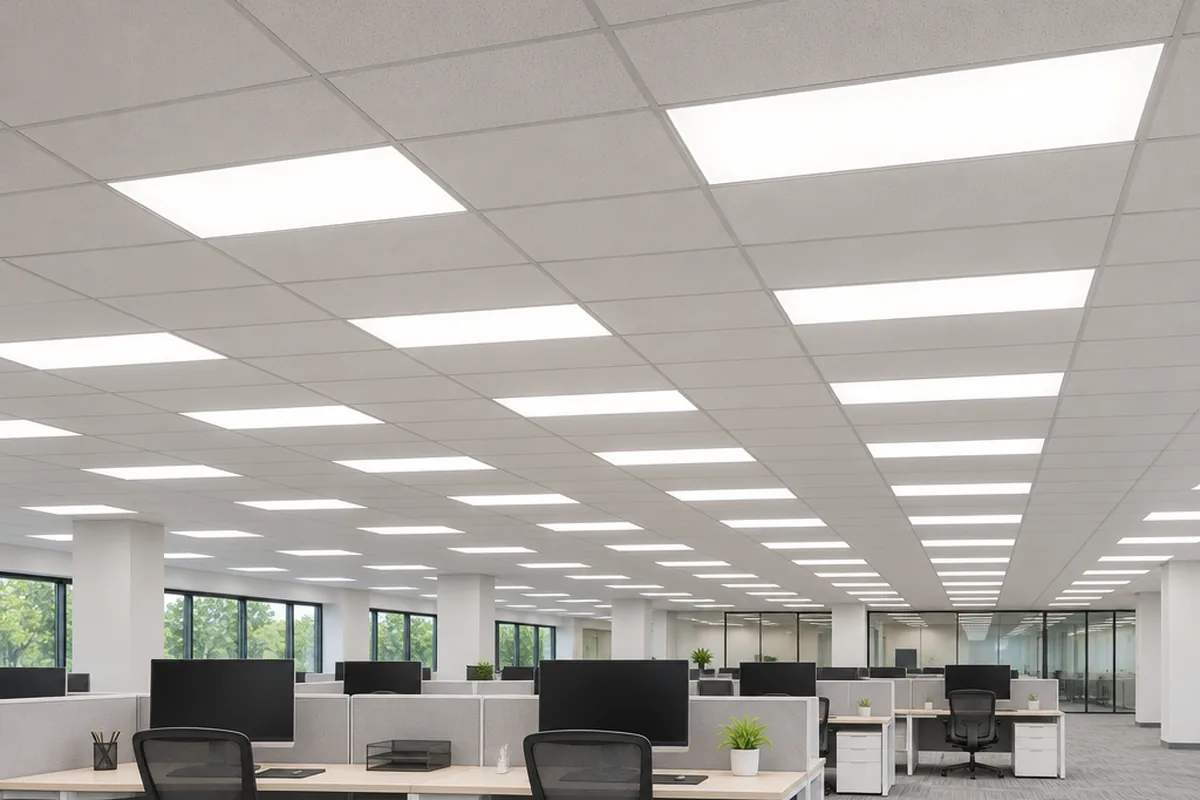
Each of these is a worn part, a mismatched lamp or a head pointed at the wrong thing. A photo of the open troffer or the track usually tells us which, and the fix happens while the space is empty.

Tell us the suite or store, the ceiling height and roughly how many fixtures or heads are out.

We send a written scope listing lamps, ballasts, drivers, lenses and heads, with the price.

The technician replaces the parts after hours, aims what needs aiming and removes the spent lamps for recycling.
The work is backed in writing by our workmanship warranty and done by a Kaminskiy-certified, background checked technician.
Swap the dark lamp with a working one from the next fixture. If the good lamp also stays dark, the ballast or a socket has failed. If the problem follows the lamp, the lamp is done. Blackened ends, slow starts and a pink glow are lamp symptoms. A hum, a hot fixture or a tar smell points at the ballast.
Replacing a lamp or ballast in kind keeps a fluorescent fixture running. Converting to LED lowers the wattage: the Department of Energy reports that swapping fluorescent lamps for LED tubes in roughly 35,000 troffers at its headquarters cut lighting energy use by about half. Conversion makes sense when ballasts are failing in numbers or lamps are getting hard to buy.
A retrofit kit keeps the troffer housing in the grid and replaces the lamps, ballast and sockets with an LED module and driver. A new flat panel replaces the whole fixture. DOE's guide rates both as higher-saving routes than tubes and notes that both involve the fixture's wiring. Your state's rule settles whether a technician or a licensed electrician makes that connection.
Lamps are labeled with a color temperature in kelvin. Lower numbers look warm and yellow, higher numbers look cool and blue. Mixing 3500 K and 5000 K lamps in one room is what makes a ceiling look patchy. We note the existing color, replace to match, and recommend one standard per suite so the next relamp is simple.
A track is a metal channel with conductors along its length, and every head twists in on an adapter that touches them. Track profiles are not interchangeable, which is why an adapter from one maker will not seat in another's channel. When an entire run goes dark at once, suspect the connector between two sections or the feed at the live end long before the heads.
LED heads seldom burn out. They dim and shift color as the diodes and driver age, and the Federal Energy Management Program treats an LED fixture as worn once its output has fallen to about 70 percent of the original. Heads bought years apart rarely match, so one wall or zone is replaced as a group. Flicker at low dimmer settings usually means the lamp does not suit the dimmer, so we try a single lamp on yours and order the rest only when it dims cleanly.
Can't find your answer? Call 855-695-1195 and ask us anything.
Call 855-695-1195Yes, in part, and the split is simple. Swapping fluorescent tubes for ballast-compatible Type A LED tubes is a lamp swap our technician does. Ballast-bypass tubes, retrofit kits and new LED fixtures rewire the fixture, and the Department of Energy's retrofit guide says those call for an electrician. A licensed electrician does that portion wherever the state requires one, and we coordinate the visit.
Both. A technician replaces lamps, ballasts, LED drivers, sockets, lenses and louvers inside an existing fixture, matching the type that was there. If the fixture itself is damaged, a like fixture takes its place on the same circuit.
They leave your building unbroken, in closed cartons, and go to a lamp recycler. Fluorescent lamps contain mercury and fall under federal universal waste rules, and several states ban them from the trash entirely. The number of lamps removed is written on your close-out.
Ballast-compatible LED tubes depend on the fluorescent ballast that is still in the fixture. The Department of Energy notes that ballasts vary, that aging ballasts can cause flicker, and that two fixtures that look identical may hold different ballasts. The cure is a compatible ballast or a different type of tube.
Yes, re-aiming is part of this service. With the store closed, a technician walks the changed layout with your manager, turns each head onto its display from a ladder, swaps beam spreads where the track system allows it and parks or removes heads that no longer have anything to light.
Most often a connector between two track sections has worked loose, or the feed at the live end has failed. Both are parts we replace on track that is already wired. When the track tests sound and the circuit behind it is dead, the fault belongs to a licensed electrician.
By two numbers. We read the kelvin rating and the lumen output printed on a lamp or head that is staying and order to those. Where older LED heads have drifted with age, fresh ones will still look different beside them, so we advise replacing a full wall or zone together.
No. Cutting in recessed cans, extending track, adding a fixture or changing how the lights are switched is added wiring. It needs a licensed electrical contractor and usually a permit, which the local building department decides. We replace trims, lamps, modules and heads in what is already there, and patch and paint the ceiling once the electrician has finished.
Yes. Relamping, ballast work and aiming are done in the evening, early in the morning or on a weekend. Workstations and displays under the ladder are covered, the floor is vacuumed where lenses came down, and you open as usual with nothing left behind.
Price follows the number of fixtures or heads, what failed in each one, the ceiling height and the lamp, panel or head you choose. A lamp swap is the smallest job and a kit or new panel is the largest. You see the count and the price in writing ahead of any ladder going up.
Tell us the suite or store, the ceiling height and how many fixtures or track heads are out, and attach a photo of one open troffer or the track. We reply with a written scope. Phone: 855-695-1195.
Parts matched to what you have. Work after hours. Old lamps recycled.
We answer in under three rings, 24/7.No price games. You get a clear written quote before any work begins, backed by our workmanship warranty.
