 BBBAccredited Business

Kaminskiy Care and Repair repairs exterior cement stucco on commercial buildings: cracks, cart and vehicle impact at corners and loading areas, loose or hollow sections, parapet caps and weep screed. A patch over lath goes on in three coats, scratch, brown and finish, with cure time between them, so a repair spans several visits and we schedule it that way. Texture and paint are matched to the wall. We do not work on EIFS or other synthetic systems or re-stucco whole buildings. Stucco is one line in our commercial exterior repair list.
Carts, pallet jacks and truck mirrors knock stucco off outside corners and expose the lath. We cut the break square, replace bent lath and corner bead, and rebuild in three coats. Where the same corner is hit again and again, a bollard or a steel corner guard is the lasting fix. Trash enclosure gates and posts are dumpster enclosure repair.
The flat top of a parapet takes sun and standing water. Cracks there send water down inside the wall, and stains appear on the face below. We repair the stucco cap, slope it to drain and seal the joints at metal copings. The roof membrane on the other side of that wall belongs to a roofing contractor.
Planters, new paving and raised soil cover the weep screed at the base of the wall. Water that should drain out stays in, the bottom course turns soft and hollow, and paint blisters. We cut back the wall, replace the screed and paper, and re-plaster with the drainage gap restored. Decayed framing behind it is dry rot repair.
Send photos of each area. On site we tap around the damage with a hammer handle to map hollow stucco, since the loose area is often larger than the visible crack.
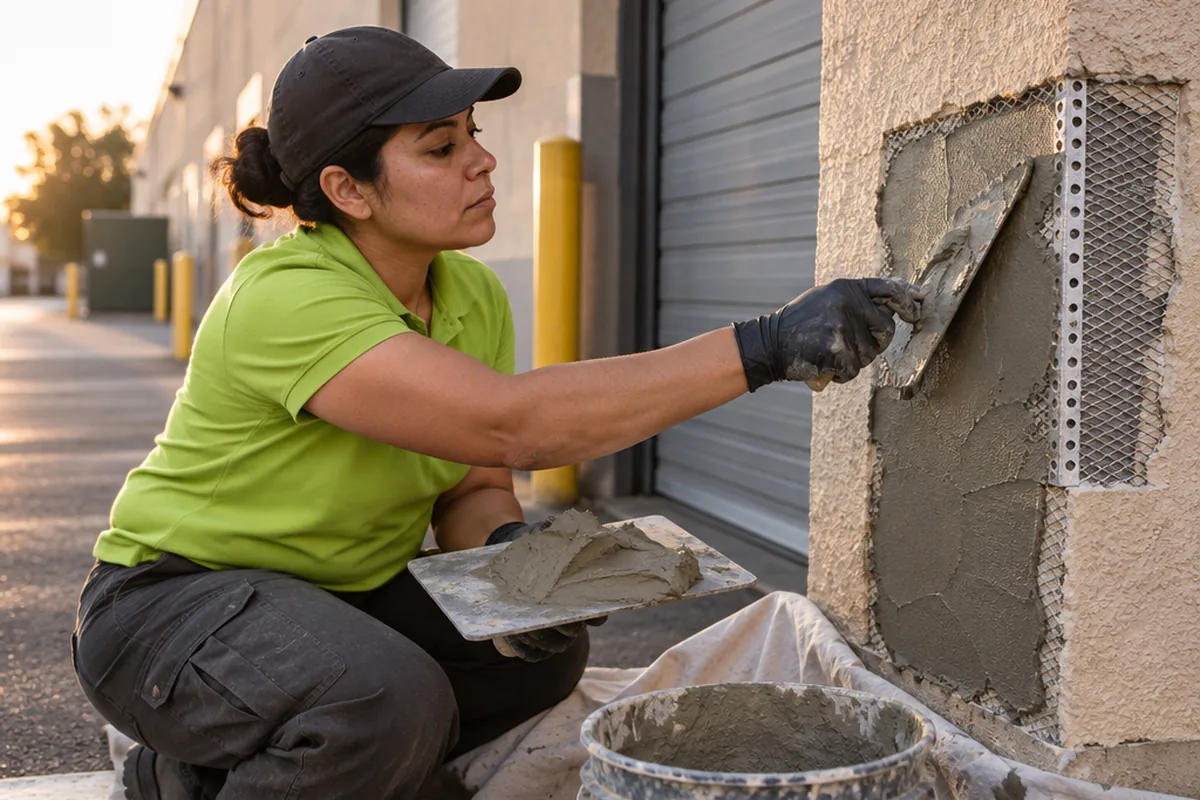
Loose plaster is removed to a firm edge. Water-resistive paper is lapped in, new lath is tied to the old, and corner bead or screed is replaced where bent or rusted.
The scratch coat goes on and cures. The brown coat levels the patch and cures longer. The finish coat is floated to match the texture. The schedule lists each return date.
After the finish has cured, the patch is primed and painted to a corner or joint so color and sheen read as one wall. Photos of each coat go in your file.
The International Building Code, which many jurisdictions adopt, requires cement plaster in not less than three coats over metal or wire lath and not less than two over masonry or concrete (section 2512.1). A single skim over a hole in a framed wall is not the same assembly, and it is why quick patches crack at their edges.
Table 2512.6 of that code gives the first coat 48 hours of moist curing and at least 48 hours before the second coat. The second coat gets 48 hours of curing and 7 days before the finish, and plaster is applied above 40 degrees Fahrenheit (2512.4). An alternate method (2512.8) shortens the first interval. Either way, the wall sets the pace, so we never promise a fast stucco repair.
Section 2512.1.2 calls for a corrosion-resistant weep screed at the foundation line of framed walls, placed at least 4 inches above earth or 2 inches above paved areas, so trapped water can drain to the outside. Landscaping and new concrete often bury it. Restoring that clearance is part of a base-of-wall repair, and the building official decides what an existing wall must meet.
Sources for the rules on this page: 2021 International Building Code, section 2512.1; 2021 International Building Code, section 2512.1.2; 2021 International Building Code, Table 2512.6 and sections 2512.4 and 2512.8.
A stucco patch is a small plastering job done in stages. We do each stage properly and tell you the dates up front.
A broken corner is cut back to solid plaster on both faces. Torn paper is replaced and lapped, new lath and a corner bead are fastened, and the scratch coat is pressed into the lath. After it cures, the brown coat brings the corner out straight, and the finish coat is floated to the wall's texture before paint.
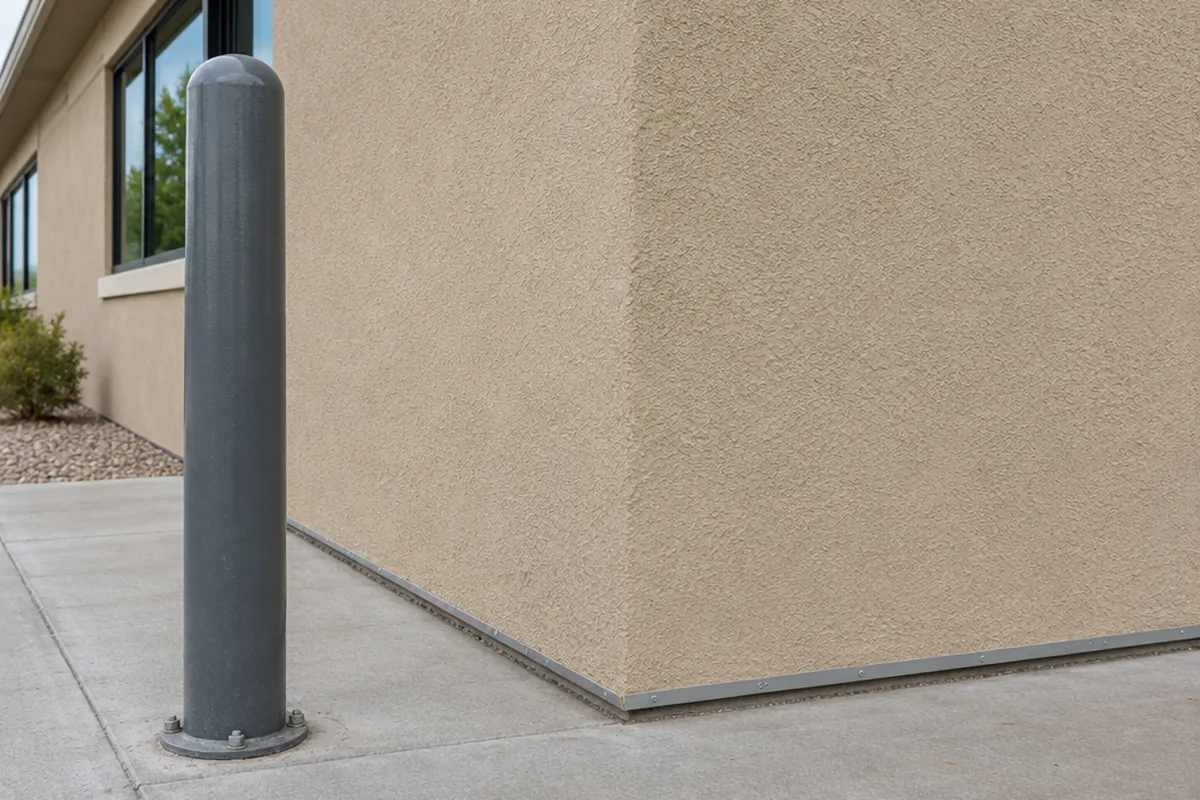
Hollow or bulging stucco above a walkway should be blocked off, since a loose section can drop. Send photos and the wall height, and we plan the visits. Wood fascia, trim bands and soffits on the same building are fascia, trim and soffit repair. If the wall is due for color after repairs, pair this with exterior painting for commercial buildings.

Send photos of each damaged area and tell us the wall height and what is in front of it.

We tap-test the wall and give you a written scope, a price and the dates for each coat.

The patch is built in three cured coats, textured, painted and photographed for your records.
The work is backed in writing by our workmanship warranty and done by a Kaminskiy-certified, background checked technician.
On a framed wall, stucco is a system: water-resistive paper, metal lath, a scratch coat keyed into the lath, a brown coat that makes the wall flat, and a thin finish coat that carries texture and sometimes color. The whole thing is under an inch thick. Water gets behind it at cracks, windows and the top of the wall, and leaves through the weep screed.
Hairline cracks are shrinkage and can be sealed and painted. A cracked rectangle around an old patch means the patch was not tied into the lath. Diagonal cracks from window and door corners follow movement in the framing. Cracks wide enough to take a coin, or with one side higher than the other, need an engineer's opinion before any plaster.
A patch shows for three reasons: the edge was feathered instead of cut square, the texture was troweled differently, or new paint sits beside old. We cut clean edges, match the float or dash pattern on a sample area, and paint the wall to a break. Fresh cement plaster also needs to cure before paint, and the coating's data sheet sets that wait.
Knock on the wall. Cement stucco sounds solid and feels like stone. EIFS sounds hollow and gives slightly, because it is a thin coating over foam board. The two are repaired in different ways with different materials. We repair cement stucco. If your building is EIFS, we tell you at the first visit and you call an installer trained in that system.
A parapet is the short wall that stands above the roof line, and weather reaches it from three sides. Its top is the weak point. A flat stucco cap cracks, a metal coping opens at its joints, and water travels down inside the framing to show as stains or blisters several feet lower. On any wall with staining high up we check the cap and the coping joints first, then rebuild the cap with a slope so water leaves it.
Large stucco walls are divided by metal control joints so shrinkage and movement have a planned place to go. Where a joint was left out, or plastered over in an earlier repair, the wall makes its own, usually a long straight crack. Sealing that crack with a flexible sealant and painting the wall is often the right repair. Packing it with hard patching material invites a new crack right beside the fill.
Can't find your answer? Call 855-695-1195 and ask us anything.
Call 855-695-1195Several visits spread over days to weeks, not an afternoon. A patch over lath is three coats, and each needs cure time before the next, so the calendar depends on the weather and the curing method. We give you the return dates with the written scope and do not promise a faster cure.
We match the texture by reproducing the float, dash or lace pattern on the finish coat. Color is matched by painting the repaired wall face to a corner or joint. Integral-color stucco that was never painted is harder to blend, and we show you a sample before finishing.
No. EIFS is a foam-backed system with its own manufacturer repair methods. We work on traditional cement stucco. If a tap test at the first visit shows the wall is EIFS, we stop and tell you, and the repair goes to an installer trained in that product.
Not always. Hairline cracks in a painted wall often stay dry behind. Cracks at parapet tops, window corners and the base of the wall are the ones that carry water. Stains, blistered paint or a hollow sound near a crack tell us water is getting in.
Because something keeps hitting it. A rebuilt corner is as strong as the original, which was not strong enough for carts and bumpers. After the repair, a steel corner guard or a bollard set in front of the corner is what stops the cycle.
The size and number of patches, height and access, how much lath, paper and trim has to be replaced, the texture, and how far the paint must be carried to blend. Several return visits are built into the price. You see it in writing before we cut.
Keep vehicles and stored items away from the wall on work days and off the patch while it cures. We cone off the area, protect doors and paving below, and schedule mixing and cutting outside the tenant's busiest hours.
A weep screed is the metal strip along the bottom edge of a stucco wall that lets water trapped behind the plaster drain out. The International Building Code, section 2512.1.2, places it at least 4 inches above soil or 2 inches above paving. When planters or new concrete bury it, the base of the wall stays wet and the stucco there turns soft.
Not reliably. The International Building Code, section 2512.4, has cement plaster applied above 40 degrees Fahrenheit, and a fresh coat has to stay damp while it cures without being washed out by rain. We watch the forecast, cover a new coat or move the visit when frost or a storm is due, and send the changed return dates in writing.
Add the wall height, the number of spots and what sits in front of each one. We reply with a scope and the dates for each coat. Quick questions: 855-695-1195.
We cut it back, rebuild it in three cured coats and paint it to match. Dates in writing.
We answer in under three rings, 24/7.No price games. You get a clear written quote before any work begins, backed by our workmanship warranty.
