 BBBAccredited Business

Kaminskiy Care and Repair handles fire-rated door installation as replacement in kind: labeled fire doors and frames in corridors, stairwells and unit entries. We also correct the items a fire door inspection report lists: doors that do not close, latches that do not catch, gaps that are too wide, missing parts. Work is scheduled so a rated opening is not left without its door. We do not perform or sign the formal inspection, and the local fire authority has the final word. Fire door work sits inside our commercial door and hardware service line.
Electrical, boiler, trash and storage rooms often sit behind rated doors that staff treat as ordinary ones. We find extra holes from old hardware, missing latch bolts and doors trimmed short. Where a part can be replaced under the label we replace it; where the door itself is compromised we replace the door. A utility door with no label is ordinary back-of-house door repair.
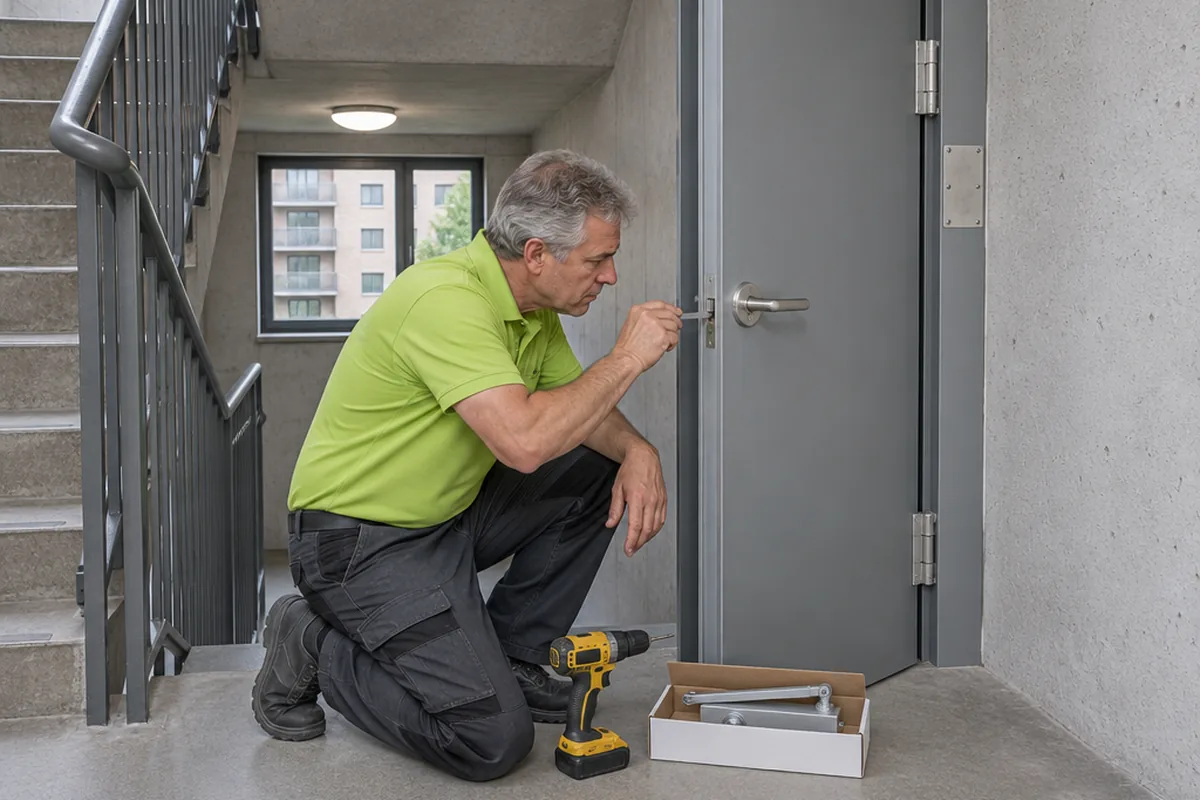
Stair doors take the most traffic and the most abuse. Closers get disconnected, wedges get kicked under the bottom, and latches are taped back for move-ins. We remove the hold-opens, replace the closer or latch with hardware listed for fire doors, and confirm the door shuts and latches from fully open. Closer work in general lives on our door closer page.
In many buildings the door between a unit and the corridor carries a label, and so does its frame. When one is damaged at turnover, it is replaced with a door of the same rating, not a stock slab from the lumber aisle. Unrated bedroom and closet doors are handled as tenant unit door replacement.
We photograph the label on the hinge edge or top of the door and the one on the frame, and note the rating, the maker and any painted-over or missing plate before quoting.
The replacement door, frame or hardware is ordered to the rating and type on the label. Hinge, lock and closer preps are made by the factory or under its procedure, not improvised on site.
The work is timed so the opening has a closing, latching door again before we leave. In an occupied residential building we post notice through the manager and keep the stair usable.
Clearances are measured from the pull side, the door is closed from fully open several times, and photos of the labels, the gaps and the latch go to you for the inspection file.
The International Building Code (2021, section 716) has fire door assemblies labeled by an approved agency and installed to NFPA 80. Section 716.2.6.1 has fire doors latching and self-closing or automatic-closing. Its Table 716.1(2) pairs a 1-hour corridor wall with a 20-minute door and a 2-hour stair enclosure with a 90-minute door. Many jurisdictions adopt the IBC with amendments, so the rating on your existing label is the one we match.
NFPA 80 limits the clearance under a swinging fire door to 3/4 inch. Along the top and both edges it calls for 1/8 inch, give or take 1/16, on steel doors, and no more than 1/8 inch on wood doors, measured from the pull face. Those figures are quoted from the 2010 edition as reproduced on a state fire marshal's inspection form; your jurisdiction may enforce a later edition.
NFPA 80 (section 5.2.1 in the 2010 edition) has fire door assemblies inspected and tested at least once a year, with a signed written record kept for the authority having jurisdiction. The International Fire Code (2021, section 705.2) adds that fire doors shall not be blocked or modified. Both are model documents that jurisdictions adopt, and the fire official has the last word. The owner arranges the inspection; we repair what it finds, including failed exit devices.
Sources for the rules on this page: International Building Code (2021), section 716 and Table 716.1(2); NFPA 80 (2010 edition), as quoted on the Kansas State Fire Marshal Fire Door Checklist, Form 817; NFPA Inspection Checklist for Swinging Doors with Builders Hardware (NFPA 80, 2019), South Carolina State Fire Marshal; International Fire Code (2021), sections 705.2 and 705.2.4; 2010 ADA Standards for Accessible Design, section 404.2.9.
We match the label, keep the factory preps and hang the door so it closes and latches every time without help.
Most of our fire door work starts with a report. The inspector lists doors that do not latch, closers that have failed, gaps beyond the limit, missing screws and open holes. We work the list in order, replace parts with listed hardware, replace the doors that cannot be saved, and return the list with a photo beside every line.
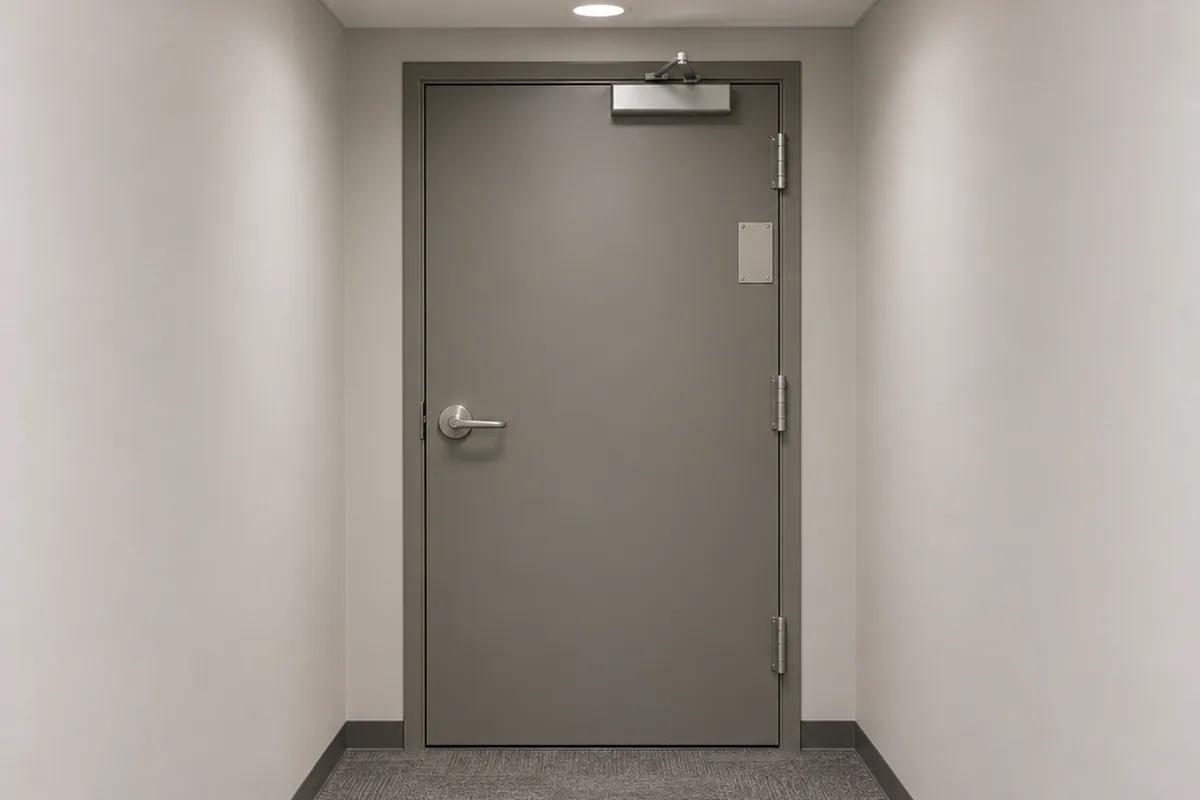
Every one of these appears on the checklist an inspector carries. Some are a part swap; some mean a new door. A bottom gap alone may be solved at the sill, which we cover under threshold replacement, provided the parts are listed for a rated opening.

Send the inspection report or photos of the door, its label and the frame label.

We confirm ratings and sizes on site and return a written scope listing each door and the correction.

Doors and hardware are replaced, each opening is tested closed and latched, and the photo record is sent to you.
The work is backed in writing by our workmanship warranty and done by a Kaminskiy-certified, background checked technician.
Open the door and look at the hinge edge, between the top and middle hinges, or along the top. The label is a small metal plate or an embossed stamp naming the listing agency and the rating in minutes or hours. The frame carries its own. If either has been painted solid or removed, tell us; a missing label is itself an inspection finding, and it changes how the door can be replaced.
Drilling for a new deadbolt, cutting in a viewer or a mail slot, trimming the bottom to clear new flooring, screwing on a sign: each can count as a field modification. NFPA's own inspection checklist looks for open holes, signs of modification and hardware not labeled for the door. It also limits signage to 5 percent of the door face, attached with adhesive. Ask before anyone drills.
A failed closer, a worn latch, a missing hinge screw or tired gasketing can be replaced with listed parts and the door stays in service. A door that is delaminating, rusted through, cut short or full of abandoned hardware holes generally cannot be made right in the field. Then the honest fix is a new labeled door, and sometimes its frame.
A rated door does its job only when it is shut. The fire code calls for swinging fire doors to close from the full-open position and latch automatically. If a door must stand open for daily traffic, the answer is a listed hold-open that releases on a fire alarm signal, installed by a licensed fire alarm contractor, not a wedge. We can hang the door; that device is their work.
Can't find your answer? Call 855-695-1195 and ask us anything.
Call 855-695-1195No. The periodic inspection under NFPA 80 is done and signed by a qualified inspector the owner hires. Our part comes after: we repair or replace what the report lists and give you photos and a parts record to attach to it. We can also flag obvious problems during other door work.
Not freely. Cutting a labeled door can void its label, and the allowance depends on the door type and the maker's procedure. The clearance under the door is also limited. Tell us about flooring changes before they happen so the door and the sill can be planned together.
Look for a label on the hinge edge or the top of the door and another on the frame. Doors to stairwells, most corridor doors in apartment and office buildings, and many mechanical room doors are rated. If the labels are painted over, we can often expose them carefully; if they are gone, the building plans or the fire official can say what the opening needs.
Only hardware that is listed for use on fire doors, installed in preps the label allows. The door must still latch by itself every time it closes. Tell us the rating and what you want to add, and we will say whether it can be done on that door or needs a different one.
A fire door needs a closer strong enough to latch it against air pressure in the stair, and the accessibility standards exempt fire doors from the 5 pound opening limit that applies to other interior doors. A worn hinge or a rubbing edge makes it worse. We correct the friction first, then set the closer no stronger than the door needs.
The rating, the size, whether the frame is replaced, and the hardware drive the price. Rated doors are ordered to the opening, so there is lead time. You receive a written scope listing each door, its rating and the price before anything is ordered.
At least once a year. NFPA 80 (section 5.2.1 in the 2010 edition) has fire door assemblies inspected and tested not less than annually, with a signed written record kept for the authority having jurisdiction. The owner engages a qualified inspector for that, and we repair what the report lists. Your jurisdiction may enforce a later edition.
We replace in kind, use listed parts and document the work, but acceptance is the fire official's decision, not ours. We do not promise an outcome on anyone's inspection. What you get is a clear record of what was wrong, what was installed and how each door tested when we finished.
Attach the inspection report or photos of each door and its labels, and tell us when the building is quietest. We reply with a written scope by door number. Prefer to talk? 855-695-1195.
Labels matched. Listed hardware. A photo record for every door.
We answer in under three rings, 24/7.No price games. You get a clear written quote before any work begins, backed by our workmanship warranty.
