 BBBAccredited Business

Kaminskiy Care and Repair handles vinyl plank installation and small-area tile installation for commercial and multi-unit property. We lay luxury vinyl plank and tile in rental units, office suites and small retail, glued down or floating to suit the traffic, and set ceramic and porcelain tile in restrooms, entries and break rooms. Slab moisture and flatness are checked first, and old flooring from the asbestos era is tested before removal. Soft wood floors are fixed first under subfloor repair. New floors are one part of the flooring services we provide to commercial properties.
Units that had carpet or worn sheet vinyl are switched to plank between residents. The calendar is tight and the slab or subfloor is rarely flat. We pull the old floor, fix what is under it, and lay one standard plank per property so every unit matches and spare boxes fit any unit. Work that goes beyond the floor is tenant unit renovation.
Office and shop floors carry chair casters, loaded carts and heavy fixtures. Floating plank can shift and gap under those loads in a large open room, so we normally glue plank or tile down there, roll it, and keep fixtures off until the adhesive has set. Where the new floor meets an old one, a reducer or transition strip finishes the edge.
Where floors are mopped daily, hosed, or walked on with wet shoes, sheet goods curl and plank edges swell. We remove the old floor, flatten or slope the substrate, and set porcelain tile with a base that turns up the wall. Break rooms often get a tile backsplash behind the sink as well, sealed where it meets the counter.
We measure the rooms, lift a corner of the existing floor and identify the slab or subfloor. The age of any old sheet goods or tile is noted for sampling.
Concrete is tested for moisture by the method the flooring maker names. The floor is checked with a long straightedge and the high and low spots are marked.
Old flooring comes out, ridges are scraped, dips are filled and the surface is cleaned. Plank cartons sit in the conditioned space for the stated time. Tile gets a dry layout so cuts balance.
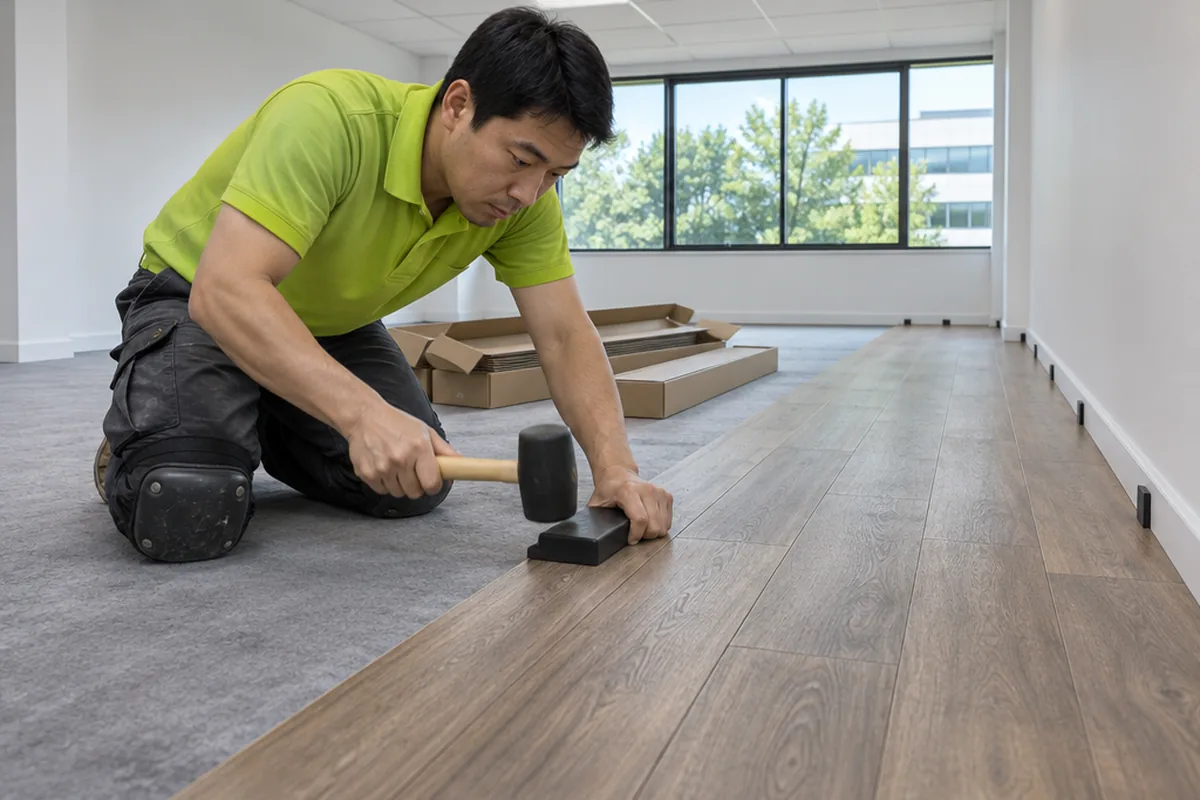
Planks are laid from a squared line and glue-down floors are rolled. Tile is set, grouted and jointed. Base and transitions are finished, and labeled spare cartons stay with you.
ASTM F2170 is the standard test method for determining relative humidity in concrete floor slabs using in situ probes. The standard notes that excess slab moisture can cause debonding and peaking of a floor covering, that manufacturers generally require moisture testing before installation on concrete, and that a result describes the slab only at the time and in the locations tested. We test where the product calls for it and keep the readings with the job record.
Under OSHA's construction rule at 29 CFR 1926.1101, vinyl and asphalt flooring installed no later than 1980 is treated as containing asbestos, with its backing and adhesive, until it has been tested and shown otherwise, and sanding it is prohibited. EPA guidance adds that when such a floor needs replacing, new floor covering can go over it where possible. So an older floor is sampled first, and covering it intact is often the plan.
Three published references shape a tile floor. ANSI A326.3 is the test for wet dynamic coefficient of friction, with 0.42 or higher as the value for level interior floors expected to be walked on wet. The Tile Council of North America's Handbook detail EJ171 covers movement joints. A TCNA technical article cites the Handbook's substrate limit of 1/4 inch out of plane in 10 feet. TCNA adds that the friction value shall not be the only factor in choosing a floor.
Sources for the rules on this page: ASTM F2170, Standard Test Method for Determining Relative Humidity in Concrete Floor Slabs Using in situ Probes; OSHA asbestos standard for construction, 29 CFR 1926.1101(g)(8) and (k)(1); U.S. EPA, Protect Your Family from Exposures to Asbestos; Tile Council of North America, Dynamic Coefficient of Friction FAQ (ANSI A326.3); Tile Council of North America, FAQ on movement joints (Handbook detail EJ171); Tile Council of North America technical article, Large Format Tile: A Wide Demand for Narrow Grout Joints.
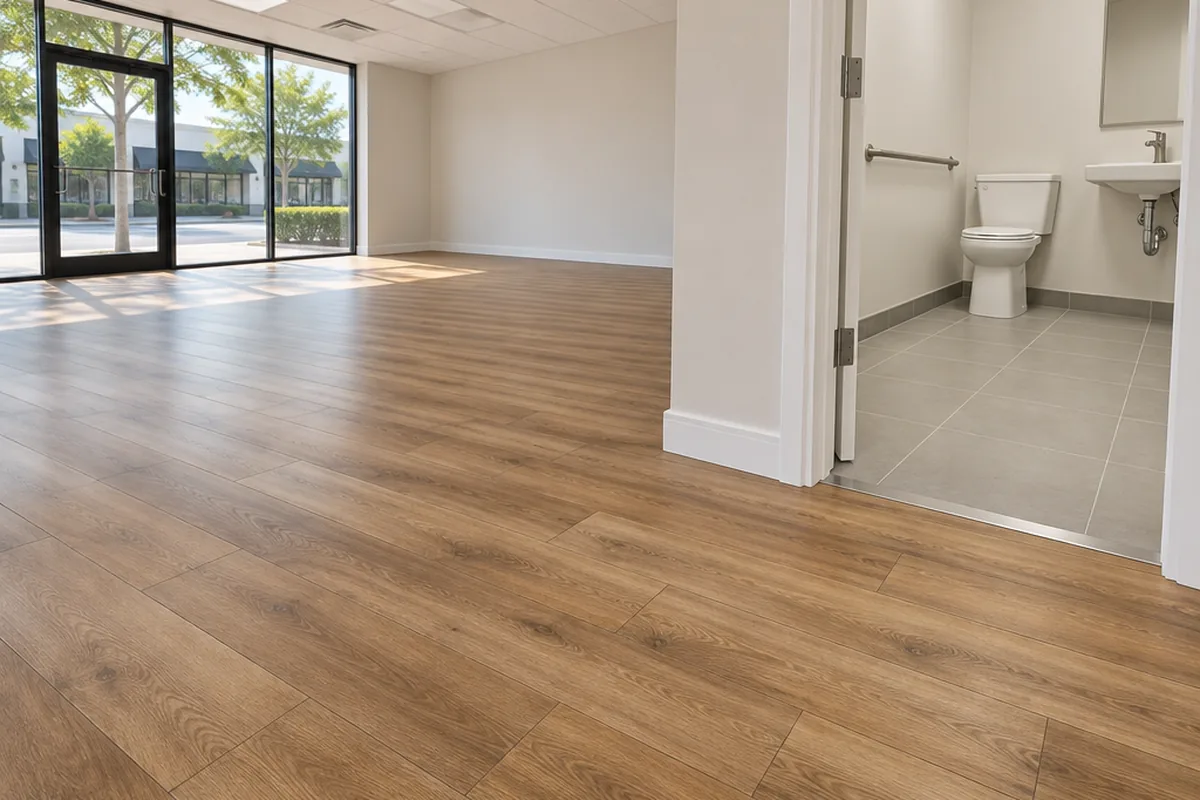
Commercial tile installation, as we do it, means new ceramic or porcelain tile in a restroom, an entry vestibule, a break room or a backsplash, not a lobby. Kaminskiy Care and Repair removes the old floor, flattens the substrate, snaps a layout so cuts balance at both walls, sets the tile in full mortar contact and grouts it. Soft movement joints go at the perimeter and where sun or moisture calls for more, following the Tile Council of North America's EJ171 guidelines. For wet areas we check the tile's published wet DCOF from the ANSI A326.3 test. The room stays closed until the mortar has cured. Large lobbies, large-format tile and stone go to a tile contractor's crew.
For apartment turnovers we install one standard floating plank per property, so every unit matches and a damaged board years later can be swapped from stored cartons. Kaminskiy Care and Repair works from the turnover calendar: material is ordered ahead and stored on site, the old carpet or sheet floor comes out, the subfloor is checked for soft spots, and the plank goes down with the heating or cooling running. Bathrooms and kitchens with water damage get the subfloor repaired before any plank is laid. We do not quote a fixed number of units per week, because prep varies from unit to unit.
A new floor can often go over the old one, provided the old floor is sound, flat and fully bonded and the added height works at the doors. Many planks may be laid over well-bonded sheet vinyl or tile, and new tile can be set over old tile once its surface is prepared. An overlay avoids demolition noise and avoids disturbing an older resilient floor, which EPA guidance favors where possible. Carpet, cushioned vinyl, and hollow or cracked tile must come out first. We check door clearances, the toilet flange and appliance openings before recommending it.
Plank shows every ridge and damp spot under it, and tile follows the surface it is set on. Most of our time goes into the floor below.
Floating plank clicks together over an underlayment and suits rental units, where speed and easy replacement matter. Glue-down plank and tile are bonded to the floor and suit offices and shops, where rolling loads, heavy fixtures and big rooms would push a floating floor around. We recommend one for each space and explain why in the scope.
If an existing plank floor is gapping or peaking, the cause is usually moisture, an uneven floor or no room to expand. Laying a new floor over the same conditions repeats it. If a tile floor is mostly sound, repairing the tile and grout may be all it needs.

Send the floor plans or room sizes, the current flooring and your turnover or closing dates.

We inspect, test where needed, and price the prep and the install as separate lines.

The floor is prepped and laid on the agreed dates, and labeled spare cartons stay with the property.
The work is backed in writing by our workmanship warranty and done by a Kaminskiy-certified, background checked technician.
The wear layer is the clear film over the printed pattern, measured in mils, which are thousandths of an inch. It is what stands between foot traffic and the picture of wood. Products sold for commercial use carry thicker wear layers than residential ones, and the manufacturer's commercial warranty states where the product may be used. We ask for that warranty sheet before recommending a plank.
Vinyl grows and shrinks with temperature. Cartons brought in cold from a truck and laid at once will expand later and peak at the joints. Manufacturers state how long the material must sit in the space and the temperature range the room must hold, before and after the install. That means the heating or cooling has to be running in a vacant unit.
Pallet jacks, hospital beds, safes and vending machines concentrate weight on small wheels and feet. On a floating floor they can break the click joints. On a glued floor they can squeeze adhesive out before it sets. Tell us what rolls or sits on the floor. It changes the product, the adhesive and how long the area stays empty.
A click joint is a thin tongue of vinyl that snaps when it flexes over a dip, and glued plank shows every ridge through its surface. We fill low areas and check with a straightedge. ASTM F710, the standard practice for preparing concrete floors to receive resilient flooring, states that it does not supersede the manufacturer's written instructions, so each product's own limits for flatness and moisture govern the job.
Porcelain is dense, absorbs almost no water and suits restroom and entry floors. Glazed ceramic is lighter duty and fine for walls and backsplashes. Quarry tile is thick, unglazed and made for kitchens. For a floor, ask for a tile rated for commercial traffic with through-body color or a hard glaze, so chips and wear paths do not show white. A matte surface holds traction better than a polished one.
Adhesive, mortar and grout gain strength over hours and days. Rolling loads on fresh glue squeeze it out, foot traffic on new tile shifts it, and washing too soon weakens cement grout. The product data sheets give the waits for walking, for carts and for wet cleaning. We post the room and give those times to your movers and janitorial crew in writing.
Can't find your answer? Call 855-695-1195 and ask us anything.
Call 855-695-1195The right product is. Look for a plank or tile the manufacturer warrants for commercial traffic, with a wear layer to suit. Rental units and small offices do well with good plank. A grocery aisle or a busy corridor may be better served by a heavier commercial tile, and we will say so.
Most rental units get floating plank. It installs quickly between residents, and a damaged board can be replaced later by unlocking the rows back to it. Glue-down makes sense on a ground-floor slab with rolling loads, or where the floor must stay very thin at the doors.
Yes, where the flooring manufacturer requires it, which is usual for glued floors on concrete. In situ relative humidity testing under ASTM F2170 uses probes set in drilled holes and takes time to read, so it is scheduled ahead of the install. If the slab is too wet, we stop and explain the options.
Often, yes. Sound, flat sheet vinyl or tile can be covered by many products, which also avoids disturbing an older floor. Carpet and cushioned or loose flooring must come out. The added height matters at doors, appliances and transitions, so we check those before recommending an overlay.
Rooms, not buildings: a restroom, a vestibule, a break room, a backsplash, a corridor section. When a project runs to a large lobby, large-format tile or stone, a tile contractor with a crew will do it faster and better, and we would rather tell you that than stretch.
A porcelain tile the manufacturer rates for interior wet use, with a published wet DCOF value from the ANSI A326.3 test, is the starting point. A matte or textured surface holds traction better than a polished one. No rating guarantees that nobody slips, because cleaning, footwear and contaminants matter as much as the tile.
Yes, when the floor is stiff enough. Tile needs a backer board or membrane over the plywood, and joists that do not flex. We check for bounce and soft spots first. A weak floor is reinforced or repaired before tile, or we recommend a resilient floor that tolerates movement.
That depends on unit size, the prep each floor needs and how the moves are scheduled, so we do not quote a fixed number. Give us the turnover calendar and we build an install sequence around it, with material ordered ahead and stored on site so no unit waits on a delivery.
It depends on square footage, the product, and above all the prep: removing old flooring, flattening, moisture testing and any subfloor repair. Tile adds demolition and many cuts around fixtures. The scope separates prep from installation so you can see what the floor itself costs and what the building's condition adds.
A floating floor can be walked on as soon as it is finished. A glued floor needs the adhesive's set time before foot traffic and longer before rolling loads. New tile stays closed for the cure time on the mortar and grout data sheets. We write those times into the schedule so movers and tenants are not booked too early.
Send room sizes or floor plans, the flooring there now, and your dates. We schedule a look at the slab or subfloor and follow with a written scope. Call 855-695-1195.
Tested slab. Flat prep. A standard floor your next repair can match.
We answer in under three rings, 24/7.No price games. You get a clear written quote before any work begins, backed by our workmanship warranty.
