
 BBBAccredited Business

Kaminskiy Care and Repair handles panic bar installation and service on commercial egress doors, covering rim and vertical-rod exit devices. A technician replaces a failed exit device in kind, fits new ones on prepared doors, and corrects dogging, strikes, rods and trim so the door latches and releases on a single push. Whether a door must have panic hardware is the building official's decision. Devices wired to a fire alarm or access control system need a licensed low-voltage contractor for that part. Exit devices are covered within our commercial door and hardware services for occupied buildings.
The back exit of a store gets shouldered open with full arms and left to slam. The latch wears, the strike loosens and the door starts blowing open at night. We replace the latch head or the whole device in kind, reset the strike and shim it so the bolt seats, then load the door by hand to prove it holds.
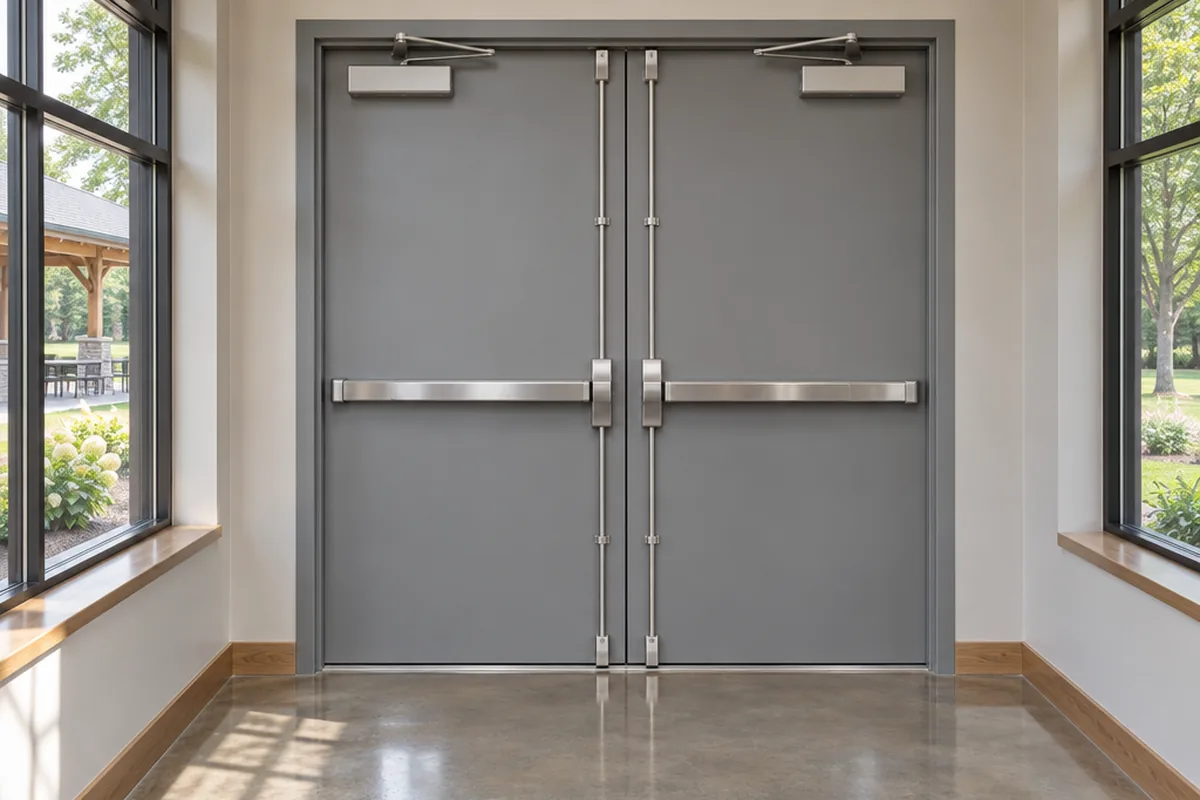
Double doors on a community room often use vertical rods that latch into the frame head and the floor. Rods bend, bottom latches fill with grit and one leaf stops catching. We clean and re-time the rods, replace bent ones and reset the floor strike. Exit hardware on courtyard and pool fence gates is the gate panic hardware service.
Front doors are commonly held unlatched during business hours with a dogging key, then left that way by accident. A worn dogging mechanism will not hold, or will not release. We repair or replace it and show staff how to lock up. Glass entry doors with concealed rods are adjusted under storefront door service.
Send the inside of the door with the bar, the outside with its trim, and the edge showing the latch. Tell us if the door is a single or one of a pair, and whether it has a label.
A device cannot latch a door that sags or binds. Hinges, closer and frame are checked first, and the strike is examined for wear and loose screws.
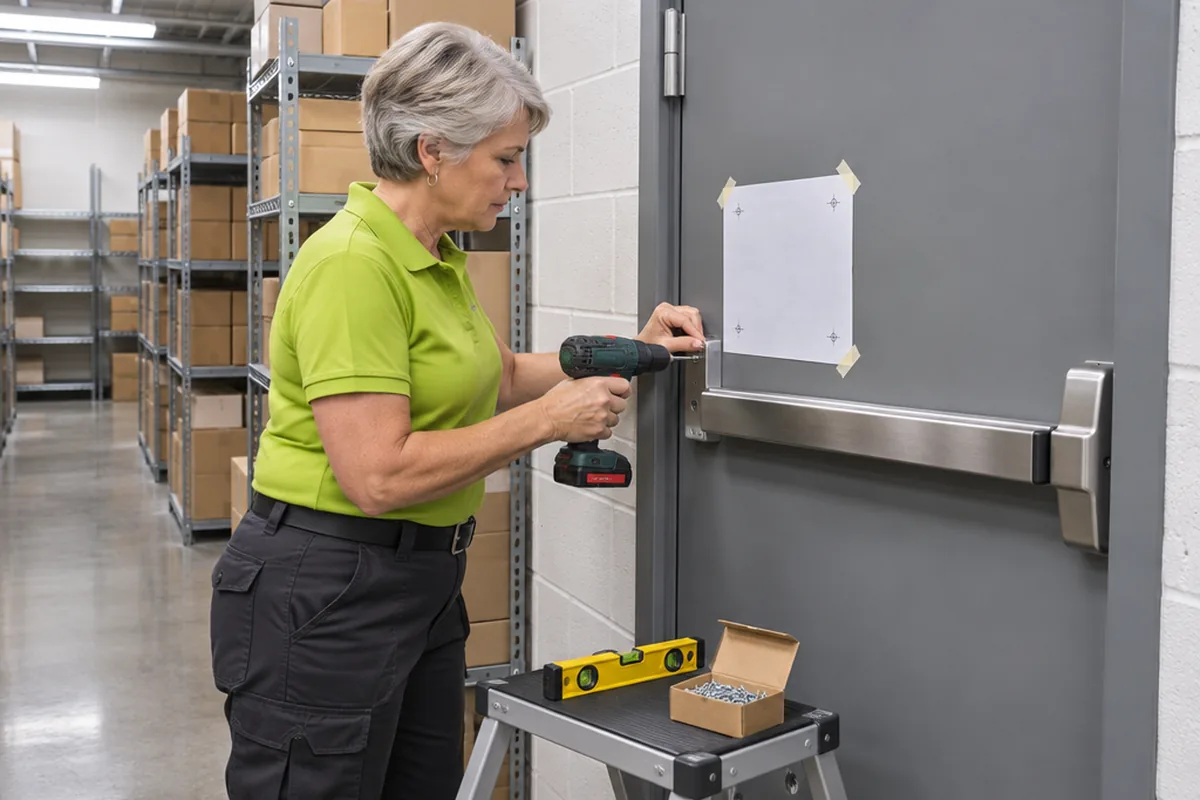
A like-for-like device reuses the existing preps. A new install on a prepared door follows the maker's template for height and backset. Anything beyond the written scope waits for your approval.
We close the door from fully open, confirm it latches, press the bar with a force gauge and try the outside trim. Results and photos go on the work order.
The International Building Code (2021, section 1010.2.9) allows no latch or lock other than panic or fire exit hardware on swinging doors serving a Group H occupancy, or rooms with an occupant load of 50 or more in Group A or E occupancies. Section 1010.2.9.2 adds certain large electrical rooms. States and cities adopt the IBC with their own changes, so ask the official when a space changes use, adds seating or is combined with the suite beside it.
IBC section 1010.2.9.3 calls for panic hardware listed to UL 305, an actuating bar that spans at least half the width of the door leaf, and a release force of no more than 15 pounds. Section 1010.2.3 places operating hardware between 34 and 48 inches above the floor. Where that code is in force, we mount to the maker's template inside that range and measure the release force afterwards.
On a labeled fire door the device must be fire exit hardware, which the IBC has listed to both UL 10C and UL 305. It has no mechanical dogging, because a fire door has to latch each time it closes. Swapping a plain panic bar onto a rated stair door is a common mistake. Rated openings are covered on our fire-rated door installation page.
Sources for the rules on this page: International Building Code (2021), sections 1010.2.3, 1010.2.9, 1010.2.9.2 and 1010.2.9.3; OSHA exit routes standard, 29 CFR 1910.36(d)(1); International Building Code (2021), section 716.2.6.2.
An exit device has two jobs that pull against each other. We set it so the door holds shut and still releases without effort.
The rim device is the simplest and most common panic bar: one latch at the door edge that catches a strike on the frame. When the latch head wears or the bar sticks, we replace the device with one of the same type and function, reuse the existing holes where they line up, fit a new strike and set the outside lever or pull.
A device that sticks is a life-safety item, so it should not wait for the next budget cycle. Most are corrected with a part or a like-for-like replacement, booked outside your open hours. A dark sign above the door is a separate fix: see exit sign and emergency lighting service.

Send photos of the bar, the latch edge and the outside trim, and tell us what the door serves.

We give you a written scope and price for the repair or the replacement device.

The device is fitted, push-tested with a gauge, and the readings and photos are sent for your file.
The work is backed in writing by our workmanship warranty and done by a Kaminskiy-certified, background checked technician.
A rim device latches at the door edge into a surface strike. A vertical-rod device latches at the top, and sometimes the bottom, through rods on or inside the door; it is used on pairs with no center post. A mortise device drives a lock body set into the door edge. Each needs different preps, so the replacement has to be the same family unless the door is changed.
Dogging holds the bar depressed and the latch retracted, turning the door into a push-pull door for the business day. It saves wear on the latch and lets people in without turning a handle. A hex key or a cylinder sets it. It should never be used to hide a latch that will not catch, and it is not offered on fire exit hardware at all.
Usually the device is fine and the door has moved. A sagging hinge drops the latch below the strike. A slow closer lets the door stop short. A loose strike shifts under impact. On rod devices, the top latch may catch while the bottom rod drags the floor. We correct the door first; replacing the device without doing that buys a few weeks. Bent frames and rusted rear doors are back-of-house door repair.
The device always lets people out. What the outside does is a separate choice: a blank plate for exit only, a pull with a cylinder, or a lever that locks with a key. The trim must match the device. For keyed and code entry on doors without panic hardware, see keypad lock installation.
Can't find your answer? Call 855-695-1195 and ask us anything.
Call 855-695-1195That depends on the occupancy type and how many people the room serves, and the building official makes the call. The model building code ties it to assembly and educational spaces at an occupant load of 50 or more and to hazardous occupancies. If your use or layout has changed, ask before the next inspection. We install what the official or your design professional specifies.
Fire exit hardware is a panic device that is also listed for a fire door. The International Building Code (2021, section 1010.2.9.3) has panic hardware listed to UL 305 and fire exit hardware listed to both UL 10C and UL 305. The fire version has no mechanical dogging, since a rated door must latch every time it closes. A labeled door gets only that kind.
Yes, in nearly every case. A device of the same type reuses the door's existing preparation. If a different style is wanted, extra holes may show, and on a labeled fire door new holes may not be permitted. We check the door and its label before recommending a change.
Not while anyone is inside. Codes and OSHA's exit route rule expect an exit door to open from within without a key, tool or special knowledge. Security is added from the outside instead: a guarded latch, solid trim and a door that closes fully. We set doors up that way.
We mount them and set the mechanical parts. Connecting an electrified device to power, a fire alarm panel or an access control system is low-voltage work for a licensed contractor in that trade. A battery-powered local exit alarm that needs no wiring is something we can install as a unit.
Exterior doors swell, frames shift and the latch binds against the strike under pressure. Dirt and old grease inside the device stiffen too. Cleaning, a strike adjustment and the right lubricant usually restore it. A device with a worn latch head or a cracked housing is replaced.
The type of device, whether rods are involved, the outside trim and whether the door needs repair first all affect the price. Fire exit hardware costs more than a plain panic device. You receive a written figure before the work is scheduled.
Close the door fully, check that it is latched by pulling from outside, then push the bar with one hand near the latch end and again near the hinge end. It should release both times without a second push. Add the test to a monthly walk and call when a door fails it.
Send photos of the inside bar, the latch edge and the outside trim, with the address and your open hours. We return a written scope. If an exit will not open at all, phone instead: 855-695-1195.
Replaced in kind or newly fitted, then push-tested and recorded.
We answer in under three rings, 24/7.No price games. You get a clear written quote before any work begins, backed by our workmanship warranty.
