
 BBBAccredited Business

Kaminskiy Care and Repair closes a property punch list item by item: move-in and move-out walkthroughs, lender and insurance inspection findings, HOA and city notices, and due-diligence lists before a sale. Each line is priced, repaired and photographed. Lines that belong to a licensed trade, an engineer or a permit are flagged, never skipped. A list too long for one appointment runs as a multi-day project. Lists that repeat every quarter suit a scheduled maintenance program. Punch lists are the closing step in our commercial remodeling and property repair services.
A lender's property condition report, an insurance loss-control visit or a buyer's inspection produces numbered findings: loose handrail, missing downspout, trip edge at a walkway, damaged siding. We price each finding by its number, repair it and return a photo per number, which is the form the requesting party expects. Loose rails are covered in depth under railing and stair repair.
A code enforcement notice or an HOA letter names the condition and a date. Typical lines are a leaning fence, peeling trim, a broken gate, graffiti or a trash enclosure that will not close. We work the notice in date order and give you photos to send with your reply. Fence lines are covered under commercial fence repair.
A move-out walk or a new tenant's move-in sheet is a page of small things: a door that rubs, a missing outlet cover, a cabinet hinge, a blind, a running toilet. We clear the whole page in a round and photograph each fix for the unit file. Wall damage in volume is handled as turnover drywall patching.
Forward the report, notice or walkthrough sheet unchanged, with its numbering and any photos. We work from the source so nothing is lost in retyping.
Each line gets a price or a flag. Flags mean a licensed trade, an engineer, a permit or more information is needed, with the reason written beside it.
Lines are grouped by building and trade for efficiency but keep their original numbers. Dated deadlines and safety items go first, and a long list gets a day-by-day schedule.
The same list comes back with each line marked done, flagged or declined by you, and a dated photo per line.
Lenders and buyers of commercial real estate commonly order a property condition assessment under ASTM E2018, a standard guide built on a walk-through survey with document review and interviews. Its stated goal is to identify and communicate material physical deficiencies, and its product is a property condition report. It is an observation, not a repair specification, so many lines need a scope decision before they can be priced.
In California, a tenant may ask for an initial inspection before moving out, held no earlier than two weeks before the tenancy ends, and the landlord then gives an itemized statement of intended repairs. The landlord has 21 days after move-out to return the deposit with an itemized statement. Since April 1, 2025, landlords must photograph the unit after possession returns and before repairs, and again after repairs. Our before and after photos by line fit that record. Other states set their own rules.
States set their own point at which repair work needs a licensed contractor, often by the size of the job. In California, the Contractors State License Board ties that point to the combined labor and material value of the job, and also requires a license whenever a building permit is needed or employees do the work. Our California work is done under contractor license #1106209. In other states we tell you in writing what applies.
Sources for the rules on this page: ASTM E2018-24, Standard Guide for Property Condition Assessments: Baseline Property Condition Assessment Process; California Department of Real Estate, California Tenants guide: Moving Out (Civil Code 1950.5); California Contractors State License Board, What Kind of Contractor Do You Need; California Contractors State License Board, B General Building Contractor classification.
A multi-day project is any list or job that cannot be finished in a single appointment, and we run it as one managed job. One project lead holds a written scope and a day-by-day schedule, phases the work around tenants and business hours, and sees that each area is cleaned when the shift ends. A change is described, priced and approved in writing before it is built. Progress photos are sent as the work moves, and the certificate of insurance and vendor forms your building requires are handled before the start date. Larger projects fall under contractor licensing rules that differ by state; in California the work is done under license #1106209, and elsewhere we tell you what the state requires.
Phasing is a map and a calendar. The map divides the work into areas that can each be closed without stranding anyone: one stairwell of two, one restroom per floor, one wing of a suite. The calendar gives each area its dates and its notice to the people affected. Noisy, dusty and odor-producing steps are set for early mornings, evenings or weekends, exits stay open, and protection goes down before work and comes up after cleanup. Night and weekend phases take more labor but shorten the disruption, so we price both ways when the choice is real.
Changes on a longer job come from hidden conditions, owner requests and errors, and each is handled the same way: that item stops, it is photographed, and the change in scope, price and schedule is written and sent for approval while the other work continues. Paperwork is settled before day one. Most managed buildings ask a vendor for a certificate of insurance naming the owner and the management company, a vendor form and a tax document, plus elevator and loading reservations. Send your building's sample certificate with the list, since missing paperwork is a common reason a start date slips.
The person who wrote the list wants evidence, not assurances. Every line we close comes back with a dated photo against its original number.
Each line carries its own price so you can approve all of it or part. The work itself is grouped: all the door items in one pass, all the exterior carpentry in another, each building walked once. That grouping is what keeps a forty-line list from becoming forty trips. Deadline and safety lines are scheduled first, cosmetic lines last.
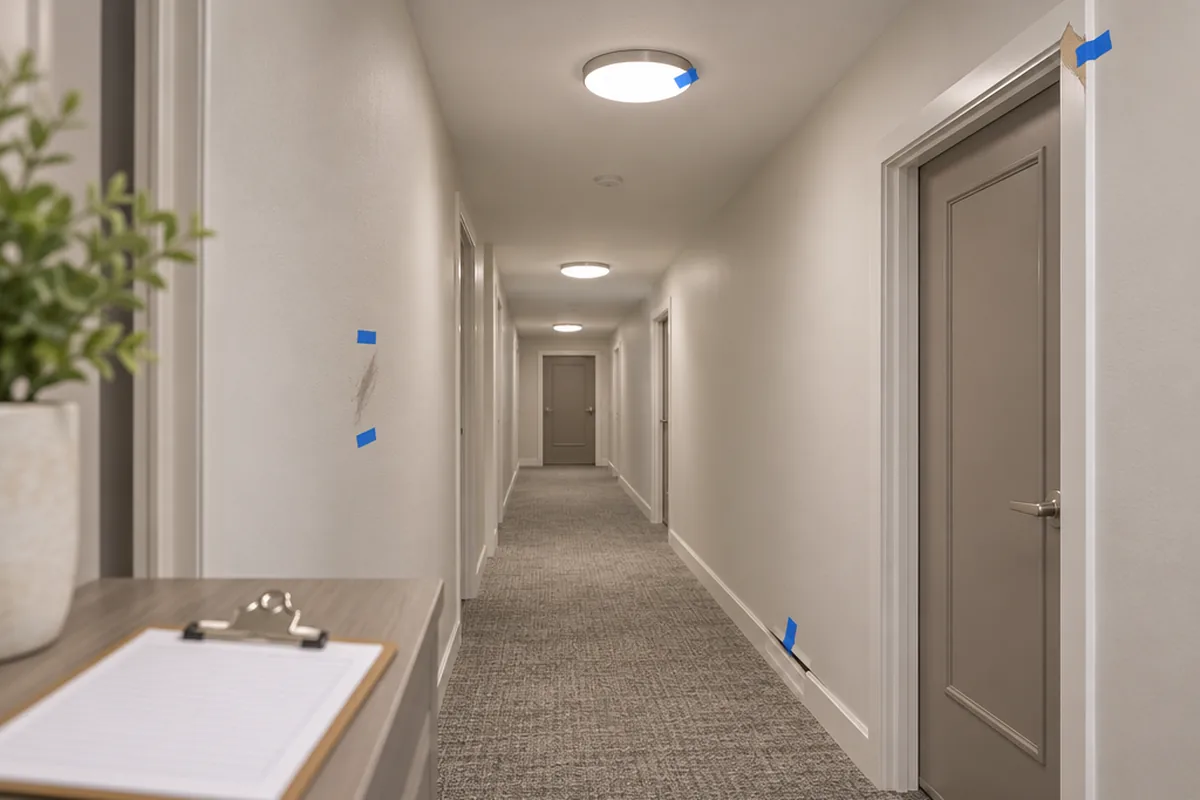
Whatever the source, the method is the same: keep the original numbering, price by line, flag what needs a license, repair the rest and return photos. Trip edges and lifted walkway surfaces are detailed under trip hazard repair.

Forward the report, notice or walkthrough sheet with the property address and the deadline.

We return the same list with a price on each line and flags on items for other trades.

Approved lines are repaired by route, and the list comes back marked with a photo per line.
The work is backed in writing by our workmanship warranty and done by a Kaminskiy-certified, background checked technician.
Lists get retyped, merged and renumbered, and then nobody can prove which finding a repair answered. Keep the source document's numbers from start to finish. If two lists overlap, cross-reference them without merging. Our scope, our photos and our marked return all use the inspector's own item numbers, so the person who wrote the list can check it off without calling anyone.
A finding like repair damaged siding at building C is an observation. To price it we need the location, the extent and the standard of repair. On a first pass we photograph and measure every vague line and write what we propose to do. You, or the inspector, confirm that the proposal answers the finding before work starts. That step prevents a second trip.
Order of work on a list follows three rules. Dated and safety items first: handrails, lighting, walking surfaces, exit doors. Then by route, building by building, so each area is disturbed once. Then by trade inside each building, carpentry before paint. Long-lead parts are ordered at the start so they do not hold the last few lines open.
A photo proves a repair when it shows three things: where it is, what was done and when. We take a wide shot that places the item, a close shot of the finished repair, and keep the date. For measured items, the tape is in the frame. The marked list and the photos travel together as one file, ready to forward to the lender, insurer, city or board.
A useful schedule shows more than start and finish. Look for the long-lead items and their order dates, the days a room or corridor is closed, cure and dry times between trades, inspection points if a permit is involved, and slack before your hard deadline. Ask what happens if a delivery slips. We build the schedule backward from your date and tell you at the start if the date does not fit.
A mixed list can be split among a painter, a carpenter and a door company, or handed to one vendor. Splitting looks economical until the handoffs: the painter returns because the carpenter was late, and nobody owns the line that sits between two trades. One vendor holding the whole list is accountable for the gaps. Lines that need a separately licensed trade are still flagged and scheduled inside the same calendar.
Can't find your answer? Call 855-695-1195 and ask us anything.
Call 855-695-1195Any punch list that says where and what: move-in and move-out walkthroughs, lender and buyer inspection reports, insurance loss-control recommendations, city code notices, HOA letters, and lists a manager writes on a property walk. The source does not matter.
Line by line. Each item gets its own price, so you can approve the whole list or choose lines. The work is then grouped by building and trade to keep labor down. Lines too vague to price are photographed and returned with a proposed repair for you to confirm.
They are flagged, never dropped. A line that needs a licensed electrician, a licensed plumbing contractor, a roofer, an engineer or a permit is marked with that reason against its original number. You can assign it yourself or ask us to coordinate the trade.
Send the notice as soon as you have it and tell us the date. We schedule dated lines first and say plainly at the start if a part's lead time or a licensed trade's calendar puts a line at risk, so you can ask for an extension with evidence of progress.
We return the original list marked line by line with dated photos, which is the form reviewers generally ask for. Acceptance is the reviewer's decision. If they want a specific form or a re-inspection, tell us at the start and we match the format.
Yes. We work the walkthrough sheet per unit and photograph each line before and after. Wall patching, paint, doors and cabinet repairs each have their own service pages for larger volumes, but a mixed page of small items is handled as one list.
We can walk a property with you and note repair items a technician can see, which is how many maintenance checklists begin. That is not an inspection report: it carries no opinion on code, structure or building systems. For those, hire an inspector, engineer or access specialist and send us what they find.
Any list or job that cannot be finished in a single appointment: several trades in sequence, work phased across floors or buildings, or sixty lines handled together. It gets one project lead, a written scope, a day-by-day schedule, tenant notices and progress photos.
Yes. Send your building's certificate requirements with the list, and we request a certificate from our insurer showing the parties your building names before the start date. Vendor registration forms are completed in the same step, since many buildings will not release keys or elevator time without them.
Usually, yes. States set their own rules on when a contractor license is required, generally tied to project value, permits and the trades involved. In California our work is performed under contractor license #1106209, a general building classification. For a property in another state, we tell you before pricing what that state requires and which parts go to separately licensed trades.
Send the report, notice or walkthrough sheet as you received it, the property address and the deadline. It comes back priced by line. Or call 855-695-1195.
Original numbers kept. A price per line. A dated photo for each one.
We answer in under three rings, 24/7.No price games. You get a clear written quote before any work begins, backed by our workmanship warranty.
