 BBBAccredited Business

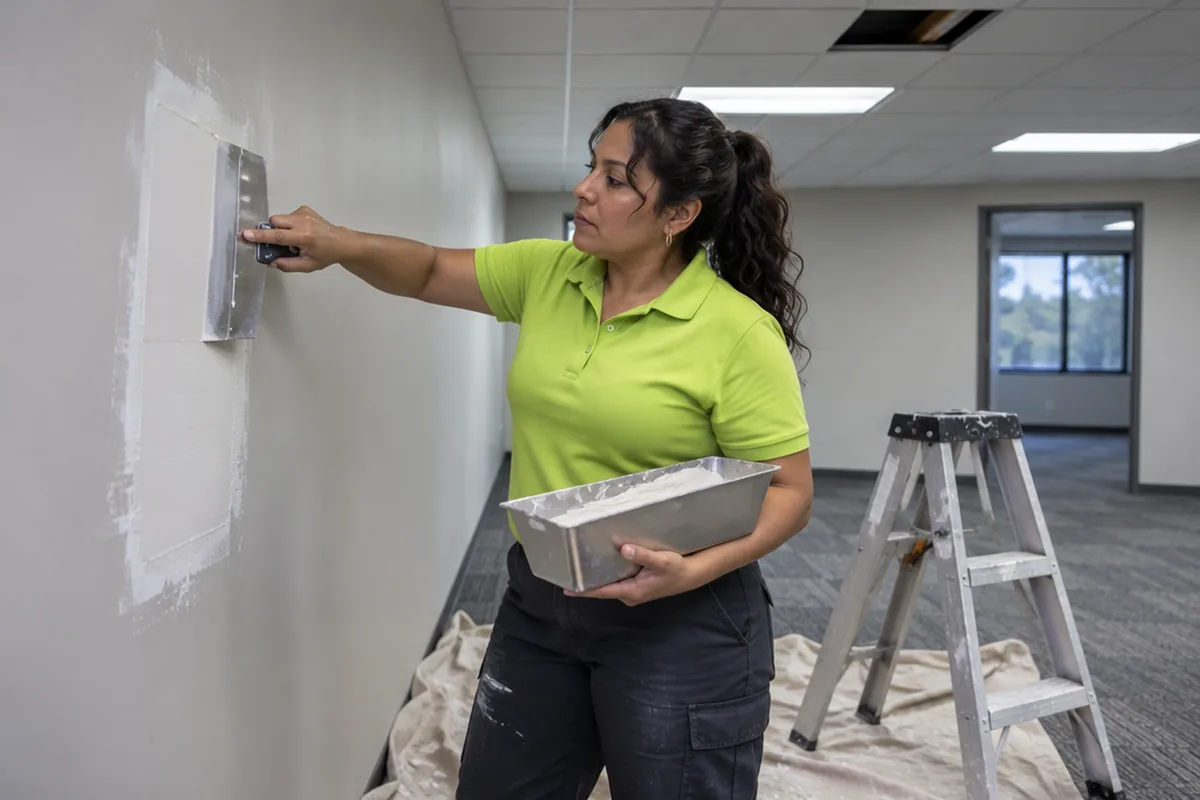
Kaminskiy Care and Repair handles commercial drywall repair, ceiling tile replacement, wall protection and water damage rebuilds for commercial and multi-unit property. One crew patches, hangs, tapes, textures and primes from a written scope, set around tenants and business hours, with photos for the file. Fire-rated assemblies go back as listed, and suspect older materials are tested before anyone cuts. Most lists start with drywall repair and turnover patching or drop ceiling tile replacement. Drywall and ceiling work sits under our commercial handyman and repair services, beside ten other trades.
One page carries everything made of board and compound: holes in a suite where people are at work, move-out damage in units on a paint deadline, cracked or sagging drywall ceilings, texture matching, paint-ready prep and access panels at buried valves. Older buildings with lath behind the walls get plaster patching from the same crew.
A drop ceiling is a separate system of tiles, tees and hanger wires, and its upkeep has a page to itself. Ceiling tile replacement means stained, sagging and mismatched tiles identified, sourced and swapped after hours, with bent grid replaced by matching parts. Tiles from the asbestos era are tested before they are lifted.
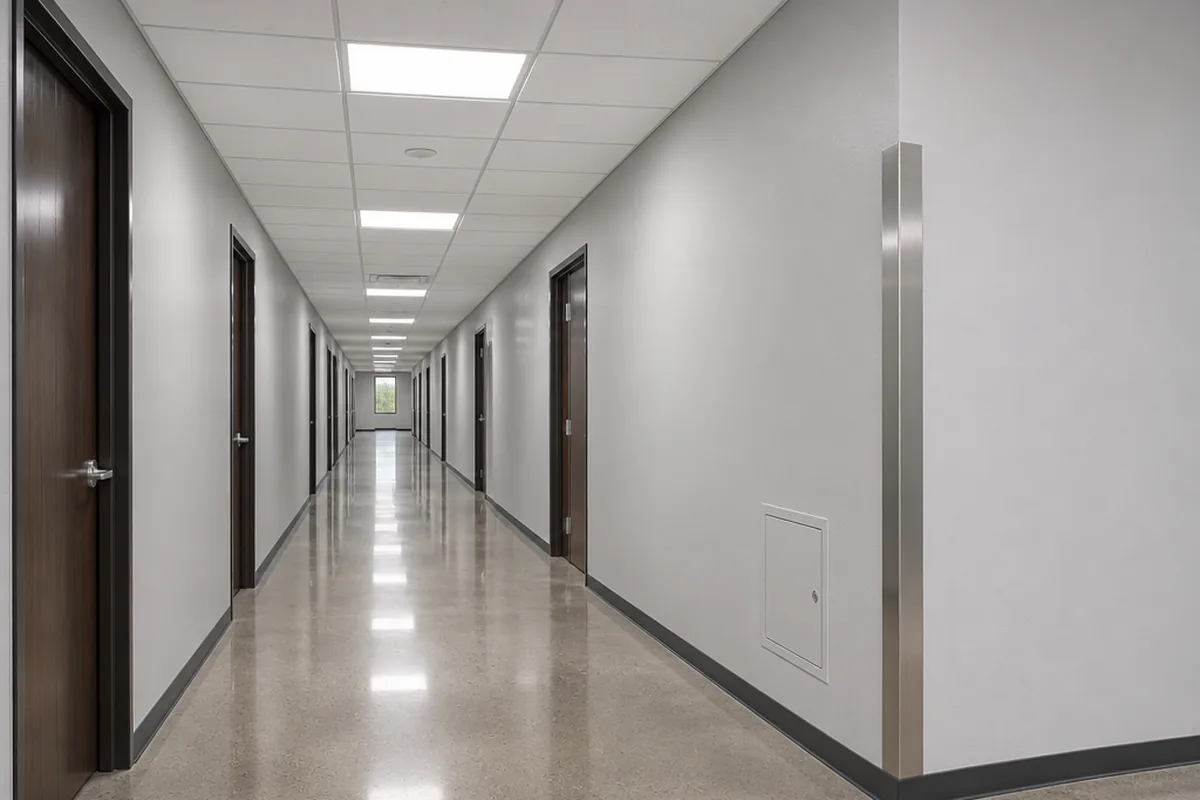
Where carts keep finding the same corner, corner guards, rails and FRP panels end the repeat patch. Where a leak has soaked the board, the rebuild runs through insurance restoration and water damage repair once the source is fixed and the cavity is dry, with photos an adjuster can use.
Send the list you keep, by unit or suite, or ask for a walk. We sort each line into patch, ceiling, panel, texture or prep, and mark anything rated or old enough to test.
The written scope prices each line and states what it assumes: board thickness, texture, finish level, and whether a wall is believed to be fire-rated. You approve it before anything is cut.
Cuts are made with a vacuum at the blade, sanding is done with a vacuum sander or a damp sponge, and floors and furniture are covered. Loud work waits for the hours the building allows.
Each repair is primed so the painter is not sealing raw compound. The area is swept and wiped down, and before and after photos reach your contact sorted by location.
Corridor walls, shafts, walls between tenants and the ceilings under upper floors are often fire-rated. The International Building Code, a model code many jurisdictions adopt, bases that rating on a fire test of the complete assembly (Section 703.2.1). So a repair copies the tested design, down to the board type, the layers and the fasteners, and a rated ceiling keeps the tile or the access door its listing names. The building engineer or the local official says what an assembly is.
EPA's guide for schools and commercial buildings says wallboard wet with clean water may be dried in place only if there is no obvious swelling and the seams are intact, and otherwise it is removed and replaced. For soaked ceiling tiles its instruction is shorter: discard and replace. We apply both lines on site. Drying equipment, and mold beyond a small area, belong to a licensed remediation company where the state licenses that work.
OSHA's silica standard for construction has no exemption based on how little silica a material holds. In a 2019 interpretation the agency said sanding joint compound with only trace silica will typically stay below its action level of 25 micrograms per cubic meter, but that dry sanding can raise heavy nuisance dust employers must control. In an occupied building that dust is your tenant's problem too, so we capture it with vacuum sanders and damp sponges inside a contained area.
Sources for the rules on this page: 2021 International Building Code, Section 703.2.1; EPA, Mold Remediation in Schools and Commercial Buildings Guide, Table 1; OSHA standard interpretation of 29 CFR 1926.1153, July 25, 2019; OSHA asbestos standard for construction, 29 CFR 1926.1101(b); EPA, Asbestos National Emission Standards for Hazardous Air Pollutants (NESHAP); EPA Renovation, Repair and Painting Program: Contractors.
Each card opens one service: what we repair, what gets tested or handed to a licensed company, and what lands in your file.
Managers call about one hole and are living with a dozen more. On a walk a technician checks corridor corners, the walls behind doors, ceiling stains, tiles that do not match and every spot another trade cut open. Each item is written up by room, with a note on texture and sheen, and anything rated or old enough to test is flagged. You choose what gets done this month.
Every line above belongs to one of the four pages in the cards. Send the whole list in one message and we sort it, price it by line and flag what needs testing or a licensed company first.

Send the list or ask for a walk, and tell us which rooms are occupied and when.

Approve the written scope by line, with rated walls and suspect materials marked before work starts.

We repair, prime and clean up after hours, then send before and after photos by location.
The work is backed in writing by our workmanship warranty and done by a Kaminskiy-certified, background checked technician.
Three questions sort most wall items. Is the board dry and firm, so a patch will hold? Is the damage wide or wet enough that cutting back to the studs and hanging a new piece is the honest repair? Or does the same spot get hit every month, which means the fix is a guard or a rail and not more compound? A vendor who answers all three in the scope saves you paying for the same corner twice.
A patch shows for one of three reasons. The compound was not feathered wide enough, so there is a hump. The texture was not matched, so there is a flat window in the wall. Or the patch was painted without primer, so it dries dull under the finish coat. The finish level the wall was built to matters as well. Ask which level the scope assumes before you approve it.
Four facts make the first scope accurate. The year the building was finished, because paint from before 1978 calls for lead-safe work, and texture, tile or plaster from 1980 and earlier is tested before it is disturbed, with licensed abatement for a positive asbestos result. Which walls face a corridor, a shaft or a neighbor. When each room is empty. And what the finish is: texture, sheen and color. A missing fact is the usual reason a price changes after work starts.
Drywall touches several licenses. Abatement of asbestos-containing material and large mold cleanup go to licensed companies, and the drying equipment after a flood is the remediation company's too. Sprinkler heads in a ceiling are a licensed fire sprinkler contractor's. New wiring behind a wall is a licensed electrician's, and the leak itself is a plumber's or a roofer's. We name each one in the scope so you can book them ahead of the patch.
Can't find your answer? Call 855-695-1195 and ask us anything.
Call 855-695-1195It covers four things: drywall repair and turnover patching, including drywall ceilings, texture, paint-ready prep and access panels; ceiling tile replacement and grid repair; corner guards, bumper rails and FRP wall panels; and the rebuild after water damage. Abatement, large mold cleanup and sprinkler work go to licensed companies.
Yes, to the listed assembly. That means the same board type and thickness, the same number of layers, the fastener pattern and treated joints, and a rated access panel where one is needed. We do not decide whether a wall is rated or approve the repair. The building engineer or the local official does, and we ask before we cut.
Usually after hours instead. Cutting and sanding make dust and noise, so occupied spaces are scheduled for evenings, early mornings or weekends, with floors and furniture covered and the area cleaned before staff return. Small patches in a back room can sometimes be done during the day if the tenant agrees.
Every repair is primed. Finish paint can sit on the same scope through our commercial painting service, or the wall can go to your painter with the primer, sheen and color notes. Tell us which, because a patch painted in the wrong sheen shows as badly as one left unprimed.
We ask for the building's survey before work. If there is none, suspect material such as popcorn texture, old joint compound, ceiling tile or plaster is sampled and sent to a lab before it is cut or sanded. If it tests positive, a licensed abatement company removes it and we rebuild afterwards.
Yes, once the leak is fixed and the area is dry. Stained and swollen board and ceiling sections are cut out and replaced, then textured and primed, with photos of each stage. Drying equipment and mold beyond a small area belong to a licensed remediation company. Our insurance restoration and water damage repair page has the detail.
Count, access and finish. Twenty small patches in vacant units price differently per patch than two in a furnished office after hours. Ceiling height, a lift, texture matching, a full skim coat and rated assemblies all add labor. Every line is priced in writing before the work is scheduled.
Yes. Send one list per property or a combined sheet. Each building is scoped on its own lines, one contact runs all of them, and photos come back sorted by property, unit and room so each owner's file stands alone.
Send the property address, the list or a few photos, the year the building was built and the hours each space is empty. We answer with a written scope by line. Or reach a person at 855-695-1195.
A scope by line. Dust held to the room. Photos of each repair.
We answer in under three rings, 24/7.No price games. You get a clear written quote before any work begins, backed by our workmanship warranty.
