 BBBAccredited Business

Kaminskiy Care and Repair handles railing repair, handrail repair and stair repair on commercial and multi-unit property, indoors and out. A technician re-anchors loose posts and wall brackets, replaces rusted base plates and broken pickets, and fixes the stair itself: cracked precast and wood treads, worn nosings, risers and landings. One flight or one side stays open. A new handrail for access is ADA handrail installation. Poured concrete, steel stringers and structural questions go to a concrete contractor, a welder or an engineer. Railings and stairs are handled alongside our commercial fence, gate and railing services.
Inside a stairwell or along a corridor, a wall-mounted handrail works loose because its brackets were screwed into drywall or into anchors that crushed. We take the rail down, find or add solid backing, fasten new brackets into framing or masonry and hang the rail back at its original height. Steps in the same flight that rock, squeak or have lost a nosing are fixed as interior stair repair.
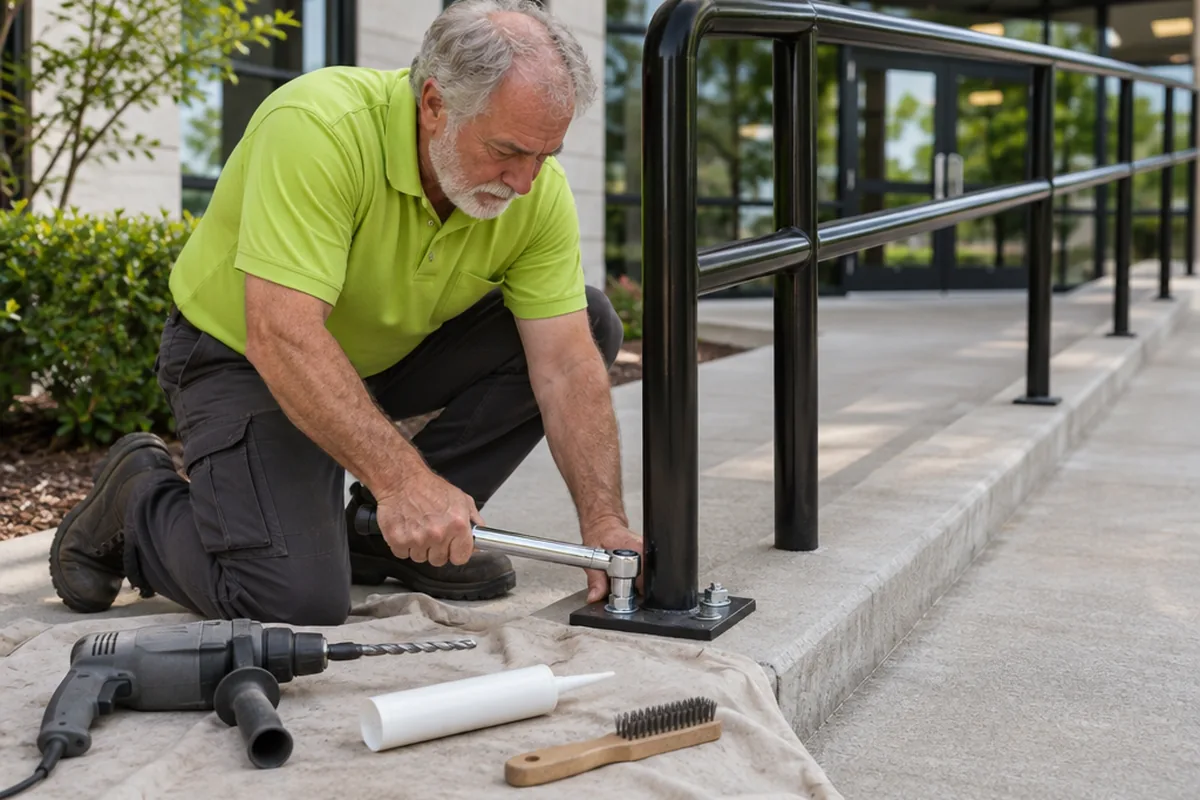
Steel posts set in concrete or bolted through a base plate rust where water sits. A weld snaps, or the plate lifts off its anchors. We core out and re-set posts, replace base plates and anchors, and swap broken pickets. Where a ramp has no handrail at all, adding one is a different job with dimensions of its own: new handrails for access.
Garden-style buildings put precast treads on steel stringers, and the treads crack while the brackets under them rust thin. That is exterior stair repair, done a flight at a time. Pipe and picket guards at a parking deck edge or an upper breezeway take cart impacts and corrosion, so we re-anchor posts and replace bent infill. Guard posts on a wood-framed walkway with soft decking belong to elevated walkway and balcony repair.
Tell us the location and what moves: a post, a bracket, a tread or the whole run. Count bad steps from the bottom. Send photos of the base or wall connection, and of a stair from the side.
The technician loads each post and bracket by hand, marks the loose ones and opens the worst connection to see what its anchors are set in. On a stair, every riser is measured and each tread sounded or probed.
One side of a stair or one lane of a walkway stays usable, or a flight is barricaded with a sign to the other stair. A section of guard removed at a drop is covered by a temporary barrier until the rail is back.
Every repaired post and bracket is push tested a second time and the risers are measured again. Photos show the anchor, the finished connection, each new tread and a tape on the rail height, for your file and your insurer's.
The International Building Code, a model code many jurisdictions adopt, requires guards along open-sided walking surfaces more than 30 inches above the floor or grade below (Section 1015.2) and sets required guards at not less than 42 inches high (1015.3), with exceptions for some dwellings. Section 1014.2 puts handrails between 34 and 38 inches above stair nosings or ramp surfaces, and the 2010 ADA Standards give the same height (505.4). An older rail built to an earlier rule is the building official's question, not ours.
Under Section 1607.9 of the International Building Code, a model code, handrails and guards are designed to resist 50 pounds per linear foot and a 200 pound concentrated load, and infill such as balusters a 50 pound load. For workplace areas, OSHA's rule at 29 CFR 1910.29(b) describes guardrails 42 inches high, plus or minus 3, that withstand 200 pounds at the top rail. We rebuild connections with those loads in mind, and we do not load test or certify.
Section 1011.5.2 of the International Building Code, a model code, sets stair risers at 4 to 7 inches and treads at 11 inches minimum, and Section 1011.5.4 lets the tallest and shortest riser in a flight differ by no more than 3/8 inch. The 2010 ADA Standards (504) likewise call for uniform risers and treads. This is the rule a careless repair breaks: a thicker replacement tread or new flooring on a landing changes one rise, and that is the step people miss.
Sources for the rules on this page: 2021 International Building Code, Sections 1011.5 (stairs), 1014.2 (handrails) and 1015 (guards); 2021 International Building Code, Section 1607.9; 2010 ADA Standards for Accessible Design, sections 504 and 505; OSHA, 29 CFR 1910.29(b); OSHA, 29 CFR 1910.22(d); California Health and Safety Code, Section 17973 (SB 721).
Kaminskiy Care and Repair fixes a loose handrail at its connection, because that is where it failed. Wall brackets pull out when they were screwed into drywall or into plastic anchors, and post-mounted rails loosen when a set screw or a weld lets go. We take the rail down, add blocking or find the framing, set new brackets with fasteners suited to wood, concrete or masonry, and re-hang the rail at the height it had. The 2010 ADA Standards ask for 1 1/2 inches of clear space behind a handrail (505.5), so a bracket swap keeps that gap. Adding a rail where none exists is a separate installation service.
We repair the walking surface of outdoor stairs and at-grade wood walkways, and the wood or bracket support under it. Wood steps at a back door get new treads and risers, and a stringer that has rotted where it meets the ground is rebuilt on a raised pad in lumber rated for ground contact. Landings are re-leveled and loose nosings reset. Boardwalk-style paths get new boards on treated sleepers over gravel, flush with the paving they meet. One flight is closed at a time with a sign to the alternate route. Poured concrete stairs, sidewalks and slabs, including grinding and lifting, are a concrete contractor's work, and a steel stringer that has lost thickness goes to a welder and an engineer.
A cracked precast concrete tread is replaced, not patched. The crack means water has reached the reinforcing steel inside, which rusts, swells and breaks the tread from within. We barricade the flight, unbolt the tread, wire-brush and prime the steel stringer where the bracket sat, fit new brackets and corrosion-resistant bolts, and set a matching precast unit level and tight. Brackets are renewed with the tread because the old ones seldom survive removal. Size is confirmed before ordering, since a thicker tread would change the rise above and below it. Surface rust on the stringer is treated while the treads are off.
Inside the building we repair the stair itself: loose and squeaking treads, worn or splintered nosings, kicked-in risers, frayed carpet at the step edge, and the balusters and newel posts that belong to the stair. A squeak is wood rubbing on wood or on a nail, so the moving joint is glued and screwed, from below when the underside is open and through the tread when it is not. Drywall under a stair is often fire protection, and we open it only with your approval. A split tread is replaced in the same species and thickness. Flights are done singly with a second route open, or after hours where there is only one stair. A cracked or sagging stringer goes to an engineer first.
Most railing failures are connection failures. We rebuild the connection in sound material and leave the rest of the rail in place.
A loose post is not fixed by tightening a nut on a rusted stud. We remove the post or bracket, clean out failed anchors and crumbled concrete or wood, and set new anchors sized for the base material: adhesive-set studs or wedge anchors in sound concrete, through-bolts with blocking in wood framing, sleeves in masonry. Steel is primed wherever it was cut or ground.
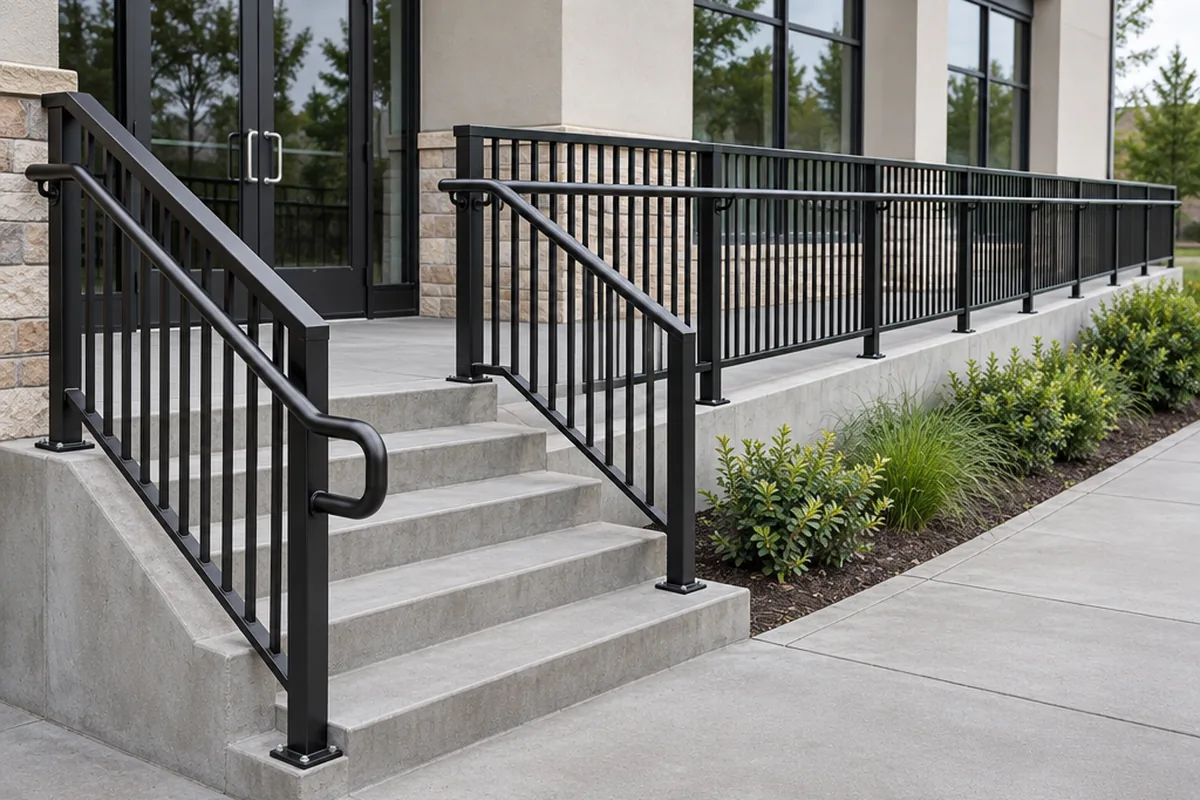
A wobble means an anchor has already failed, and a cracked or rocking tread should be barricaded until it is fixed. Send the location and photos, and we scope the repair and plan the open route with you.

Send the location and photos of the post bases, wall brackets or the stair seen from the side.

Approve a written scope listing each post, bracket, tread and nosing to be repaired, with the price.

We make the repair, push test every connection, measure the risers and send the photo record.
The work is backed in writing by our workmanship warranty and done by a Kaminskiy-certified, background checked technician.
A guard keeps people from falling off an edge. A handrail gives a hand something to grip on a stair or ramp. One assembly can do both, but the two have different heights and different jobs. On a stair with an open side you often see a 42 inch guard with a separate handrail mounted lower on its inside face. Knowing which part is loose tells us what the repair has to restore.
Steel posts rust where water collects: inside a core hole, under a base plate, at the bottom weld. The post can look fine above while its bottom inch is gone. Tapping with a hammer and probing with a pick finds it. Small losses are cut out and rebuilt. A post rusted through is replaced, and its pocket is detailed to drain instead of pooling again. Surface rust on sound steel is only a coating job, but paint is never used to cover a failed connection.
Wood rail posts loosen when their bolts crush the fibers, or when rot starts at the cut end and the fastener holes. A post notched over a rim and held with nails was never strong. We replace the post, bolt it through with blocking and seal the end grain. Rot that runs into the framing below is a larger repair, covered under dry rot and termite damage repair.
Aluminum railings are kits of brackets, screws and snap covers, so a repair depends on finding matching parts. We identify the system and source them. Cable infill needs correct tension, and its end posts carry high loads. Glass panels are a glazier's work. Whatever the system, we rebuild the connection that failed and leave the design of the rail as the building official accepted it.
A stair has four parts worth naming on a work order. The stringers are the sloped beams that carry the flight. Treads are the boards or slabs underfoot, risers are the upright faces between them, and the nosing is the front edge of each tread. Landings are the flat platforms where a flight starts, ends or turns. Replacing a tread or a nosing is routine carpentry. A stringer is the structure of the stair, so damage there gets an engineer's eye before any repair.
Outdoors, wood stairs rot at the foot of the stringer, in the notches under each tread where water sits, and at the top connection to the landing. Indoors nothing rots: glue blocks let go, nails slide in their holes and treads start to rock. For workplaces, OSHA's walking-working surfaces rule, 29 CFR 1910.22(d), tells employers to inspect these surfaces regularly and to repair or guard a hazard before the surface is used again.
Can't find your answer? Call 855-695-1195 and ask us anything.
Call 855-695-1195Most can be repaired. The rail, pickets and posts usually outlast their anchors, so we rebuild the connection at the base or the wall. Replacing a section is the answer when posts have rusted or rotted through along a run, and the scope says so with photos.
Yes. This service covers existing guards and handrails anywhere on the property: stairwells, corridors, ramps, entries, pool decks, parking structures and common areas, in steel, aluminum or wood. New handrails installed for accessibility are a separate service with dimensions of their own.
No, it is replaced. A crack lets water reach the reinforcing steel, and a patch traps the damage inside. The tread comes off, new brackets and bolts go on, and a precast unit of the same size is set in its place. Keep the flight barricaded from the day the crack is reported until the new tread is in.
Yes. A squeak is one joint moving, usually where a tread meets the riser or the stringer. We glue and screw that joint, working from below if the underside is open and through the tread if it is not, then plug or fill the screw heads to match the finish. A tread that has split along its overhang is replaced, not refastened.
Because people set their stride on the first two steps and stop looking. The International Building Code, a model code many jurisdictions adopt, limits the difference between the tallest and shortest riser in a flight to 3/8 inch (Section 1011.5.4). That is why we measure every rise before and after a repair, and why a replacement tread has to match the thickness of the old one.
Not poured concrete, and not structural steel. Concrete stairs, walks and slabs belong to a concrete contractor. A stringer that has lost thickness or separated at a weld needs a qualified welder, usually under an engineer's direction. We handle wood stairs, precast treads and their brackets, and surface rust on a stringer, which we clean and prime while the treads are off.
We restore the connections and the walking surface and report what we measured, including rail height, openings and riser heights. Whether an existing railing or stair has to meet the current code or the one it was built under is the building official's decision. We do not certify either, and an engineer should evaluate anything with a structural question.
By working one side at a time where there are two rails, scheduling single-rail stairs for low-traffic hours and setting a temporary barrier wherever a guard at a drop comes off. Where a stair is the only way to a unit, the work is staged with the resident and a safe walking surface is back before we leave each day.
It can. In California, Health and Safety Code section 17973, known as SB 721, reaches stairways and walkways that depend on wood framing and stand more than six feet above ground on buildings with three or more multifamily units. A stair carried on steel stringers is a different case, and the inspector you hire decides what falls under the law.
It follows the count of connections or steps, what they anchor into, and access. A bracket re-hung on blocking differs from a post cored out of a concrete ramp, and precast treads are priced per unit once the size is confirmed. Welding, matching parts for an aluminum system and after-hours work add to it. The written scope prices each location, so the pressing items can be approved first.
Send the address, where the railing or stair is, what moves and photos of the post bases, wall brackets or the steps from the side. We reply with a written scope by location. If a guard at a drop is loose or a tread is cracked now, barricade it and call 855-695-1195.
Connections rebuilt in sound material, push tested and photographed.
We answer in under three rings, 24/7.No price games. You get a clear written quote before any work begins, backed by our workmanship warranty.
