 BBBAccredited Business

Kaminskiy Care and Repair does dry rot repair and termite damage repair on commercial and multi-unit buildings: beam ends, posts, stair stringers, sill plates, fascia and trim are cut back to sound wood and rebuilt. A technician probes to find where solid wood starts, replaces the member with treated or primed lumber, seals it and closes the leak path that fed the decay. Killing termites is a licensed pest control company's job, never ours. Rotted siding boards belong to siding and fascia repair. It is the wood repair page within our commercial exterior repair services.
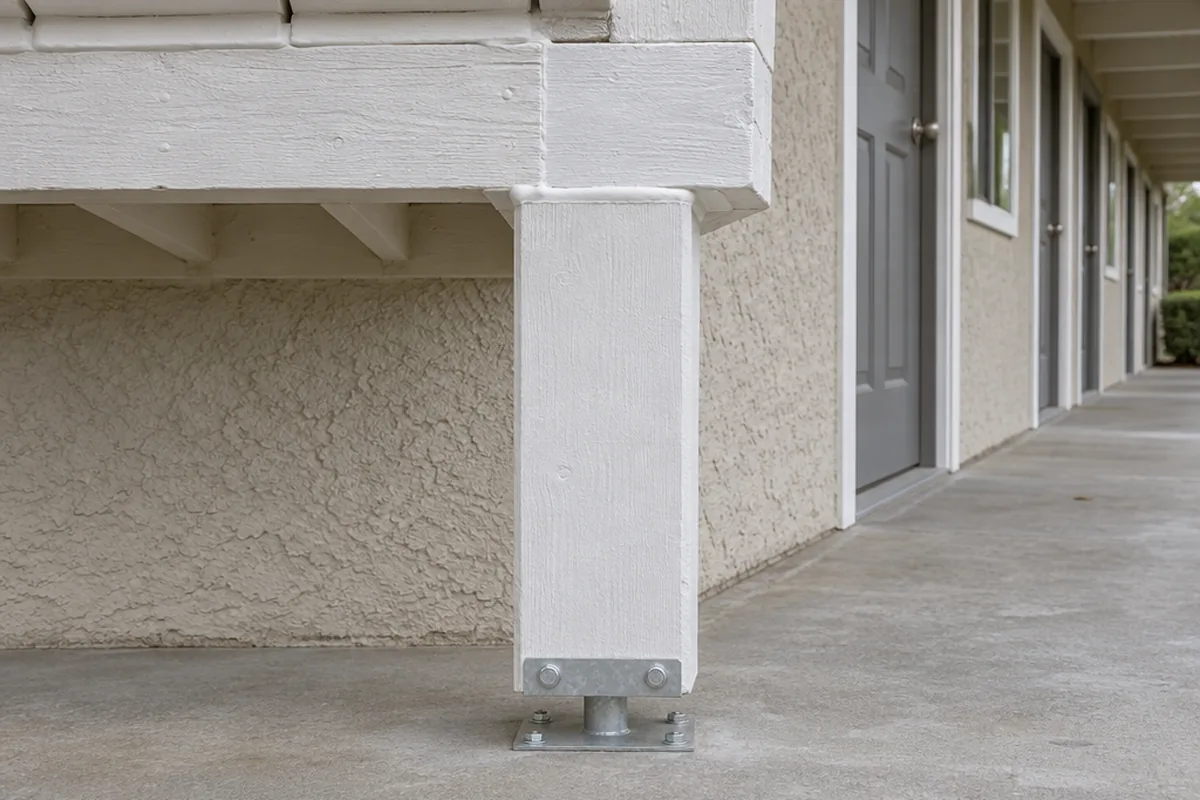
Posts set straight on a concrete slab wick water into the end grain, and a stair stringer does the same where it lands on the walk. We cut the post or stringer back to dry wood, splice or replace it, and set the new base on a metal standoff so it never sits in a puddle again.
Decorative beams and rafter tails that project past the roof edge take rain on the end grain every storm. Paint hides the damage until a screwdriver sinks in. We remove the soft section, scarf in new wood or replace the tail, cap or flash the top, then prime all six sides before it goes up.
A wood-destroying pest report often lists dozens of items across many buildings. We work that list by building and item number, replace what the report marks as damaged, photograph each opening before it is closed and hand the board one record. In California, elevated balconies on that list fall under our SB 721 and SB 326 balcony repairs.
Send the pest report or inspection notes, a few photos and the building count. We ask about tenant notice, parking under the work and where a saw can run.
The technician probes each member with an awl and a moisture meter, marks where solid wood begins and writes the scope by location, so the price reflects the real extent.
Soft wood comes out past the last stained fiber. New lumber is treated or primed on every face, fastened with corrosion-resistant hardware, flashed where water lands and caulked.
Before anything is covered you get photos of the cavity, the new member and the finished surface, labeled by building and item, for the owner, lender or board.
The long-standing guideline cited by the USDA Forest Products Laboratory is to keep wood below 20 percent moisture content. Decay fungi grow when wood stays above fiber saturation, roughly 25 to 30 percent. That is why we meter the wood around a repair: new lumber fastened to a wet wall is only the next piece to rot.
California's Structural Pest Control Act (Business and Professions Code 8505) defines inspecting for wood-destroying pests and organisms, reporting on them and treating them as structural pest control, the work of registered pest control companies. Section 8556 lets a licensed contractor remove and replace the wood they damaged when a pest inspection report identifies the work or it is incidental to other work. Our California license is #1106209.
The International Building Code, which many jurisdictions adopt, requires naturally durable or preservative-treated wood in set locations: framing on a foundation wall less than 8 inches from exposed earth (section 2304.12.1.2) and posts bearing on a slab in contact with the ground (2304.12.2.2). Treated lumber carries a quality mark (2303.1.9.1). Your local official decides what applies.
Sources for the rules on this page: USDA Forest Products Laboratory, Decay of Wood and Wood-Based Products Above Ground in Buildings (Carll and Highley, 1999); California Business and Professions Code section 8505; California Business and Professions Code section 8556(a); 2021 International Building Code, Chapter 23; EPA Lead Renovation, Repair and Painting Program; California Business and Professions Code section 8516.
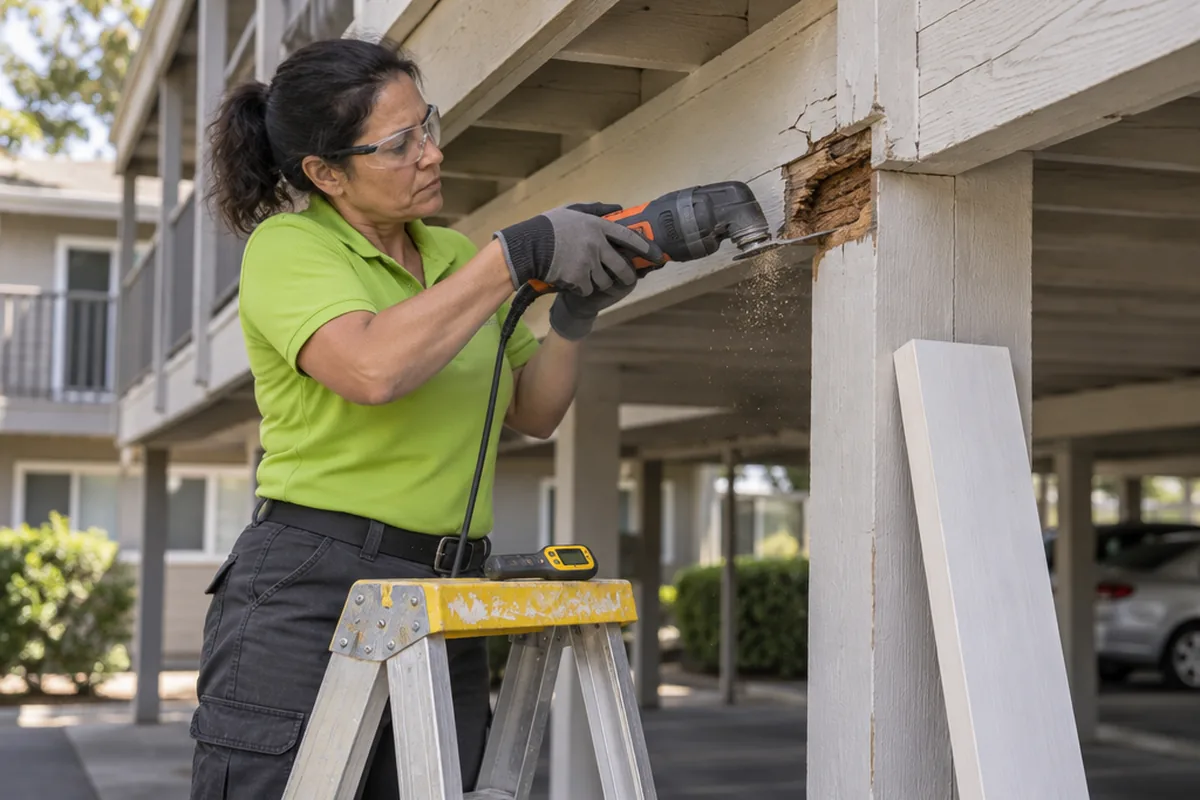
Dry rot repair means removing wood that a decay fungus has softened and putting sound wood back. On commercial buildings it shows up at beam and rafter ends, post feet, stair stringers, sill plates and fascia. We probe to find the limit, cut past the last stained fiber, splice or replace the member in treated or primed lumber and correct the detail that kept it wet: a missing cap, a post standing on the slab, a gutter that spills. Members that carry load are shored first, and anything beyond a like-for-like replacement goes to an engineer.
Termite damage repair replaces the wood the insects hollowed out. It does not kill them. A licensed pest control company inspects, reports and treats first, and then we work through its report: eaten trim, fascia, sill plates, studs and joist ends are cut out and rebuilt, and each opening is photographed before it is closed. In California, Business and Professions Code section 8556 lets a licensed contractor replace pest-damaged wood that an inspection report identifies. We hold California License #1106209.
A wood-destroying pest report is a ready-made repair list. In California, Business and Professions Code section 8516 requires the report to name the damaged members, such as fascia, rafters, joists and trim boards, and to mark their locations on a diagram. On request it separates damage that is evident from conditions likely to lead to damage. Under that section a follow-up more than four months after the original inspection is a new original inspection, not a reinspection, so when you want the same report closed out we plan the repairs to finish inside four months.
Four neighbors take the wood this page does not. Wood decks, balconies and second-floor corridors are deck, balcony and elevated walkway repair. California owners and associations holding an inspection report start at SB 721 balcony inspection and repair. Boards on the wall and at the eave, soffits and corner boards included, are siding, fascia, trim and soffit repair. Loose railings and worn stair treads are commercial railing and stair repair. One written scope can carry items from every one of them.
A patch over soft wood fails within a season. We remove the damage, rebuild the member and change the detail that kept it wet.
Most of the damage we open is end grain that sat wet: the foot of a post, the tip of a beam, the last foot of a stringer. We shore the load, cut to bright wood, splice or swap the member, lift it off the concrete with a standoff base and cap or flash the top. Then primer, caulk and paint.
One soft spot is a small repair. Left wet, it travels along the grain into framing. Send photos and the report, and we will tell you which items are ours and which belong to the pest company. Decayed corner boards and window casings are handled as exterior trim and soffit repair.

Send the pest report or photos, the number of buildings and any deadline you are working against.

We probe the wood on site and give you a written scope and price listed by location.

The damaged wood is replaced and sealed, and you receive labeled photos of each repair.
The work is backed in writing by our workmanship warranty and done by a Kaminskiy-certified, background checked technician.
The name misleads. The crumbly brown wood called dry rot was decayed by a fungus while it was wet, then dried out. Research published by the USDA Forest Products Laboratory notes that common decay fungi on exterior woodwork can sit dormant in dry wood for years and resume when water returns. A repair that leaves the leak in place restarts the clock.
Decay runs farther along the grain than the surface shows. We probe outward until the awl stops, then cut beyond the last discolored fiber into bright wood. A splice needs enough sound length on both sides to carry fasteners. When too little solid wood is left to splice, the whole member is replaced, and loads are shored first.
Subterranean termites travel in mud tubes from the soil and eat along the grain, leaving thin shells of wood. Drywood termites live inside the piece and push out pellets. Either way, damaged wood tells you they were there, not whether they still are. A licensed pest control company answers that and treats. We rebuild after they finish.
Walk the property after rain. Note where sprinklers hit wood, where gutters overflow onto beams, where soil or mulch touches the wall and where posts stand in water. Push a screwdriver into anything that looks swollen. A list with building numbers and photos lets us price most of the work before the site visit. Overflowing gutters are a job for our gutter cleaning programs.
Can't find your answer? Call 855-695-1195 and ask us anything.
Call 855-695-1195No. Termite inspection and treatment belong to a licensed pest control company, and in California only a registered company may inspect and report on wood-destroying pests. We replace the wood they damaged. Schedule treatment first, then our repair, so new lumber is not installed into an active colony.
Yes. Send the full report with its diagram. We price each damaged-wood item by building and location, tell you which findings are treatment items for the pest company, and return photos of every completed item so the report can be closed out.
We probe with an awl and read the wood with a moisture meter, working outward from the visible damage until the wood is hard and dry. The written scope states the expected extent. If opening the area shows more, we stop, send photos and price the added work before going further.
Only in small, non-structural spots where the surrounding wood is dry and solid, such as a shallow pocket in trim. Posts, beam ends, stringers and sill plates carry load, so the decayed section is cut out and replaced with new lumber.
Access, the size of the member, how much has to be shored and how many locations are on the list. A beam end on the second story costs more than a post base at grade. You get a written price by location before work starts, and hidden damage is priced before it is repaired.
Rarely. Most repairs are outside the units. We give you notice language for residents, block off the work area, keep exits and stairs open or provide a marked detour, and schedule saw work for daytime hours your community allows.
Replacing trim and small sections in kind often does not, while structural members such as beams, posts and stairs may. The local building official decides. We tell you when the work looks like permit work, and questions about load go to an engineer first.
The cause differs and the carpentry is the same. Dry rot is decay from a fungus that grew while the wood was wet, so the repair also has to stop the water. Termite damage is wood eaten by insects, so a licensed pest control company treats before we rebuild. In both cases the weakened wood is cut out and replaced.
Yes, on its own page. Decayed joists, ledgers and decking on wood decks, balconies and elevated walkways are repaired under our deck, balcony and elevated walkway service, and California balconies named in an inspection report follow the SB 721 page. This page covers framing and trim elsewhere on the building: beams, posts, stringers, sills and fascia.
Attach the pest report or your own list, photos of the worst spots and the number of buildings. We answer with a written scope by location. Prefer to talk it through? Call 855-695-1195.
A scope listed by location. Repairs scheduled around residents. Photos of every opening for your file.
We answer in under three rings, 24/7.No price games. You get a clear written quote before any work begins, backed by our workmanship warranty.
