
 BBBAccredited Business

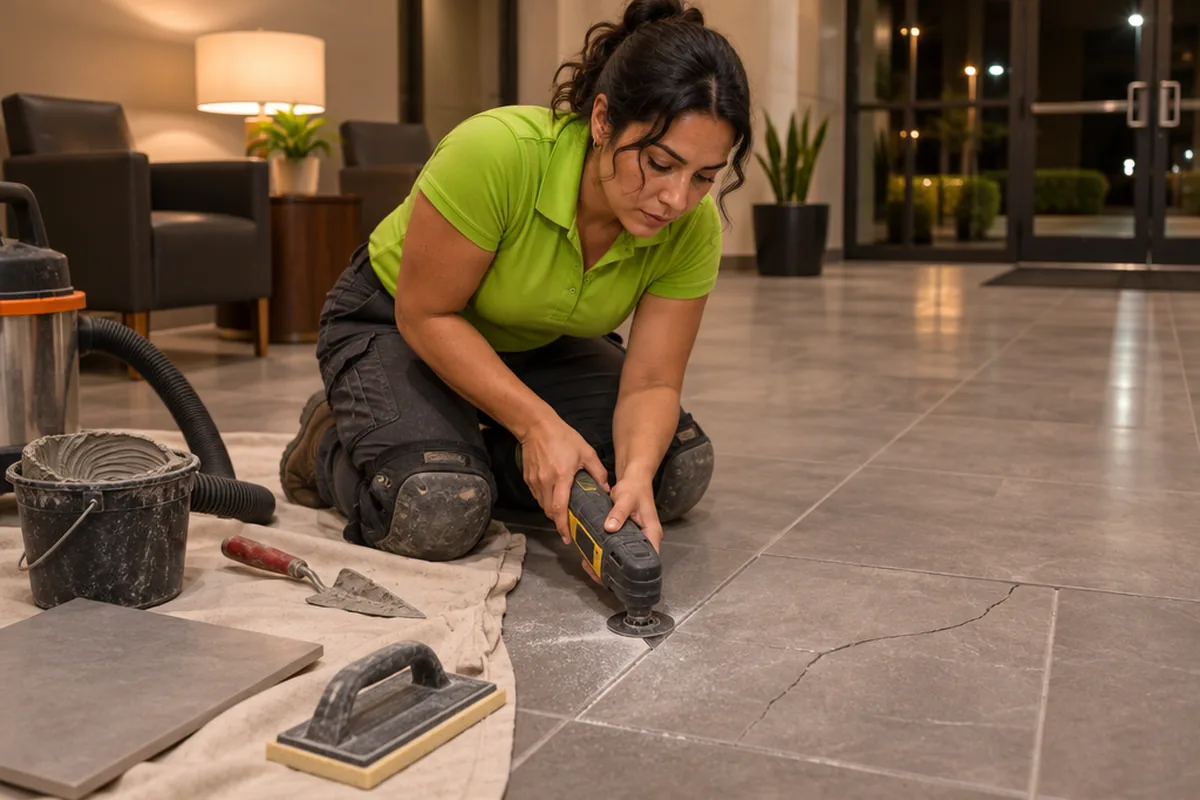
Kaminskiy Care and Repair provides commercial tile repair and grout repair for lobbies, restrooms, corridors and kitchens. A technician replaces cracked, loose and hollow ceramic, porcelain and quarry tiles with matching ones, and cuts out failed grout and regrouts the joints in cement or epoxy. The cause is found first, and the work is done after closing so it cures overnight. This is repair, not a new floor: new tile is commercial tile installation. Tile and grout repair sits with the other commercial floor repair and installation services we offer.
A crack that crosses several tiles in a straight line is following something below: a slab crack, a control joint or the seam between two pours. Swapping the tiles alone buys a few months. We open the line, check what is under it, and reset the tiles over a crack isolation membrane or move the soft joint to where the floor wants it. Broken edges that catch a heel also go on a trip hazard repair list.
Water gets under restroom tile at the toilet base, the floor drain and the door. The mortar softens and tiles rock or ring hollow, while the joints around urinals stain dark for good. We lift and reset the loose field with a mortar made for wet rooms, then cut out the stained joints and regrout them, often in epoxy.
Quarry tile takes dropped pans, rolling racks and hot water every shift. Degreasers eat the grout until joints sit low and hold water, then tiles pop along the cook line. We chip out the broken pieces, degrease the bed, set new quarry tile and pack the joints with epoxy grout made for kitchen floors, in sections the kitchen can spare after the last shift.
Send a wide photo, a close photo of the tile and the joints, and a rough count of damaged tiles. Tell us the tile size and whether spare boxes are stored on site.
The technician taps the floor with a hard tool to map hollow tiles, marks them with tape, cuts a short test run of grout and looks for the line, load or leak behind the damage.
Grout is cut first so neighboring tiles do not chip. Bad tiles are broken out from the center, old mortar is ground flat and new tile is bedded to the same height. Failed joints are raked out under a vacuum.
Joints are grouted to match and the area is coned off until the mortar has cured. Photos of the opened floor and the finished repair go into your work order.
The Tile Council of North America's handbook calls for movement accommodation in every installation and gives the guidelines in its detail EJ171. TCNA's technical staff tie tile that has tented, and sometimes cracked, to movement joints that were not used enough. In a small room the gap at the wall can be sufficient. A long corridor needs soft joints in the field. When we find none, we say so, because new tiles will lift in that same spot.
The FDA Food Code, the model that state and local health departments adopt in their own editions, says physical facilities shall be maintained in good repair (section 6-501.11) and that floors be smooth and easily cleanable (6-201.11). Where floors are not cleaned by water flushing, it wants the floor and wall juncture coved and closed to no larger than 1 millimeter (6-201.13). Missing tile and eroded joints are the kind of item an inspector writes up.
The 2010 ADA Standards, section 303, let a vertical edge on an accessible route stand no more than 1/4 inch. A tented tile, or the pocket where one is missing, usually exceeds that. We measure the edge before and after the repair and write both figures on the work order. We do not survey or certify a route.
Sources for the rules on this page: Tile Council of North America, FAQ on movement joints (Handbook detail EJ171); Tile Council of North America, FAQ on grout; FDA Food Code 2022, sections 6-201.11, 6-201.13 and 6-501.11; 2010 ADA Standards for Accessible Design, section 303; Tile Council of North America, FAQ on tented tile; ANSI A108.02, section 4.3.8, as quoted in a Tile Council of North America technical article on grout joints.
Grout repair means cutting the failed grout out of the joint and packing new grout in; a fresh skim over old grout does not hold. Kaminskiy Care and Repair regrouts restroom, kitchen and lobby tile, on floors and on walls, for property and facility managers. The old joint is raked out with a carbide or diamond blade under a vacuum, deep enough for new material to lock in, then filled, tooled and left to cure before the floor is washed. We regrout to natural breaks, a whole restroom or a full bay, so new and aged grout do not sit side by side. Loose tiles are reset first, because grout cannot hold a tile down.
Epoxy grout is the better choice wherever urine, grease or harsh cleaners reach the floor, because it does not absorb liquid the way cement grout does. It is a two-part resin that costs more and takes longer to place, and it needs no sealer afterwards. Cement grout with a penetrating sealer remains a sound, lower-cost answer for dry lobbies and walls. We recommend one or the other room by room and write the product on the scope. Old epoxy that has to be ground out adds time, and we tell you that before pricing.
A grout line that cracks again in one place is sitting on a joint that moves, and the fix is flexible sealant, not more grout. The Tile Council of North America advises caulk in place of grout where tile changes substrate, such as where a floor meets a wall, because the two surfaces move independently and grout there will crack and let moisture in. We rake those joints out and fill them with a color-matched silicone or urethane sealant, which TCNA notes holds up better than acrylic in wet horizontal joints. The bead around the fixtures themselves is renewed as restroom caulk and seal work.
A good tile repair is hard to find afterwards. The tile matches, the joint lines run through and the new piece sits flush with the old ones.
Tile lines are dropped every few years, and a new box with the same name can come from a different dye lot. We check the building's spare stock first, then search by size, thickness and finish. When no match exists, we harvest tiles from a closet or from under a fixture, or lay a deliberate border so the repair reads as design.
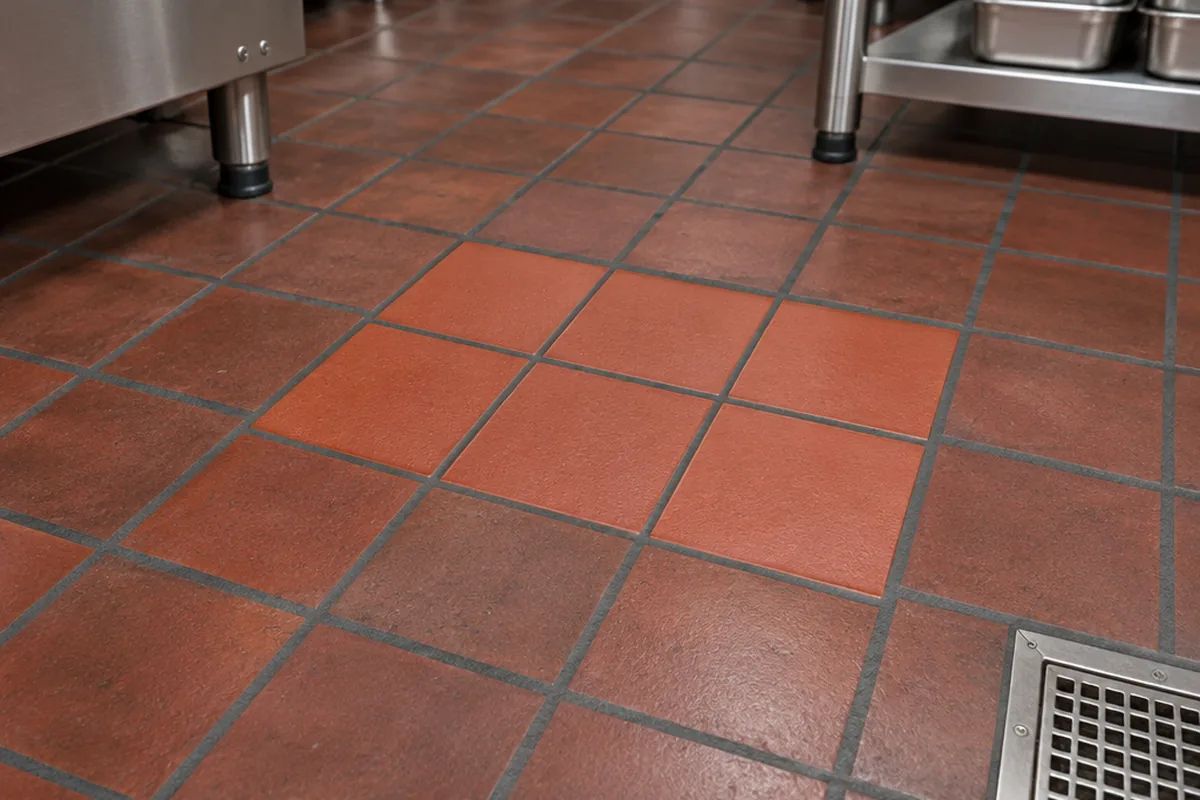
Two quick checks before you call. Tap the tiles around the damage with a coin and count the ones that sound hollow. Then drag a key along a joint: if the grout comes out as powder, cleaning will not save it. Both answers shape the scope.

Send photos, a count of bad tiles, the state of the joints and the hours the area sits empty.

We write a scope that names the cause, the tile source, the grout type and the price.

Tiles are reset and joints regrouted after hours, then photographed once cured.
The work is backed in writing by our workmanship warranty and done by a Kaminskiy-certified, background checked technician.
Almost every cracked floor tile traces to one of three things. Movement: the slab cracked or shrank and took the tile with it. Missing joints: the floor expanded with nowhere to go and the tiles pushed against each other. A point load: a safe, a pallet jack wheel or a dropped tool hit a tile with a void under it. Each leaves a different pattern, and the pattern picks the repair.
A hollow sound means the tile is not fully bedded. It may be a void the installer left, or the bond may have sheared since. A single hollow tile that is not cracked or rocking can stay. A patch of them that grows from month to month is a floor coming loose, and resetting it early costs far less than replacing broken tile later.
Count and location decide it. Damage in one area with a clear cause is a repair. Damage scattered through the whole floor, tile with no match to be found, or hollow tile in every room points to replacement, and we price that path too. Between the two sits the sectional repair: one bay or one restroom relaid wall to wall so the match line falls at a doorway.
Hard, intact grout that has only darkened can be deep cleaned with an alkaline cleaner and sealed. Grout that is cracked, sandy, missing or stained through its depth has to come out. A sealer slows staining in cement grout but does not waterproof it or outlast daily mopping, and acid brighteners attack the joint a little each time. We test a small area before recommending which of the three a floor needs.
According to the Tile Council of North America, cement grout joints smaller than 1/8 inch generally should be filled only with unsanded grout. ANSI A108.02 ties the width to the tile itself: the joint is to be at least three times the actual variation in the facial dimensions of the tile supplied. Matching the original grout type matters, because sanded grout forced into a hairline joint bridges the top and falls out.
A few boxes of the original tile in a storage room are the least expensive insurance a building has. Keep them flat, dry and labeled with the area they came from. If none exist, buy two extra boxes the next time any tile goes down. After each repair we tell you how many spare tiles are left, so the count stays known.
Can't find your answer? Call 855-695-1195 and ask us anything.
Call 855-695-1195Yes. We cut the grout around the tile first, break it from the center outward and grind the old mortar off the slab. The neighboring tiles stay untouched. The risk is a tile that was set tight with no joint at all, and we point that out before starting.
Because the cause is still there. A crack in the slab, a floor with no movement joints or a void under the tile will break the replacement the same way. We look under the first tile we lift and change the repair to suit: a membrane over the crack, a soft joint, or full mortar coverage.
We look for spare stock in the building first, then for the same size and finish from suppliers. If nothing matches, tiles can be taken from a hidden area such as a closet, or the repair can be laid as a border or doorway band in a contrasting tile. You see the proposed tile before it is set.
Not reliably. A thin layer over old grout has little to hold on to and flakes off under mopping. We cut the old grout out to a real depth, vacuum the joint and fill it completely. That is slower than skimming, and it is the difference between a repair that lasts years and one that lasts a season.
Usually yes. Epoxy does not absorb liquids, so it resists the staining and odor that cement grout picks up around toilets and urinals, and it tolerates disinfectants. It costs more in material and labor. For dry areas such as a lobby wall, cement grout with a sealer is a sensible, lower-cost choice.
That joint is moving. Typical spots are where the floor meets a wall, over a joint in the slab, at a doorway or around a column. Rigid grout cannot stretch, so it breaks. The lasting fix is a flexible sealant joint in that location, color matched so it blends with the grout.
It depends on the mortar and grout used. Standard materials want the area left alone overnight before foot traffic, and longer before carts, heavy loads or wet cleaning. Rapid-setting products shorten that when an entry cannot stay closed. The scope states the product and the wait, and we barricade the area until then.
Yes. Kitchen tile is replaced after the last shift, with the pocket cleaned of grease so the new bed bonds. We use setting and grouting materials suited to hot water and degreasers. The repair has to cure before the line is washed down, so we plan it with the kitchen manager.
It depends on the number of tiles, how hard the old ones are to remove, whether a matching tile is on hand, the feet of joint to regrout and the grout chosen. Epoxy and after-hours work add to it. You receive a written price before the visit, and anything found under the floor is priced before we continue.
When damage is spread across the whole floor, when hollow tile shows up in every area, or when no acceptable match exists. At that point money spent on patches is wasted. We will say so and price a new floor, or refer a large lobby to a tile contractor with a full crew.
Attach a wide photo, a close-up and the tile size, and tell us when the area is closed. We answer with a scope, a tile match plan and a grout recommendation. Or call 855-695-1195.
Cause found. Tile matched. Joints packed full while the building is closed.
We answer in under three rings, 24/7.No price games. You get a clear written quote before any work begins, backed by our workmanship warranty.
