

 BBBAccredited Business

Kaminskiy Care and Repair does commercial electrical work of one kind: in-kind replacement on existing circuits, for commercial and multi-unit property, planned around business hours. That covers light fixtures, lamps, receptacles, switches, exit signs and unit smoke and CO alarms. Start with office and retail lighting replacement or outlet, switch and GFCI replacement. New circuits, panels, breakers, controls and permit work are a licensed electrical contractor's, and we can coordinate one. Florida and North Carolina license electrical work separately. Electrical and lighting is one part of our commercial handyman services.
Troffers flicker, lenses yellow and one corner of the suite always looks dim, while the receptacle under the conference table stopped gripping plugs years ago. We work the suite ceiling first and desk height second, replacing lamps, ballasts, drivers, lenses, receptacles and plates with matching parts on the wiring that is there.
A sales floor depends on aimed light, and a kitchen pass depends on protected receptacles. Track heads and cans are handled under recessed and track lighting on the lighting page. Receptacles near sinks and prep areas are covered under GFCI outlet replacement, along with what the code asks for there.
Breezeway lights fail singly and go unreported. Unit alarms age out on a date printed on the back. Managers send us both lists: exterior and walkway fixtures by building, and smoke and CO alarm replacement by unit number, each closed with a log.
A spreadsheet, a marked-up floor plan or phone photos all work. Note the fixture or device, where it is and what it is doing.
Each line is marked replace in kind, coordinate with a licensed electrician, or outside our scope. You see that sort ahead of any price, so no line turns into a surprise later.
Lighting and device work happens ahead of opening, once the doors lock or on a weekend. A circuit is shut off only where staff have been told it will be.
Every item gets a photo and a note: what was replaced, the part used, and anything we saw that belongs to another trade.
The National Electrical Code is revised on a three-year cycle and becomes law only where a state or city adopts an edition. That is why a question such as where ground-fault protection is required has a local answer. We replace what exists in kind and point you to the local building department when a rule is in doubt.
OSHA's exit route standard, 29 CFR 1910.37(b), requires each exit route to be adequately lighted and each exit marked by a sign reading Exit. Paragraph (a)(4) adds that exit lighting must be in proper working order at all times. That makes a dark exit sign a repair item, not a someday item. Details are on the exit sign and emergency lighting page.
Fluorescent tubes and most high intensity discharge lamps contain mercury. Federal universal waste rules at 40 CFR part 273 cover them, and EPA lists several states that keep them out of landfills entirely. Spent lamps from our work are boxed unbroken for a recycler, and the count goes on your paperwork.
Sources for the rules on this page: OSHA 29 CFR 1910.37(a)(4) and (b)(1)-(2); U.S. EPA, Recycling and Disposal of CFLs and Other Bulbs that Contain Mercury; U.S. EPA, Universal Waste; U.S. Consumer Product Safety Commission, GFCI Fact Sheet (Pub. 099), footnote 1.
Commercial lighting repair, device replacement, exit lighting and unit alarms: each page says where a licensed electrical contractor takes over.
A typical first job is a walk of the whole property with the manager's list in hand. Dead lamps and drivers, cracked plates, loose receptacles and dark exit signs are replaced in kind as we go. Anything that points to a wiring fault is tagged, photographed and handed to a licensed electrician instead of being covered up.
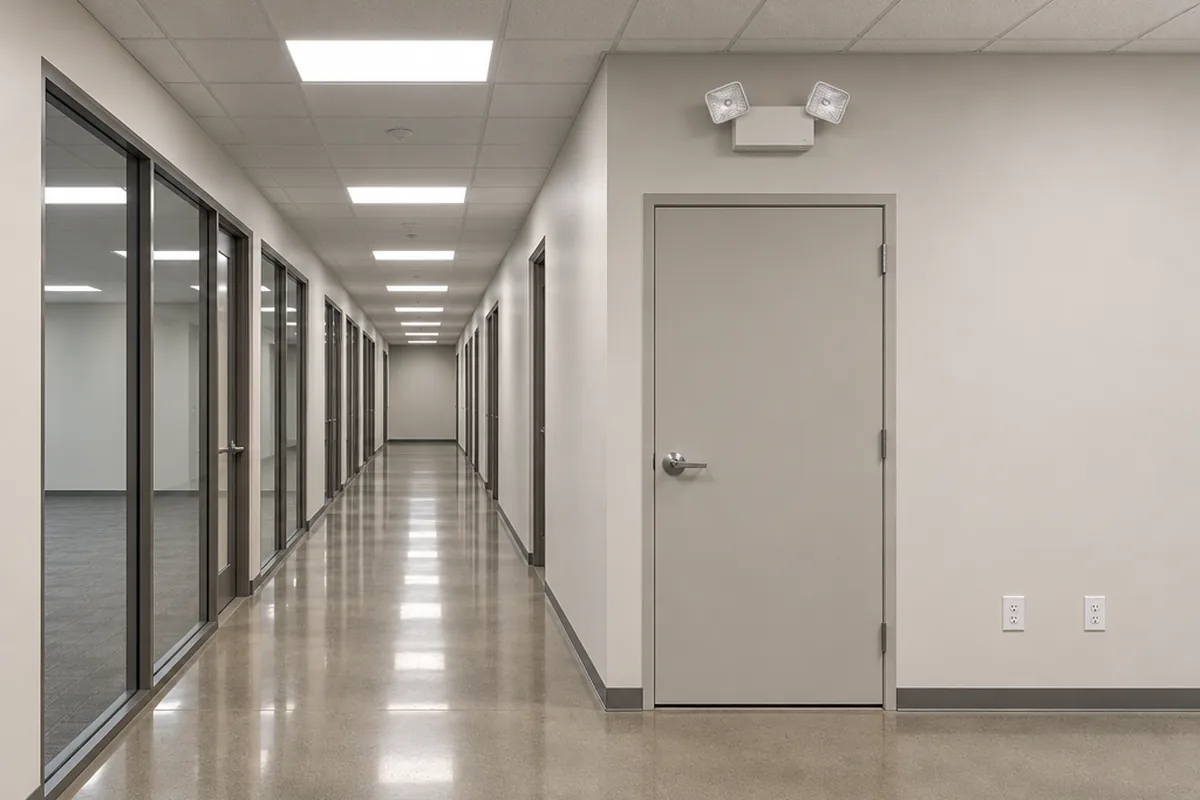
Five of those six are replacements in kind. The sixth, the copier, needs a circuit of its own from a licensed electrical contractor, and our note on dedicated equipment outlets explains how that is arranged. Short on places to charge a phone? See USB outlets and charging stations.

Send the property list, the addresses and the hours each space sits empty.

We return the list sorted by trade, with our part scoped and priced in writing.

A technician completes the round and you receive photos and notes for every line.
The work is backed in writing by our workmanship warranty and done by a Kaminskiy-certified, background checked technician.
In kind means the new part does the same job in the same place on the same wiring: a receptacle for a receptacle of the same rating, a driver for a driver, an exit sign for an exit sign. Nothing is added to the circuit and nothing is moved. That is the work a technician does, and it covers most of what fails in a building.
Heat marks on a plate, a burning smell, lights that dim when equipment starts, or a device that fails again weeks after replacement all point past the part to the wiring or the load. We stop at that point. A licensed electrician diagnoses it, and our notes and photos go with the referral.
Offices keep adding things that plug in. Swapping a receptacle for one with USB ports is device work. A machine whose nameplate calls for its own circuit is different: that is added wiring by a licensed electrical contractor, and no power strip or extension cord stands in for it.
A good electrical close-out names the location, the part removed, the part installed and the date. For exit and emergency lighting it also records the test. For unit alarms it records the manufacture date. Those records are what an insurer, a fire inspector or the next manager will ask to see.
Can't find your answer? Call 855-695-1195 and ask us anything.
Call 855-695-1195We replace existing fixtures, lamps, ballasts, drivers, receptacles, switches, exit signs, unit emergency lights and unit smoke and CO alarms in kind on existing circuits. We also do the work around an electrician's job: patching, painting and mounting. We do not add circuits or work inside panels.
Yes, as replacement in kind. Commercial lighting repair for us means finding the failed part of an existing fixture, whether lamp, ballast, driver, photocell, battery or the fixture itself, and replacing it with its match on the same circuit. Added fixtures, new circuits and lighting controls go to a licensed electrical contractor.
No. We are a handyman and repair company, licensed, bonded and insured, and our technicians replace existing parts in kind. Work that needs an electrical permit goes to a licensed electrical contractor. We can coordinate that contractor so you still have one point of contact.
It depends on the state. Many allow like-for-like replacement of fixtures and devices, others restrict it, and Florida and North Carolina require a licensed electrical contractor for electrical work. We check the rule for your property's state and tell you where the job falls ahead of scheduling.
Yes. Lighting and device replacement is scheduled for early mornings, evenings or weekends. When a circuit has to be switched off, we agree the time and the affected rooms with your contact first, so no one loses a workstation or a cooler without warning.
No. A licensed fire alarm contractor handles panels, pull stations, horn strobes and monitored detectors. What we replace are the self-contained smoke and CO alarms inside rental units and small offices, and the exit signs and battery emergency lights on the lighting circuit.
The drivers are the count of fixtures and devices, the ceiling height and lift access, the parts specified, and how many separate trips the building's hours force. Our portion is priced in writing ahead of the work, and the licensed electrician's portion is quoted separately so the two are never blended.
Yes. A lighting and device walk can be added to a recurring maintenance plan. The technician replaces what has failed since the last round, runs the monthly exit and emergency lighting check if you want it logged, and sends the updated record.
Attach the list or a few photos, the property address and the hours the space is empty. We answer with the list sorted by trade and a written scope. Or call 855-695-1195.
Sorted by trade. Priced in writing. Documented line by line.
We answer in under three rings, 24/7.No price games. You get a clear written quote before any work begins, backed by our workmanship warranty.
