 BBBAccredited Business

Kaminskiy Care and Repair upgrades an existing commercial restroom without re-plumbing it: faucets, toilets and flush valves replaced at the same connections, new partitions, accessories and mirrors, light fixtures swapped in kind, fresh paint and new flooring. It is a commercial bathroom remodel sized to the walls and pipes already there, phased so one restroom stays open. Replacing fixtures can count as an alteration under accessibility rules, so we raise that before pricing. Report-driven corrections are ADA restroom updates. Restroom projects are one branch of our commercial remodeling services for occupied buildings.
Every tenant on the floor uses it and every prospect is walked past it. The fixtures run, but the laminate partitions are swollen at the bottom, the faucets are three different models and the lighting is yellow. We replace partitions, faucets, flush valves, accessories and light fixtures in kind, repaint and refloor, one restroom at a time so the floor is never without.
Customers judge the kitchen by the restroom. A single-user room gets a new toilet and lavatory on the existing rough-in, a new faucet, mirror, dispensers and light, wall panels or paint, and a floor that cleans easily. A stall door that only needs a latch, or one running valve, is a repair: see commercial restroom repair.
Pool and clubhouse restrooms take wet feet, sunscreen and hard use. We replace corroded accessories with stainless, set new toilets and faucets, recoat walls with a scrubbable finish and replace flooring with a slip-resistant tile or sheet product, scheduled outside the season or midweek when the amenity is quiet.
We list every fixture, partition, accessory and light by restroom, note shut-off locations and wall construction, and photograph each wall straight on.
The scope says which restroom closes on which dates and which one staff and visitors use meanwhile. Signs go up and the janitorial crew is told.
Old partitions and accessories come off, holes are patched, walls are painted or paneled, flooring goes down, then fixtures, partitions and accessories are set and sealed.
Every valve is checked for leaks, every flush and faucet is run, doors and latches are cycled, and the room is cleaned and photographed before the closed sign comes down.
Section 202.3 of the 2010 ADA Standards says that where existing elements or spaces are altered, each altered element or space shall comply with the applicable requirements, with an allowance where compliance is technically infeasible. Put plainly, a lavatory, mirror or dispenser we replace is set to the current dimensions, such as a rim no higher than 34 inches (section 606.3), and an upgrade may not reduce the access a room already has (section 202.3.1).
Section 202.4 adds a second duty when a primary function area is altered: the path of travel to it, including the restrooms serving it, is made accessible unless the cost is disproportionate. Federal regulations list restrooms themselves as not being primary function areas. So a restroom upgraded alone is judged element by element, while one upgraded alongside a suite renovation may be where the path-of-travel work lands. The building official decides.
The EPA lists the federal standard for flushometer-valve toilets at 1.6 gallons per flush, with WaterSense labeled models at 1.28 or less, and reports older units flushing 3.0 to 7.0 gallons. State and local codes may set their own limits, so we check before ordering. A valve and bowl must be matched to the same flush volume to clear properly, so we replace them as a pair or confirm the rating marked on the bowl.
Sources for the rules on this page: 2010 ADA Standards for Accessible Design, sections 202.3, 202.4, 213.2 and 606.3 (U.S. Access Board); U.S. Department of Justice, ADA Title III Regulations, 28 CFR 36.403; U.S. EPA WaterSense, Commercial Toilets.
Most of what dates a restroom is bolted on: fixtures, partitions, accessories, lights. All of it can change without opening a wall.
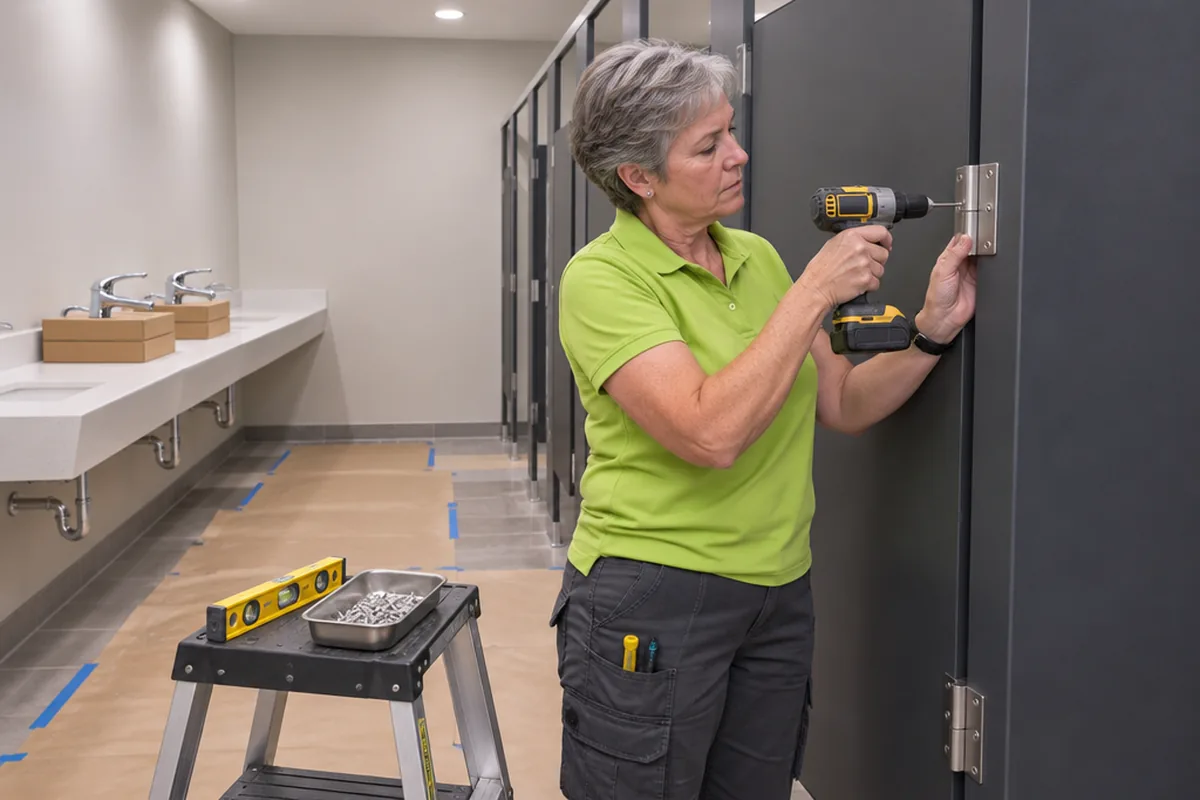
A typical upgrade swaps the toilets and flush valves at the existing carriers or flanges, replaces lavatory faucets and supply stops, hangs new partitions, mounts matching dispensers, mirrors and hooks at current heights, changes light fixtures in kind, coats the walls and lays new floor. Grab bars are reset or added during the job, as our grab bar installation page describes.
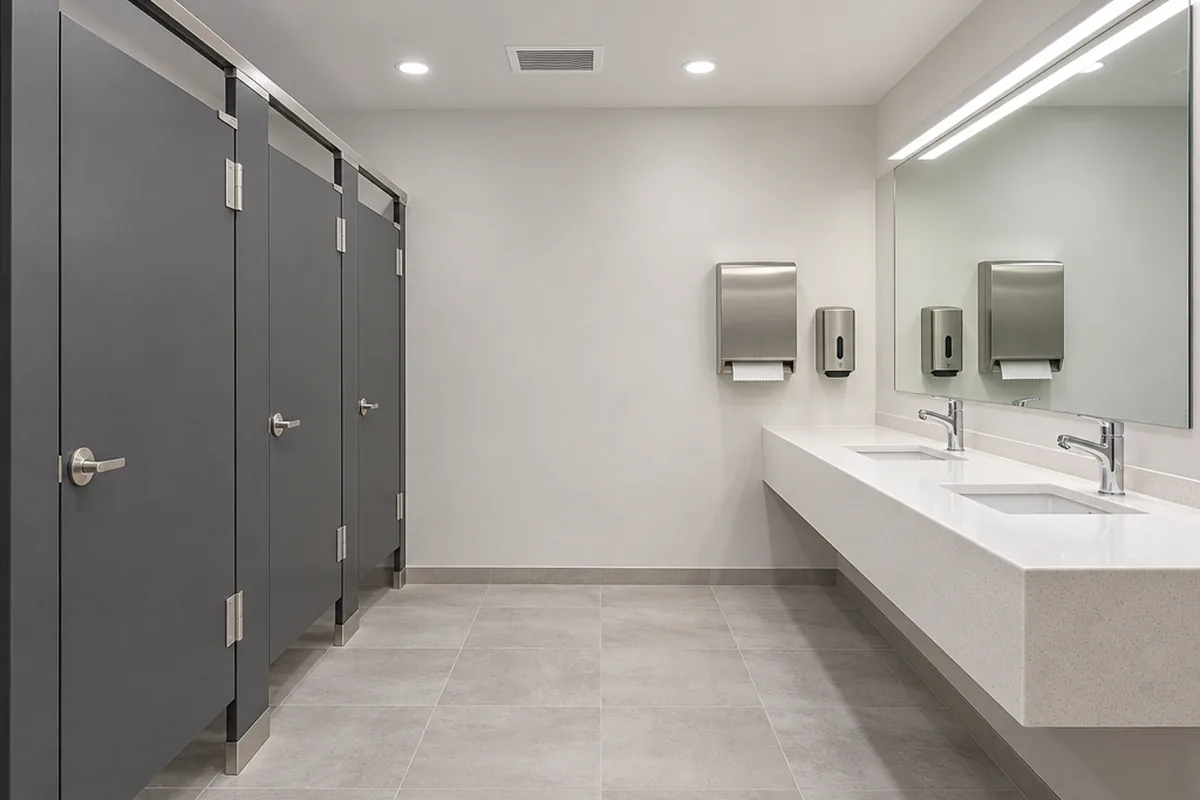
When every item in a restroom is at the end of its life, one planned upgrade is less disruption than a year of work orders. If two or three items are failing, repair those and wait. We will tell you which case you have.

Send the building address, how many restrooms and fixtures, and the hours they can be closed.

We count and measure each room and return a written scope with a fixture schedule and the phasing.

Restrooms are upgraded one at a time, tested, cleaned and photographed before they reopen.
The work is backed in writing by our workmanship warranty and done by a Kaminskiy-certified, background checked technician.
Baked-enamel steel is the entry level and rusts at the bottom where mops hit it. Plastic laminate looks good and swells if water gets into the core. Solid plastic and phenolic do not absorb water and suit pools, schools and busy public rooms. Stainless is the long-life choice. Layout matters more than material: we keep the accessible stall's size and door swing exactly as they are unless a designer changes them.
A wall-hung toilet hangs on a carrier inside the wall; a floor-mounted one sits on a flange at a set distance from the wall. The new bowl has to match what is there. Flush valves come in set flush volumes and must match the bowl. Lavatory faucets must match the hole spacing of the sink or counter. We record all of this on the fixture schedule before ordering.
Restroom walls do well in a scrubbable coating, covered under high-traffic coatings, or in rigid panels behind the fixtures, covered under FRP wall panels. Floors need a surface that drains toward the floor drain and a sealed joint at the wall. Small rooms are within our commercial tile installation work, and new tile over sound old tile is sometimes possible.
Some older restrooms are too small for the clearances in section 603 of the 2010 ADA Standards. For alterations, section 213.2 allows a single unisex toilet room in the same area and on the same floor where bringing the existing rooms up is technically infeasible. Deciding that is a job for an architect and the building official. We bring it up at the walk so it is settled before fixtures are ordered.
Can't find your answer? Call 855-695-1195 and ask us anything.
Call 855-695-1195Yes, and that is the scope of this service. Toilets, flush valves, lavatories and faucets are replaced at their existing drains and supplies. Partitions, accessories, mirrors, lights, wall finish and flooring are renewed around them. Moving or adding a fixture is permit work for a licensed plumbing contractor.
It is the version that keeps the layout. A remodel that enlarges stalls, adds fixtures or moves walls needs an architect, a permit and licensed plumbing and electrical contractors. An upgrade renews everything a visitor sees and touches while the walls, drains and supplies stay where they are, which is why it can be phased in an open building.
The room being worked on is closed, with signs, while another stays open. In a building with one restroom, work is scheduled when the business is closed and planned so the room is back in use before opening. The phasing is written into the scope so tenants know in advance.
It can. Under the 2010 ADA Standards, an element that is altered has to meet the current requirements where feasible, so a replaced lavatory, mirror or dispenser is installed to current dimensions. Larger obligations depend on the building and on other work under way. That judgment belongs to the building official or an access specialist, not to us.
ADA restroom updates correct specific items listed in an access report, such as a mirror height or a dispenser location. A restroom upgrade renews the room: fixtures, partitions, accessories, lighting and finishes. When an upgrade is planned and a report exists, we fold the report's items into the same job.
Yes, in kind. Light fixtures and hand dryers are replaced on the existing circuit and box. Adding a dryer where none exists, or adding fixtures, needs a new circuit and a licensed electrical contractor. We tell you which case applies when we open the first cover plate.
Fixture count and fixture grade drive it, then partition material, wall and floor finish, and after-hours phasing. A two-stall room with standard fixtures is a different job from a six-stall room in stainless and tile. You get a written scope and a fixture schedule with one price per restroom before anything is ordered.
Yes. We record the partition color, fixture models, accessory line, paint and floor product from the first restroom, and build the next ones to that list. Janitorial staff then stock one type of refill and one set of repair parts for the whole building.
Send the address, the number of restrooms and stalls, a photo of each wall and the hours each room can close. A scope and fixture schedule come back. Or call 855-695-1195.
Fixtures in place. One room closed at a time. Photos before it reopens.
We answer in under three rings, 24/7.No price games. You get a clear written quote before any work begins, backed by our workmanship warranty.
