
 BBBAccredited Business

Kaminskiy Care and Repair handles commercial outlet repair by replacing the worn device in kind: loose receptacles, failed switches and dimmers, cracked plates, GFCI outlets at sinks, rooftops and exterior walls, and USB outlets, in offices, stores, clinics and rental units. Each device goes back on its existing box and circuit and is tested, with the work done after hours. Heat, scorching or repeated tripping is a wiring fault for a licensed electrician, and so is any new circuit, which we coordinate. Device replacement belongs to our commercial electrical and lighting category.
The receptacle by the conference table and the one at the copier take a plug dozens of times a week. Contacts lose their grip and chargers fall out. We replace them with commercial-grade devices of the same rating. Where a room needs ports more than plugs, the same boxes can take USB outlets and charging stations. Dim or flickering fixtures overhead are a different visit: office and retail lighting replacement.
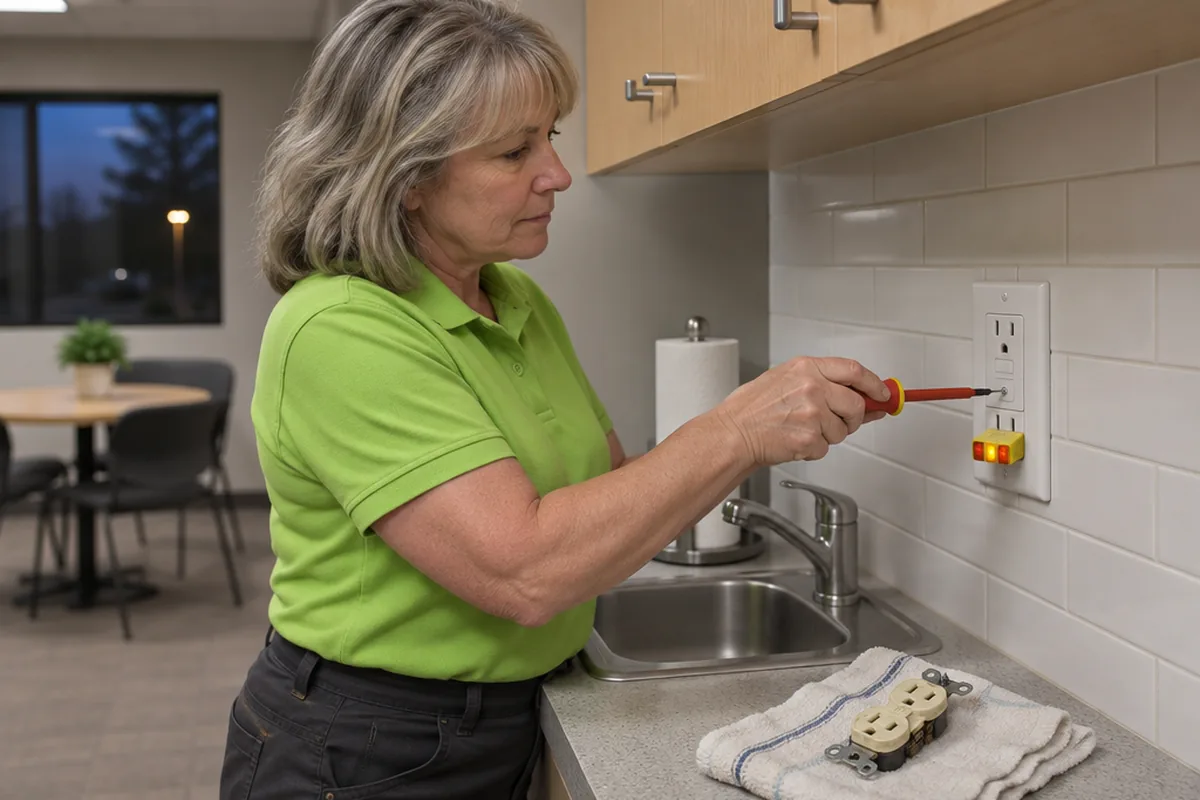
A receptacle beside a lavatory, a break room sink, a prep table or a rooftop unit is where ground-fault protection earns its place. Older buildings often have plain devices there, or GFCIs that stopped resetting years ago. We fit GFCI receptacles in the existing boxes, trip test each one and label what it protects. Tired counters and cabinets around them belong to break room remodeling.
Every turnover turns up devices that were painted over, cracked by furniture or pulled loose in the box. We replace receptacles, switches and plates through the unit to one standard color and grade, so the next move-in inspection has nothing to write down. Plates go back on once the walls are dry, which is why this pairs with unit turnover painting.
Send the count by room or unit, and say what each device is doing: dead, loose, cracked, warm, sparking, will not reset. Warm and sparking go to the top.
The circuit is switched off at the panel and checked dead at the device with a tester ahead of any screw being loosened. Staff on that circuit are told first.
The replacement matches the old device's amperage, voltage and type. Wires are landed under the screws or clamps, the box is checked for damage, and the device is set flush.
Each receptacle is tested for correct wiring and plug grip, each switch for operation, each GFCI with its own button and a plug-in tester. Plates go on, and the room list is marked off with photos.
Three OSHA paragraphs cover the basics. 29 CFR 1910.305(b)(2) requires each outlet box in a completed installation to have a cover or faceplate. 29 CFR 1910.303(b)(7)(iv) allows no damaged parts that may adversely affect safe operation or mechanical strength. 29 CFR 1910.305(j)(2)(ii) says a receptacle must not accept a plug of a different voltage or current rating, except that a 20-ampere T-slot receptacle takes a 15-ampere plug. So a cracked plate, a broken face or a mismatched device gets replaced.
The National Electrical Code, section 210.8(B), lists where receptacles outside dwelling units need GFCI protection. The 2020 edition names bathrooms, kitchens, rooftops, outdoors, receptacles within 6 feet of a sink, indoor damp and wet locations and locker rooms with showers. Many jurisdictions adopt the code, each on its own edition, and the local inspector decides. Separately, OSHA's 29 CFR 1910.304(b)(3)(i) calls for GFCI protection on 125-volt, 15- and 20-ampere receptacles in bathrooms and on rooftops, for installations made after August 13, 2007.
The Consumer Product Safety Commission advises testing each GFCI once it is installed, at least once a month after that and following any power failure: press the test button and confirm the power drops. CPSC notes the device reacts to a difference as small as 0.006 amperes. One that will not trip, or will not reset, has failed and is replaced. In a commercial building somebody has to own that round, and we can add it to a maintenance plan and log every device.
Sources for the rules on this page: OSHA 29 CFR 1910.305, sections (b)(2), (c)(4), (g)(1)(iv) and (j)(2); OSHA 29 CFR 1910.303, sections (b)(2) and (b)(7)(iv); National Electrical Code (NFPA 70), 2020 edition, section 210.8(B) (text published by the U.S. Virgin Islands DPNR); OSHA 29 CFR 1910.304(b)(3)(i); OSHA 29 CFR 1910.302(b)(4); U.S. Consumer Product Safety Commission, GFCI Fact Sheet (Pub. 099).
Kaminskiy Care and Repair replaces plain receptacles with GFCI receptacles, and worn-out GFCIs with new ones, in commercial restrooms, break rooms, kitchens, rooftops and exterior walls. A GFCI outlet fits the box and the conductors already there, so the swap is a replacement in kind. The technician first maps which receptacles an upstream device already protects, then installs, trips each device with its own button and a plug-in tester, and labels it along with the receptacles it guards. Outdoors and on roofs we fit weather-resistant devices with in-use covers. A device that trips again with nothing plugged in is reporting a real fault, which a licensed electrician traces. GFCI protection at the breaker is the electrician's work as well.
We swap existing receptacles for USB-A and USB-C receptacles and set up plug-in charging stations, furniture-mounted power units and pop-up desktop units in lobbies, conference rooms and waiting areas. Nothing is added to the wiring: every port runs from a box or receptacle the room already has. A USB receptacle is deeper than a plain one, so the technician checks box depth and what else loads the circuit ahead of ordering. OSHA's 29 CFR 1910.305(g)(1)(iv) bars flexible cords from passing through walls, ceilings or floors, so a table unit's cord runs in the open to the nearest receptacle. Beside a sink, ground-fault protection stays in place. EV chargers are a licensed electrical contractor's work, never ours.
A dedicated outlet for a copier, refrigerator, kiln or sterilizer is not a device swap. It is a new circuit, and a new circuit is permit-level work that a licensed electrical contractor installs under that contractor's own license, with the local building department deciding the permit. Kaminskiy Care and Repair does not run cable, set boxes or land conductors. Our part is to scope the location from the equipment nameplate, coordinate the licensed electrician, and do the surrounding work: access openings, patching, painting and mounting. OSHA's 29 CFR 1910.305(g)(1)(iv) does not let a flexible cord stand in for the fixed wiring of a building, so an extension cord is not the answer either.
Most dead or loose outlets are worn devices on good wiring. We replace the device and tell you plainly when the problem is behind it.
A manager's list rarely has one bad outlet. It has thirty across a floor. We work it room by room with the circuits off in sequence: worn receptacles out, commercial-grade ones in, GFCIs trip tested at the sinks, switches and dimmers replaced where they stick or crackle, and every plate matched. Each device is tested and ticked off the list.
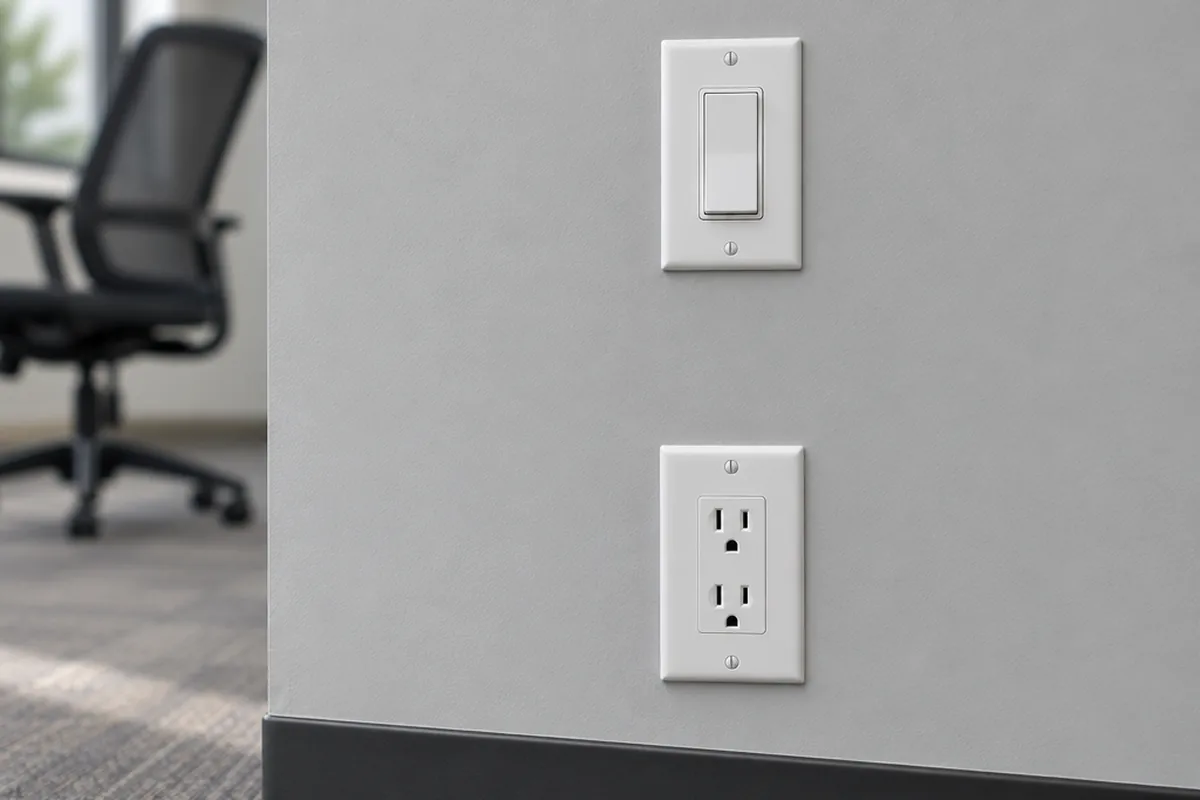
Those are worn devices. A plate that is hot, a burning smell or black marks around the slots are different: switch that circuit off if you can and call, because that one goes to a licensed electrician.

Send the room or unit list and mark anything that is warm, scorched or sparking.

We reply in writing with a price per device type and the hours each circuit will be off.

The technician replaces and tests each device, then returns your list checked off with photos.
The work is backed in writing by our workmanship warranty and done by a Kaminskiy-certified, background checked technician.
Inside a receptacle, each slot has a pair of brass contacts that squeeze the plug blade. Use and heat relax them. A loose contact makes poor connection, and poor connection makes heat, which relaxes it further. That is why a plug that falls out is worth fixing early. The cure is a replacement device, since the contacts are not serviceable.
Receptacles are sold in residential, commercial and heavier grades. Commercial-grade devices have thicker contacts, a stronger body and clamp-type terminals, and they last far longer under daily plugging. Tamper-resistant devices add shutters behind the slots and are common in units, waiting rooms and child care spaces. We replace with the grade the space needs, never a lighter one.
When one outlet is dead and everything else in the room works, check three things first: a wall switch that controls it, a tripped GFCI device elsewhere along that run, and whether only one half is dead. If none explains it, a connection has opened at that device or the one upstream. We find and replace the failed device.
A switch that crackles, feels soft or needs a second push has worn contacts. A dimmer that is slightly warm is normal, but one that buzzes or flickers is usually mismatched to LED lamps or loaded past its rating. We replace with a dimmer listed for the lamp type and total wattage on that switch.
A GFCI compares the current leaving on one conductor with the current returning on the other. When a few thousandths of an ampere go missing, it treats the difference as a leak to ground, perhaps through a person, and opens the circuit. It guards people, not wiring against overload. One GFCI receptacle can also protect the plain receptacles wired after it, which is how a single tripped device leaves a second room dead until somebody finds the reset button.
Read the machine's nameplate. An ordinary wall outlet shares 120 volts at 15 or 20 amperes with everything else on its run. If the label's amperage comes close to that alone, if it shows 208 or 240 volts, or if the manual asks for an individual circuit, no replacement device will stop the tripping. A licensed electrical contractor adds the circuit, usually under a permit, and we close the wall afterward with drywall patching in occupied space.
Can't find your answer? Call 855-695-1195 and ask us anything.
Call 855-695-1195We replace them. The contacts inside a receptacle cannot be serviced, so outlet repair on a commercial property means taking out the worn device and installing one of the same rating in the same box, on the same conductors. Nothing is added or rerouted. If the conductors are damaged or too short to work with safely, that repair belongs to a licensed electrician.
Yes. A GFCI receptacle fits the existing box and lands on the existing conductors, so nothing is added to the circuit. The technician checks the box depth, the circuit rating and whether a device upstream already protects that spot, then trip tests and labels the new one. Protection built into a breaker is a licensed electrician's work.
The National Electrical Code answers that in section 210.8(B). Its 2020 edition lists bathrooms, kitchens, rooftops, outdoors and receptacles within 6 feet of a sink, among other places. Your state or city may be on a different edition, and the local inspector judges an existing building, so we replace devices and leave the ruling to that office.
Usually moisture in an outdoor box, a failing appliance, a damaged cord or a device that has worn out. Unplug everything and press reset. If it holds, plug items back in singly to find the cause. If it trips with nothing connected, or a fresh device trips at once, the wiring down the line needs a licensed electrician.
Heat at a device means a loose connection, a failing contact or more load than the circuit should carry. Stop using it. We can replace a worn receptacle, but discoloration, melted plastic or a burning smell is treated as a wiring fault and referred to a licensed electrician ahead of anything being put back.
Yes. A USB receptacle goes in the same wall box on the same conductors as the device it replaces. It is bulkier than a plain receptacle, so the box depth is checked first. Phones and tablets charge from any port; a laptop needs a higher-output USB-C port, so tell us if laptops matter.
No, not ourselves. Each of those means cable, a box and a place in the panel that were not there, which is permit-level work for a licensed electrical contractor. For an added outlet or an equipment circuit we scope the job, coordinate that contractor and then patch, paint and mount. Vehicle chargers we leave to the electrical contractor entirely.
The answer changes from state to state, and in places from city to city. Many allow like-for-like device replacement, while Florida and North Carolina require a licensed electrical contractor. We look up the rule for the property's location and tell you up front whether the job is ours or coordinated.
Only the circuit being worked on, and only while its devices are changed. On a floor-wide list we move circuit by circuit after hours and tell your contact which rooms go dark and when, so servers, coolers and security equipment are planned around.
Price depends on the number of devices, the grade and type chosen, and how the building's hours break up the work. GFCI, USB and dimmer devices cost more than standard ones, and rooftop or weather-resistant locations take longer. Pricing is written per device, which makes a long list easy to approve in parts.
List the rooms or units, the number of outlets, GFCIs, switches and plates, and anything warm or scorched. Photos help. We answer in writing with a per-device price, or call 855-695-1195.
Like for like. Tested one by one. Faults reported, never hidden.
We answer in under three rings, 24/7.No price games. You get a clear written quote before any work begins, backed by our workmanship warranty.
