 BBBAccredited Business

Kaminskiy Care and Repair handles commercial door installation on commercial and multi-unit buildings: replacement hollow metal, solid wood and fiberglass entry doors hung in the existing frame or in a new one, with hinges, closer, lockset prep, threshold and weatherstrip. We install a door you supply or one we order to the opening's measurements, at an hour that keeps the entrance usable. Glass storefront systems are a glazing contractor's work, and labeled openings are covered under fire-rated door installation. Entry door installation is part of our door and hardware work for commercial property.
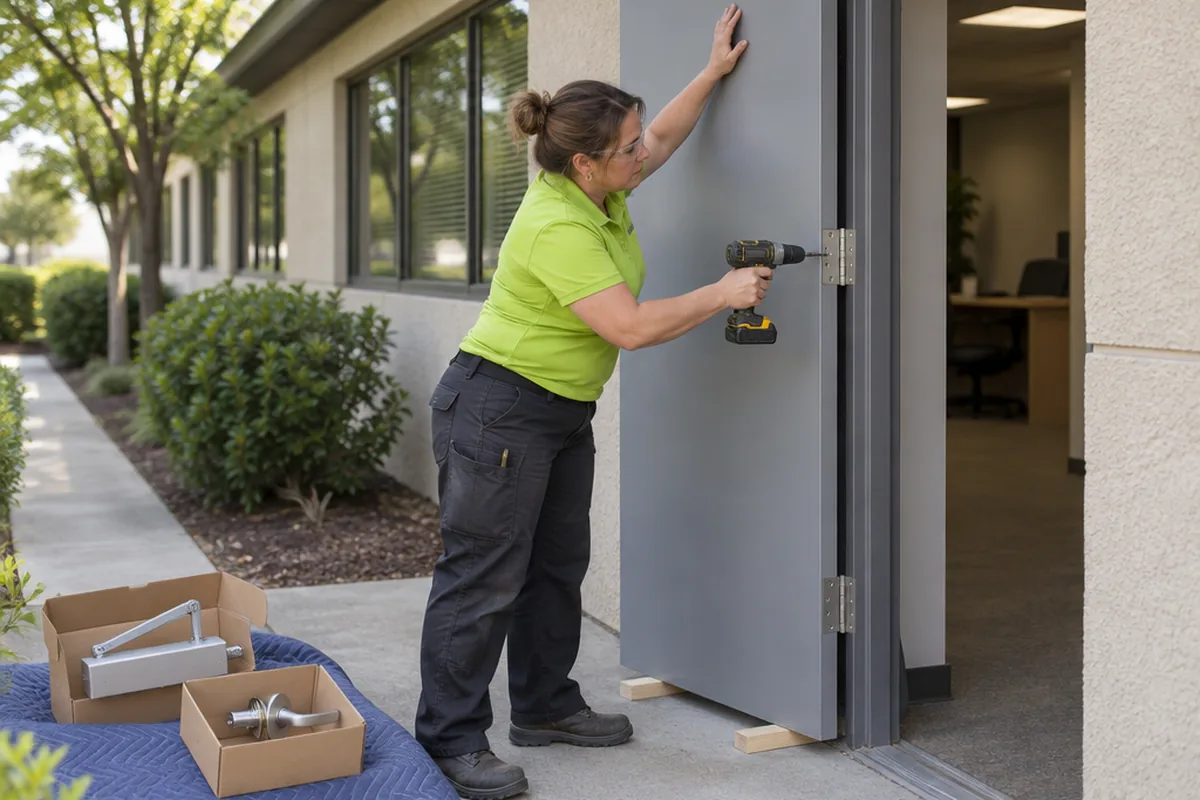
Staff entrances on the weather side rust from the bottom seam up until the steel face separates and the lock rattles in its pocket. We measure the frame, order a galvanized hollow metal door with matching hinge and lock preps, hang it in the existing frame and move the closer and lever across or replace them.
A pried door usually has a bent lock edge and a spread frame at the strike. Patching that steel rarely holds. We replace the slab, and the frame too when the strike jamb is torn, then set a reinforced strike and a latch guard. Glass entries stay on our storefront door repair page.
Wood doors on pool buildings, laundry rooms and mail rooms swell, split at the rails and stop latching. For community managers we swap them for fiberglass or solid-core doors sized to the old frame, with closers that pull them shut. Doors into the apartments themselves are covered under tenant unit door replacement.
We record width, height and thickness, the hinge locations, the lock backset, the hand of the door and the frame depth. An old slab that was trimmed to fit a racked frame is a bad pattern for its replacement.
The door is ordered with hinge and lock preps that match the frame, or as a blank we prep on site for a wood door. You see the door type, the hardware list and the price in writing first.
The old door comes off and the new one goes on in the same working block, so the building is never left open overnight. Hinges are shimmed until the gap is even on the head and both jambs.
Closer, lockset, threshold and weatherstrip go on, the frame joint is sealed, and the door is cycled until it latches unassisted. Photos and the hardware list are sent for the property file.
The International Building Code (2021, section 1010.1.1) and the 2010 ADA Standards (section 404.2.3) both call for 32 inches of clear opening, measured from the face of the door to the stop with the door open 90 degrees. The IBC also sets a clear height of 80 inches. Many jurisdictions adopt the IBC, and the local official decides what applies to an existing opening.
IBC section 1010.1.2.1 has side-hinged doors swing in the direction of exit travel where they serve a room or area with an occupant load of 50 or more, or a Group H occupancy. OSHA's exit route rule (29 CFR 1910.36(e)(2)) says much the same for workplaces. Reversing a door's hand during a replacement is a code question first and a carpentry question second, and the answer is the building official's to give.
Table 404.2.4.1 of the 2010 ADA Standards asks for 18 inches of wall beyond the latch edge on the pull side of a front approach, and 12 inches on the push side when the door has both a closer and a latch. A new frame set a few inches over can erase that space. We install to those dimensions; we do not survey or certify a building.
Sources for the rules on this page: International Building Code (2021), sections 1010.1.1 and 1010.1.2.1; 2010 ADA Standards for Accessible Design, section 404.2.3 and Table 404.2.4.1; OSHA exit routes standard, 29 CFR 1910.36(e)(2).
Slab, frame, hinges, closer, lock and threshold are planned as one opening, so nothing has to be forced to fit on installation day.
When the frame is plumb and its anchors are tight, only the door needs to change. We order a slab with hinge and lock preps that line up with the frame, transfer or replace the closer and lockset, fit a new sweep and adjust the strike. If the bottom of the opening is worn too, we pair the job with a new threshold and sweep.
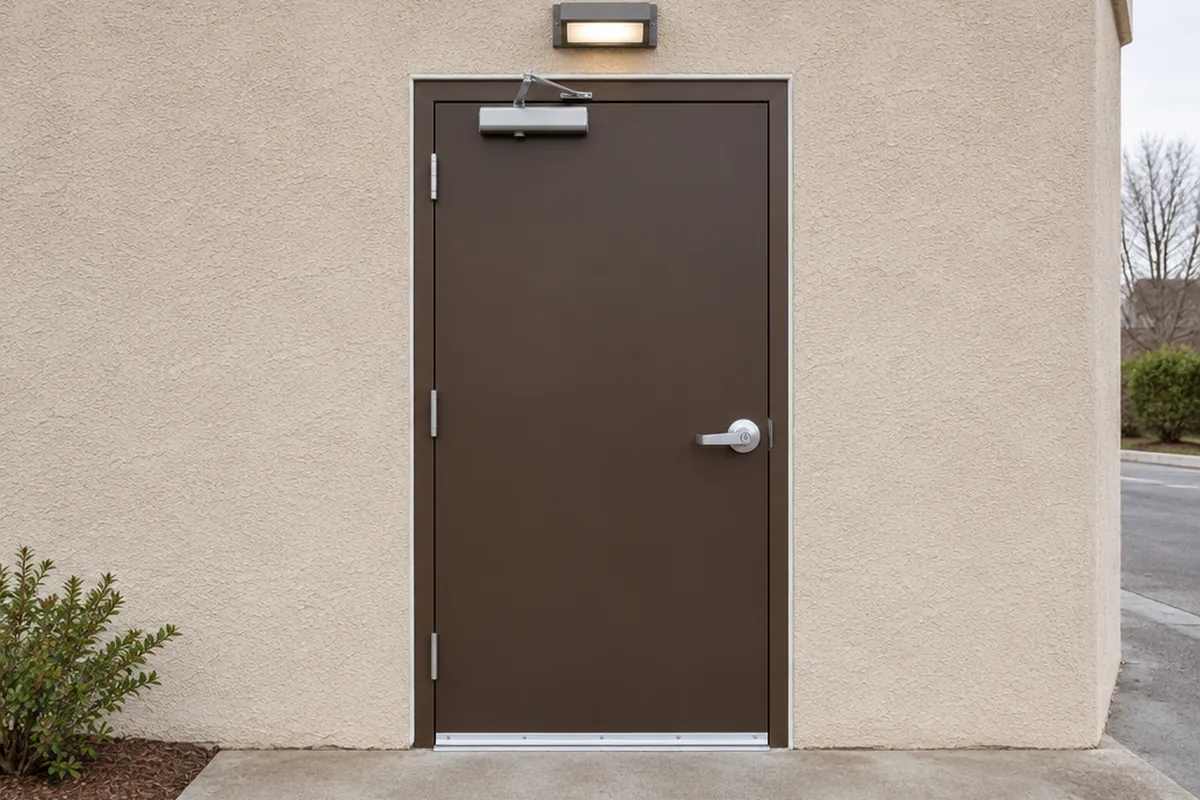
A door with these faults costs more to keep patching than to replace. When the slab is sound and only the hardware is tired, a new door closer or a replacement lockset is the smaller job, and we say so.

Send photos of both faces of the door, the hinge side and the frame, plus the opening size if you have it.

We confirm measurements on site and give you a written scope naming the door, the hardware and the price.

The door is hung, the hardware set and tested, and you receive photos and the parts list for your records.
The work is backed in writing by our workmanship warranty and done by a Kaminskiy-certified, background checked technician.
Stand on the outside of the door. Hinges on your left make it a left-hand door, hinges on your right a right-hand door, and a door that opens toward you is called reverse. The hand decides which lockset, closer arm and exit device fit. Ordering the wrong hand is the most common reason a replacement door sits in a hallway for three weeks.
Hollow metal is the workhorse for exterior and back-of-building entries: it takes abuse, holds hardware and can be ordered galvanized for wet exposures. Solid-core wood suits interior suite entries where appearance counts. Fiberglass does not rust or swell, which makes it a good fit for pool buildings and coastal sites. We recommend by exposure and traffic, not by habit.
A steel frame can outlive several doors. It needs replacing when the strike jamb is torn, the hinge reinforcements have pulled loose, the bottoms have rusted through at the slab, or the frame is so far out of square that no door will seal. A knock-down frame can be set in an existing wall opening; a welded frame in masonry is a bigger job and we tell you which you have.
A commercial door arrives with cutouts for its hinges, its lock and sometimes its closer. Those preps must match the frame and the hardware you plan to reuse. A cylindrical lock prep will not take a mortise lock, and hinge spacing differs between door makers. That is why we measure the frame's hinge and strike locations instead of trusting the tag on the old slab.
Can't find your answer? Call 855-695-1195 and ask us anything.
Call 855-695-1195Yes. We install doors supplied by the owner or the tenant as long as the size, hand and preps suit the opening. Send the order sheet or photos of the door before the visit. If the door will not fit the frame, we would rather tell you then than on installation day.
Often only the door. If the frame is plumb, its anchors are tight and the hinge and strike reinforcements are intact, a new slab can be hung in it. A torn strike jamb, rusted frame bottoms or a frame racked out of square means the frame goes too. We check with a level and a tape before quoting.
No. Aluminum and glass storefront doors, sidelights and glass lites are supplied and set by a glazing contractor. We install hollow metal, wood and fiberglass entry doors, and we repair the hardware on existing storefront doors. If your opening is a glass system, we tell you that up front.
It may. Many building departments treat a like-for-like door swap differently from a new frame, a wider opening or a change in swing. The local building official decides, and requirements differ from city to city. We tell you when the scope is the kind that usually calls for a permit so you can ask before work starts.
The old door is removed and the new one hung in the same working block, so the opening is not left unsecured between visits. We schedule that block early, late or on a weekend, and we plan around deliveries and tenant access for that particular entrance.
The door material and size, whether the frame is replaced, how much of the existing hardware can be reused, and the wall the frame sits in. Special-order sizes and preps add lead time. You receive a written price for the door, the hardware and the labor before anything is ordered.
Usually, if they are in good order and the new door is prepped for them. We test the closer for leaks and the lockset for wear first. Reusing a worn lock on a new door saves little, so we point out parts that are near the end of their life and let you decide.
Photos of both faces of the door, the hinge side and the frame, plus the opening's width and height if you can take them. On site we confirm the thickness, hinge locations, lock backset, hand and frame depth. Say so if the door or frame carries a fire label, because a labeled opening is ordered and installed under its own rules.
Send the address, photos of both sides of the door and frame, and the door's width and height if you can measure them. We answer with a written scope and an install window. Or call 855-695-1195.
Measured on site. Priced in writing. Hung and tested with the hardware in place.
We answer in under three rings, 24/7.No price games. You get a clear written quote before any work begins, backed by our workmanship warranty.
