
 BBBAccredited Business

Kaminskiy Care and Repair replaces dark exit signs and failed unit emergency lights in kind on the existing circuit: batteries, lamps, charger boards or the whole unit. For property and facility managers we also run the monthly 30-second and yearly 90-minute tests described in NFPA 101 and hand over a written log. Normal ceiling fixtures are office lighting replacement. Central inverter systems and anything wired to the fire alarm belong to licensed contractors. Life-safety lighting is one service in our commercial electrical and lighting group.
Residential buildings spread their exit and battery lighting across many small corridors, and nobody owns the monthly check. We take the round on a schedule: press the test button on every unit, time the yearly discharge, replace what fails and leave a dated log in the manager's file.
Every corridor and stair has battery units that sit on charge for years. Batteries swell, lamps corrode and charging lights go out. We test each unit, replace batteries or whole units like for like, and number them on a floor plan so the following round takes half the hunting.
Back-of-house exit signs get hit by stock, coated in grease and forgotten. A sign that is dark, half lit or hidden behind shelving is the item a fire inspector writes first. We replace the sign in kind and report anything that blocks its view. The door hardware under it is a separate trade item: panic bar and exit device service.
Send the fire inspection notice or your own list. If there is no list, tell us the number of floors and exits and we count units on the first walk.
Each sign and unit is tested on its button or by switching off its circuit, so we replace only what fails and know whether the battery, lamp or charger is at fault.
Batteries are matched by voltage and capacity, lamps by type. A whole unit is replaced with one of the same kind on the same box and circuit, after hours where the corridor is busy.
The log lists each unit by location with test date, duration, result and what was replaced. A copy stays on site for the inspector.
NFPA 101, the Life Safety Code, section 7.9.3 describes the manual test routine: a functional test every month for at least 30 seconds, and once a year for at least 1 1/2 hours on battery-powered equipment, with written records kept by the owner for the authority having jurisdiction. Many jurisdictions adopt NFPA 101 or a fire code with similar terms, and the local fire official decides what applies.
For workplaces, 29 CFR 1910.37(b) requires each exit to be marked by a sign reading Exit, with letters at least six inches high and principal strokes three-fourths of an inch wide, illuminated to at least five foot-candles by a reliable light source. Paragraph (a)(4) requires exit lighting to be in proper working order at all times.
Some exit signs have no wiring and glow from sealed tritium gas. The Nuclear Regulatory Commission states these must not be thrown out as normal trash: the owner transfers an unwanted sign to a specific licensee such as the manufacturer and reports it within 30 days under 10 CFR 31.5. We identify them by their label and leave removal to that channel.
Sources for the rules on this page: NFPA 101, Life Safety Code, 2012 edition, sections 7.9.2.1, 7.9.3 and 7.10.9 (text published by CMS); OSHA 29 CFR 1910.37(a)(4), (b)(2), (b)(6) and (b)(7); U.S. Nuclear Regulatory Commission, Backgrounder on Tritium EXIT Signs; U.S. EPA RadTown, Tritium in Exit Signs.
A sign can glow for years on a dead battery. We replace what has failed and prove the rest with a timed test.
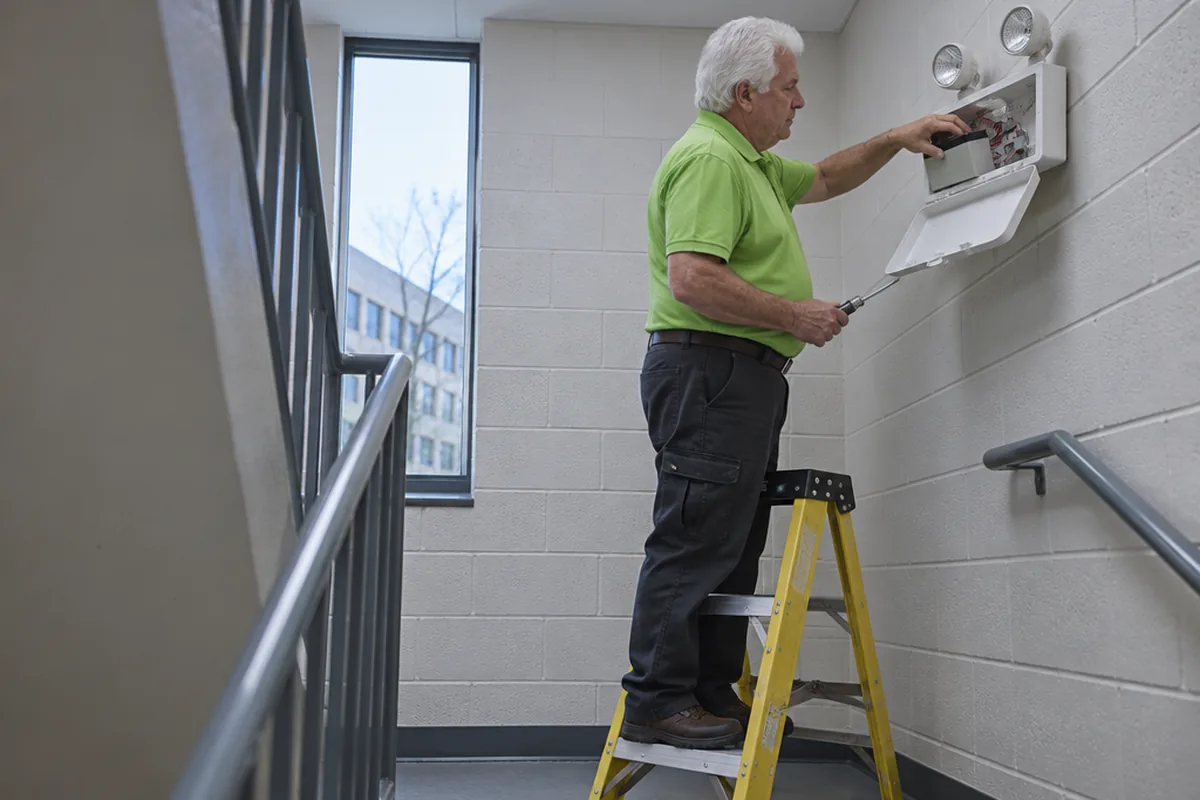
A technician walks every exit sign and battery unit with a floor plan, runs the test, and replaces failed batteries, lamps or units on the spot where parts match. The annual round includes the 90-minute discharge. You receive a numbered log: location, date, duration, pass or fail, and the part replaced.
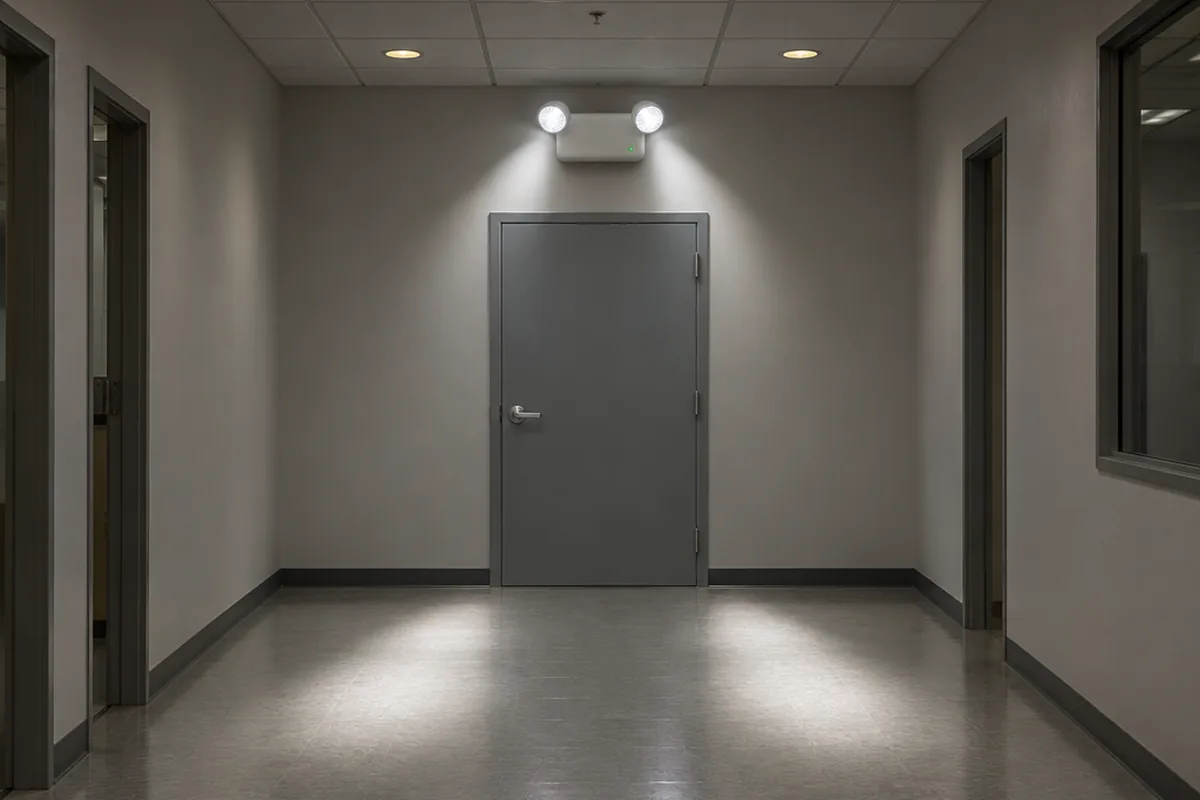
A failed test almost always comes down to a battery past its life. It is a like-for-like replacement, and the test log that follows is what answers the notice.

Send the inspection notice or the number of floors, exits and battery units.

We price the test round in writing and list unit prices for likely replacements.

A technician tests, replaces what fails and hands you a dated log for each unit.
The work is backed in writing by our workmanship warranty and done by a Kaminskiy-certified, background checked technician.
A unit emergency light is a charger, a sealed battery, a transfer circuit and one or two lamp heads. While the building has power, the charger keeps the battery full. When power drops, the transfer circuit puts the lamps on the battery. The Life Safety Code's performance figure is 1 1/2 hours of light, which is what the yearly test checks.
Sealed batteries in these units wear out from heat and age whether or not they are ever used. A worn battery still lights the lamps for a few seconds, which is why the 30-second monthly test exists and why the long yearly test catches what the short one misses. Replacement batteries must match the voltage and capacity on the old label.
A unit with a sound charger and housing needs only a battery or lamps. A unit with a dead charger board, melted lamp heads or a brittle, yellowed housing is replaced whole, usually with an LED model on the same box. Combination exit sign and light units are replaced with the same combination so coverage does not change.
Newer units test themselves and show the result on a status light. NFPA 101 allows that method, but it still calls for a visual inspection at intervals of no more than 30 days and written records. Someone has to walk past, read the light and write it down. We do that walk on a schedule if your staff cannot.
Can't find your answer? Call 855-695-1195 and ask us anything.
Call 855-695-1195NFPA 101, section 7.9.3, describes a functional test every month for at least 30 seconds and a yearly test of at least 1 1/2 hours for battery-powered equipment, with written records. Your jurisdiction may adopt that code or a fire code with similar wording, so the local fire official has the final word.
Yes. Emergency light testing is a standing service here: a technician can take the round monthly, yearly or both. Each unit is tested, timed where required and recorded by location. Failed batteries, lamps and units are replaced in kind, and the log is left on site and sent to you.
Whichever the test points to. If the charger works and the housing is sound, a fresh battery or lamp restores the unit. If the charger has failed or the unit is old and brittle, a like unit goes on the same box and circuit. You see the choice in the written scope.
A sign runs on building power day to day, so it looks fine. The inspector presses the test button, which switches it to battery. If the battery is dead, the sign goes dark. Damaged faces, missing arrows where a direction is needed and signs hidden by storage are other common notes.
No. A licensed fire alarm contractor services the alarm panel, detectors, pull stations and horn strobes. Our work is limited to exit signs and battery lighting units on the lighting circuit. If a unit is tied into the alarm or a central inverter, we note it for the licensed contractor.
Leave it in place and keep it out of the trash. Tritium signs are identified by a radiation symbol and label. Federal rules require the owner to transfer an unwanted or damaged sign to a licensed recipient, such as the manufacturer, and to report the transfer. We flag these signs on the log so the owner can arrange it.
Cost turns on the number of units, how many fail, the parts they take and whether the visit includes the 90-minute annual test, which adds time on site. Because failures are unknown until tested, the scope prices the round and lists unit prices for batteries and replacements.
Attach the notice or tell us how many floors, exits and battery units the building has, and when corridors are quiet. We send back a priced plan for the test round. Call 855-695-1195 with questions.
Every unit tested. Failures replaced in kind. A dated log on site.
We answer in under three rings, 24/7.No price games. You get a clear written quote before any work begins, backed by our workmanship warranty.
