 BBBAccredited Business

Kaminskiy Care and Repair replaces failed exterior light fixtures in kind on existing wiring: wall packs, canopy and soffit lights, bollard and path lights, stairwell and breezeway fixtures, plus the lamps and photocells that run them. Property and community managers get a fixture log by building with photos. Battery-backed egress lights are under exit and emergency lighting service. Pole lights above ladder and small-lift height, and any new circuit, go to a licensed electrical contractor. Outdoor fixtures are part of our commercial lighting and electrical services.
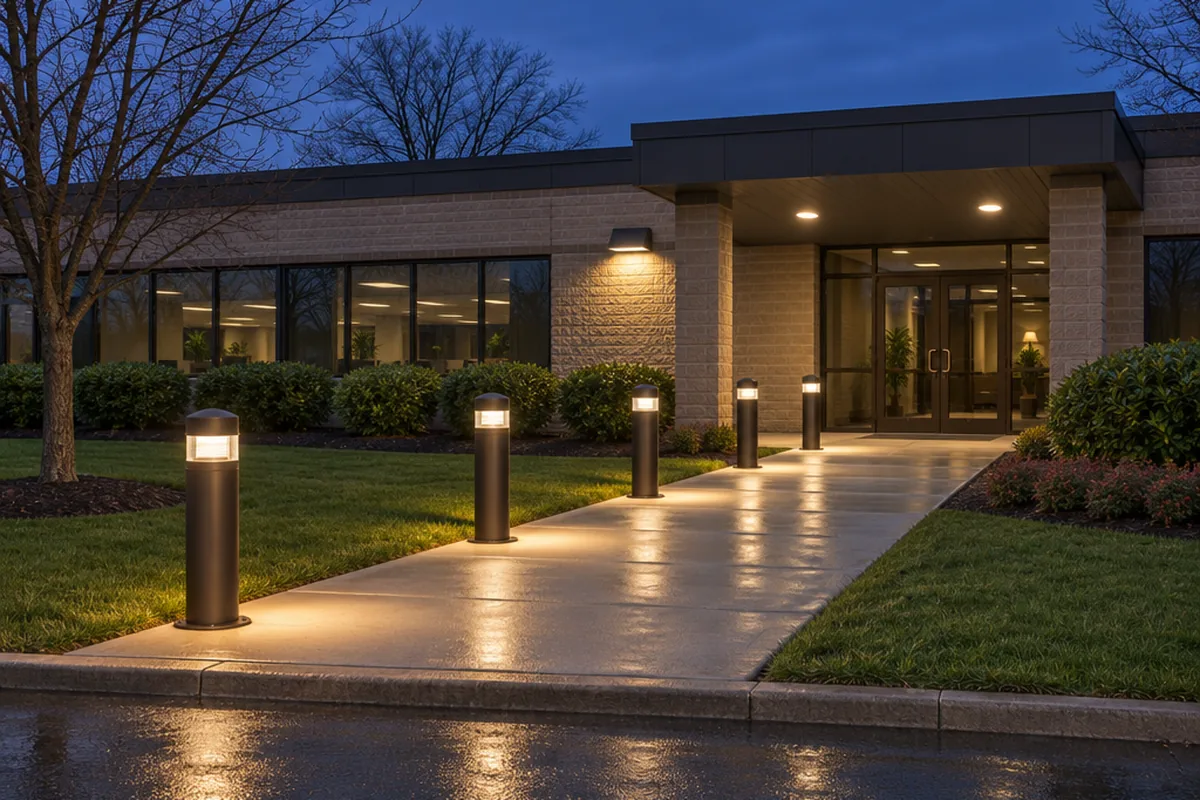
Bollards get hit by mowers, carts and bumpers, and path lights get buried by mulch. We replace broken heads, lenses and lamps and reset leaning bollards on their existing bases and wiring. A light that is dead because the underground feed is cut goes to a licensed electrical contractor.
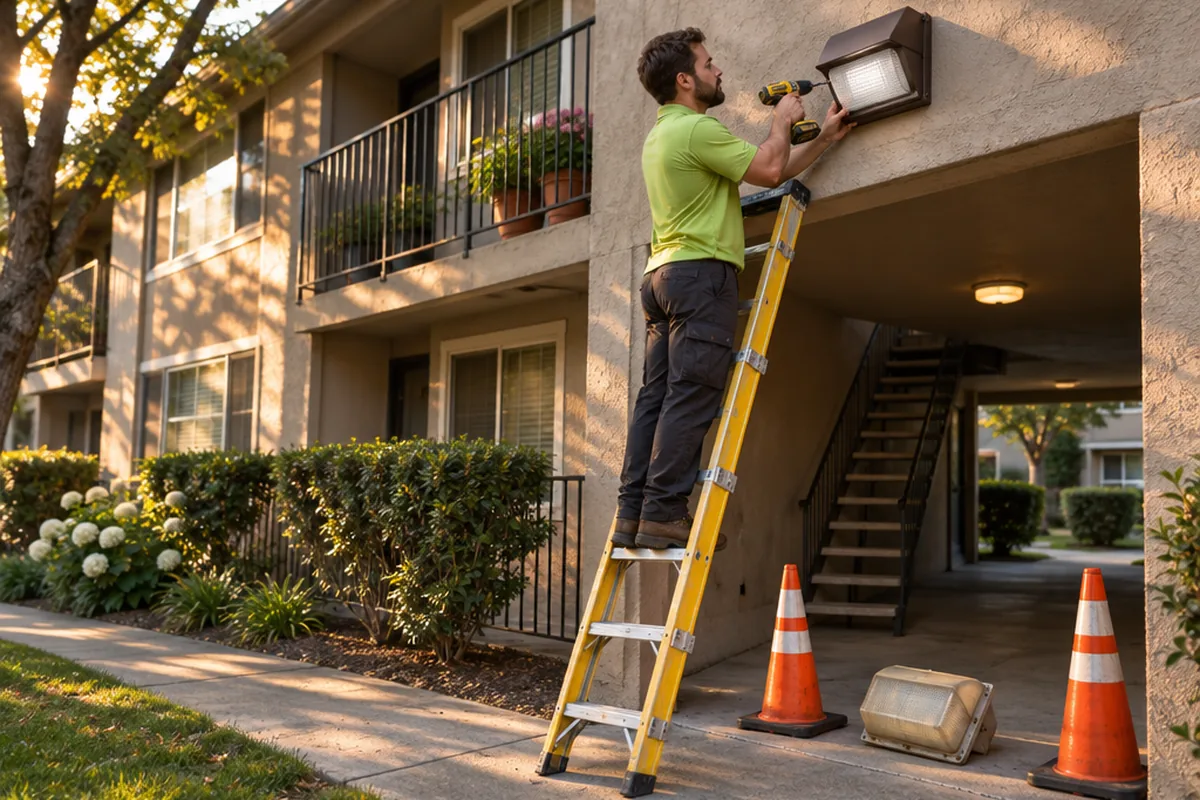
Open corridors and stairs depend on a few fixtures each, so one failure leaves a landing dark. We replace dead breezeway and stairwell fixtures with the same type on the same box, reseal the mounting and note each one by building and floor. Worn treads found on the way are a separate repair: exterior stair and walkway repair.
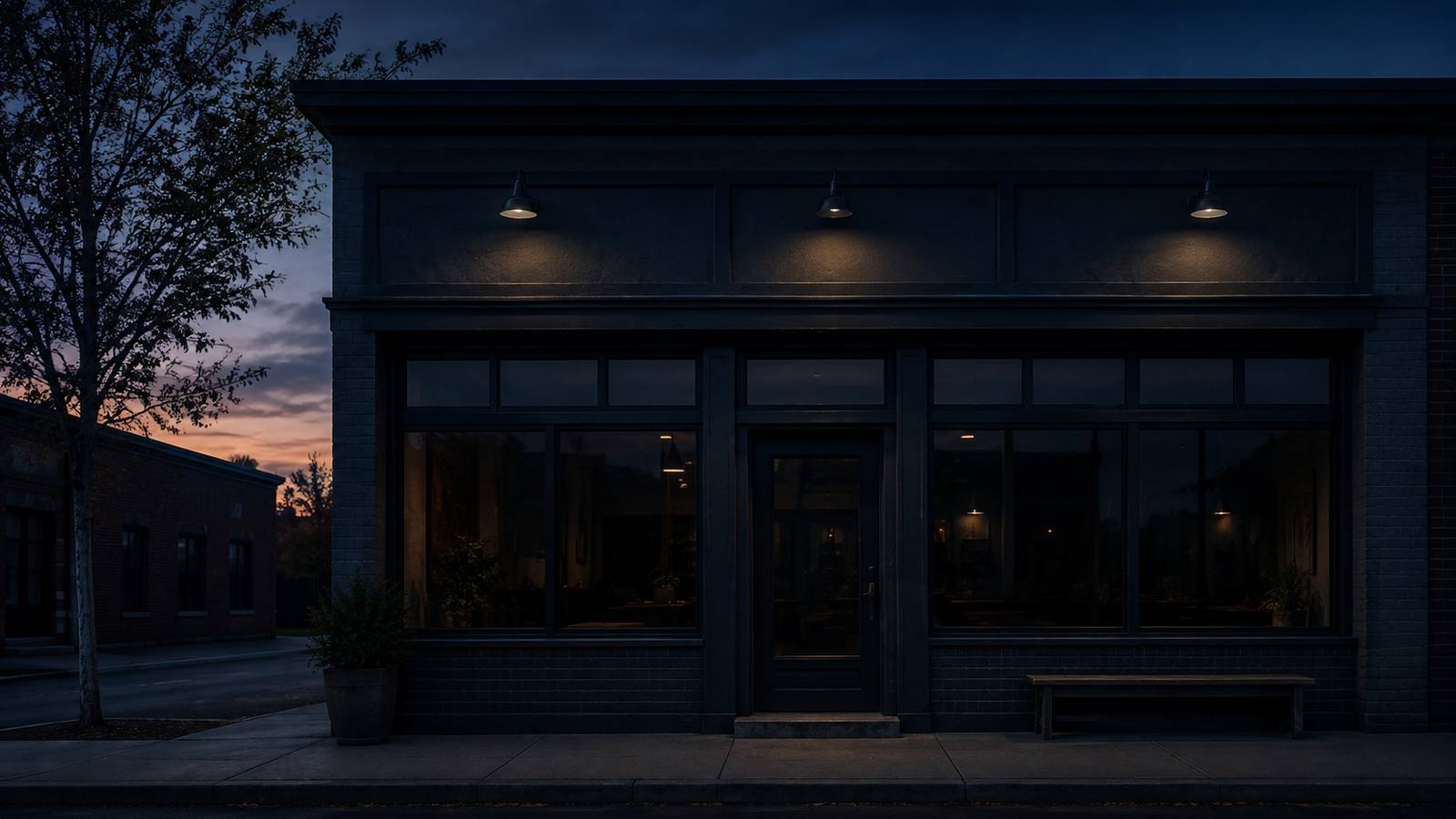
The wall pack over a rear door and the canopy lights at the entry run every night of the year. Lenses cloud, gaskets fail and water gets in. We swap the fixture or its lamp and photocell, and seal the top and sides against the wall while leaving the drain path open.
Send a site map with the dark fixtures circled, or photos with the building number in frame. A night photo helps more than a daytime one.
The technician opens each failed fixture in daylight, finds whether the lamp, driver, photocell or the fixture itself is gone, and loads matching parts.
Fixtures go back on the existing box with fresh gaskets. Walkways under the ladder are coned off, and one route stays open for residents and customers.
Each photocell is covered so the light comes on in daylight. The log lists every fixture replaced, with a photo.
OSHA's electrical standard, 29 CFR 1910.305(j)(1)(iv), says fixtures installed in wet or damp locations must be identified for that purpose and built or installed so water cannot enter or collect in lampholders and other electrical parts. An indoor fixture hung under an open canopy does not meet that. Every replacement we hang outdoors carries a wet or damp location marking to suit where it sits.
OSHA defines an exit route in three parts, and the last is the exit discharge: the part that leads directly outside or to a street, walkway or open space. Under 29 CFR 1910.37(b)(1) each exit route must be adequately lighted so an employee with normal vision can see along it. The light over the back door is part of that picture.
EPA lists metal halide, high pressure sodium and mercury vapor lamps, the usual wall pack and pole lamps, among bulbs that contain mercury, and names high intensity discharge lamps as federal universal waste. They are packed unbroken and recycled, just like fluorescent tubes. An LED replacement fixture ends that stream for the next round.
Sources for the rules on this page: OSHA 29 CFR 1910.305(j)(1)(iv); OSHA 29 CFR 1910.34(c); OSHA 29 CFR 1910.37(b)(1); U.S. EPA, Recycling and Disposal of CFLs and Other Bulbs that Contain Mercury; U.S. EPA, Universal Waste.
A dark walkway is a complaint first and a claim second. Most are a lamp, a photocell or a fixture that let water in.
Managers hand us the list security or residents made after dark. We open every fixture on it in daylight, replace lamps, photocells, drivers or whole fixtures in kind, reseal each one and cover the photocells to prove they switch. You get the list back with a photo and a result on every line.
Day-burning and cycling lights are almost always a photocell or a lamp at end of life. Water and insects mean a failed gasket. All are replaced in kind, and loose boards or lifted edges we pass on the route are noted for trip hazard repair.

Send the site map or photos with each dark fixture marked by building.

We price the round in writing, fixture by fixture, and agree which walkways stay open.

The technician replaces, seals and tests each light and returns the completed log.
The work is backed in writing by our workmanship warranty and done by a Kaminskiy-certified, background checked technician.
A light that never comes on has a dead lamp, driver or photocell. A light that never goes off has a photocell that failed closed or is shaded by a sign or a grown tree. A light that cycles is an old discharge lamp near the end. We test in that order and replace the whole fixture only when the housing itself is done.
Wall packs fail at the gasket and at the top edge where they meet the wall. Sealant belongs across the top and down the sides, with the bottom left open so condensation can drain. A fixture caulked all the way around fills like a fishbowl. We also check that the conduit entry behind the fixture is sealed.
When an old discharge wall pack fails, the like replacement today is an LED fixture of similar light output on the same box and the same switch leg. LEDs send light in a set direction instead of all around, so we pick a distribution that covers the walkway without glaring into windows across the way.
A bollard is a post bolted to a concrete base with a feed coming up through the middle. Heads, lenses and lamps are replaceable. A bent post can be swapped on sound anchor bolts. If the base is broken or the underground cable is damaged, the repair moves to a concrete crew and a licensed electrical contractor, and we say so on site.
Can't find your answer? Call 855-695-1195 and ask us anything.
Call 855-695-1195Yes. We replace failed wall packs, canopy and soffit fixtures, breezeway and stairwell lights, bollard heads and path lights with like fixtures on the existing box and wiring. Lamps, drivers and photocells are replaced on their own when the fixture is still sound.
Only where the fixture can be reached safely from a ladder or a small lift. Tall poles need a bucket truck and are a licensed electrical contractor's work, as is any pole with damaged wiring or a failed base. We note them on the survey so your list is complete.
The photocell that switches them has failed in the on position, is dirty, or has been shaded. A technician tests it by covering and uncovering it, replaces it if it does not respond, and checks whether one photocell controls a group of fixtures.
We can tell you which fixtures are out and restore them. We do not measure light levels or judge a site against a lighting standard. For that, a lighting designer or engineer takes readings. A sensible order is to get every existing fixture working, then decide whether a study is needed.
When an old fixture fails, an LED fixture of similar output is the normal like replacement and goes on the same box and switching. Converting a whole property that still works is a larger project, and adding fixtures or circuits is for a licensed electrical contractor.
States differ. Many allow a like-for-like fixture swap on existing wiring, and some, including Florida and North Carolina, require a licensed electrical contractor. We check first and tell you plainly whether the round is ours or one we coordinate.
Four things set the price: the count and type of fixtures, how high they are, whether lamps or whole fixtures are replaced, and how spread out the buildings are. We price each fixture on the list in writing so you can approve the whole round or the urgent lines first.
Mark the dead lights on a site map or send photos with building numbers. Add the hours when walkways are quietest. We respond with a written, fixture-by-fixture scope. Call 855-695-1195 to start by phone.
Fixtures replaced in kind. Photocells tested. A log for every building.
We answer in under three rings, 24/7.No price games. You get a clear written quote before any work begins, backed by our workmanship warranty.
