
 BBBAccredited Business

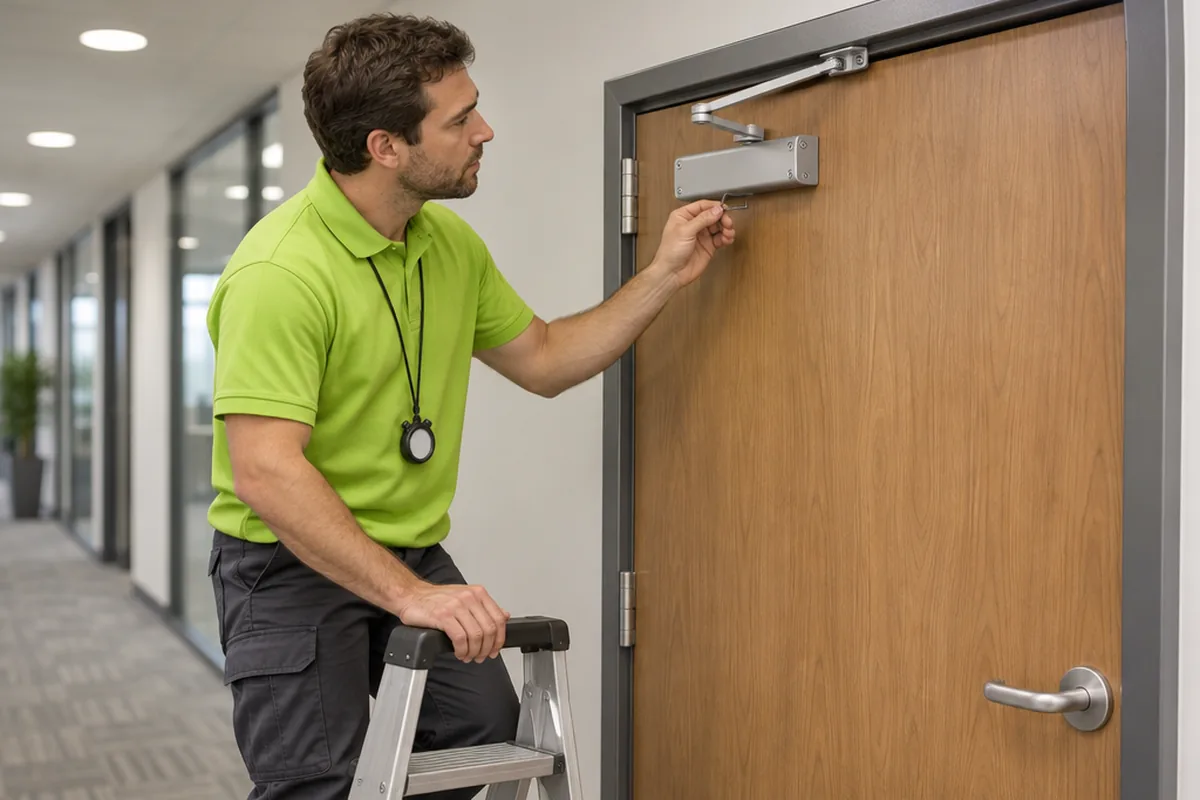
Kaminskiy Care and Repair provides door closer installation and door closer repair for commercial and multi-unit buildings. On surface-mounted closers a technician sets sweep speed, latch speed and backcheck, replaces closers that have leaked their fluid, re-fastens arms and brackets, and sizes a new closer to the door's width and exposure. Each door is timed and noted, usually outside business hours. Floor closers and concealed overhead closers are adjusted where they allow it; rebuilding or replacing those goes to a door specialist. Closer service is one line in our full list of commercial door and hardware services.
Suite and restroom doors are often set heavy so they latch against air pressure. Then visitors lean into them. We reduce the spring setting to the lowest that still latches, slow the swing and note the opening force in pounds, so the next complaint can be checked against a number.
An exterior door meets wind, stack pressure and temperature swings that thicken or thin the fluid. It slams in January and hangs open in July. We set backcheck so a gust cannot throw the door into the wall, tune sweep and latch for the season and replace bodies that weep. Pivots and glass entries are on our storefront door repair page.
Common-area doors in multi-unit buildings get the roughest handling and the least attention. Arms are bent from forcing, brackets tear out of thin frames and residents disconnect what annoys them. We through-bolt the closer, replace arms and brackets and leave the door self-closing again. Stair doors with a label follow our fire door replacement rules.
A photo of the top of the door from each side tells us the mount: regular arm, top jamb or parallel arm. We also need the door width and whether it faces outside.
Before turning a valve the technician checks hinges, the latch and the door edge for rubbing. A closer cannot overcome a door that drags, and cranking it up only hides the fault.
Spring power first, then sweep, then latch, then backcheck, a fraction of a turn at a time. A body that shows oil is replaced, matched to the existing hole pattern where one exists.
We time the door from 90 degrees, measure the push needed to open it and confirm it latches from a slow close. The numbers go on the work order beside the door number.
Section 404.2.9 of the 2010 ADA Standards limits the force to push or pull open an interior hinged door to 5 pounds. Its advisory says that means the continuous force to swing the door, not the first push that starts it moving. Fire doors are set to the minimum force the local authority allows, and the U.S. Access Board notes no maximum is specified for exterior hinged doors.
The International Building Code (2021, section 1010.1.3) uses the same 5 pounds for interior swinging egress doors that are not fire rated. For other swinging doors it allows up to 30 pounds to set the door in motion and 15 pounds to swing it fully open. The IBC is a model code; the local official decides which limits govern a given door.
For a closer, section 404.2.8.1 sets a minimum of 5 seconds for the door to travel from 90 degrees open to 12 degrees from the latch. For spring hinges, section 404.2.8.2 sets 1.5 seconds minimum from 70 degrees to closed. We install and adjust to those figures and record them. We do not survey or certify a building's accessibility. Knob-to-lever changes on the same doors are our ADA door hardware and lever service.
Sources for the rules on this page: 2010 ADA Standards for Accessible Design, sections 404.2.8 and 404.2.9; U.S. Access Board, Guide to the ADA Standards, Chapter 4: Entrances, Doors, and Gates; International Building Code (2021), section 1010.1.3.
We tune each closer to its door, then record what we set, so the next person with a hex key has a baseline.
Most closers do not need replacing. They need their four settings put back in balance: spring power for the door's size, sweep speed for the main swing, latch speed for the last few inches, and backcheck to cushion the opening. We set them in that order, tighten the arm and its fasteners, and time the door before we leave.
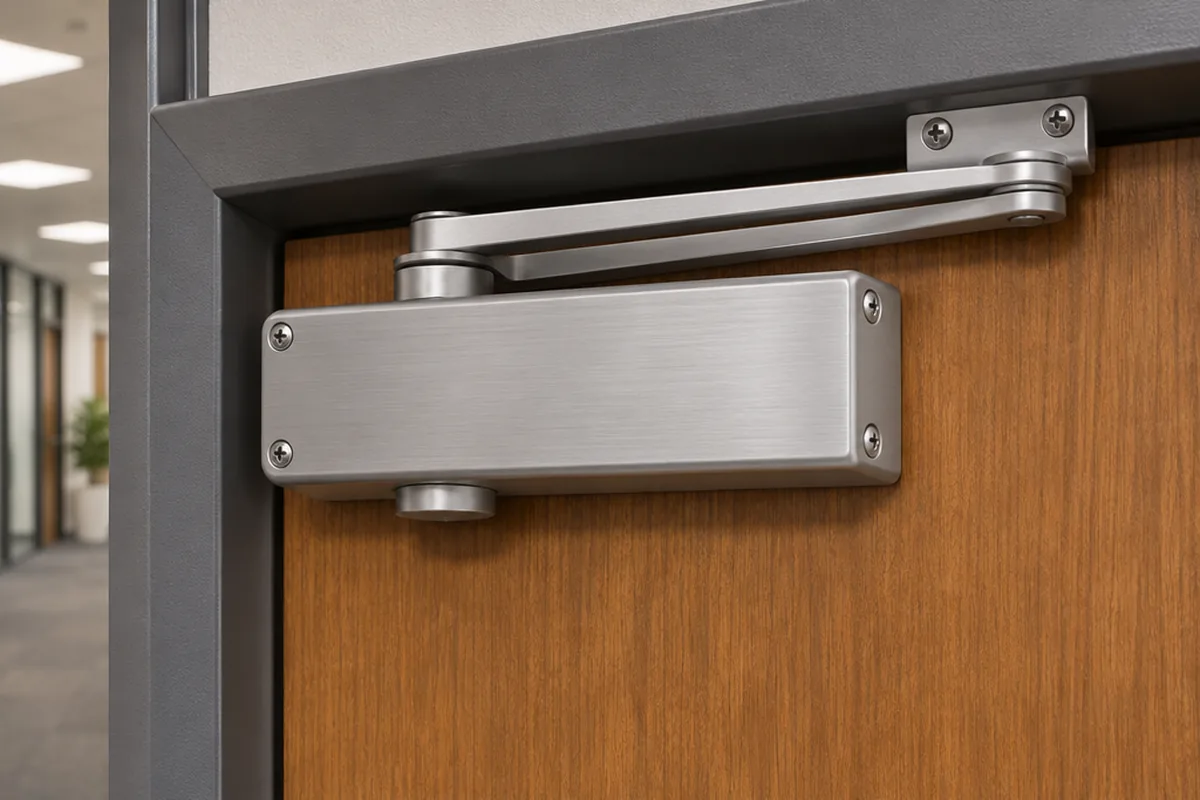
Oil means the seals are gone and the closer is replaced. Everything else on this list is usually an adjustment or an arm, found in a short call before or after hours.

Tell us which doors slam, stall or leak, and send a photo of each closer.

We send a written scope and price for adjustment or replacement, door by door.

Each closer is set or swapped, timed with a stopwatch and logged for your maintenance file.
The work is backed in writing by our workmanship warranty and done by a Kaminskiy-certified, background checked technician.
Opening the door winds a spring and pushes a piston through hydraulic fluid. Letting go lets the spring drive the door shut while the fluid squeezes back through small passages. Valves on those passages set the speed. The spring decides whether the door can latch; the valves decide how gently it gets there. Mixing those two up is behind most bad adjustments.
Sweep is the long part of the swing, from wide open to the last few inches. Latch speed covers the final few inches, where the door needs just enough pace to click past the strike. Backcheck adds resistance as the door is opened hard, protecting the wall, the hinges and the arm. Valves are turned in small fractions; backing one all the way out can dump the fluid.
Closers are rated in spring sizes, and most current models adjust across a range. A wide or exterior door needs more spring than a narrow interior one. Too little and the door never latches in a breeze; too much and it fails the opening force limit. We size from the door width and location, then reduce to the lightest setting that latches reliably.
The same closer body mounts three ways. Regular arm sits on the pull side and is the most efficient. Top jamb mounts on the frame head on the push side, common on aluminum frames. Parallel arm sits on the push side with the arm folded along the door, out of reach of vandals, at some cost in power. The mount must suit the frame, the reveal and the swing.
Can't find your answer? Call 855-695-1195 and ask us anything.
Call 855-695-1195No. Once the seals fail and fluid escapes, the closer loses control of the door and cannot be refilled in the field. It is replaced. We match the new body to the existing mounting holes where the maker's pattern allows, which keeps the door face clean.
Hydraulic fluid thins in heat and thickens in cold, so a closer set in one season runs fast or slow in another. Exterior doors show it most. A seasonal adjustment of the sweep and latch valves corrects it, and closers with all-weather fluid drift less.
For interior hinged doors on an accessible route, the 2010 ADA Standards set 5 pounds maximum, measured as the steady push to swing the door. Fire doors and exterior doors are treated differently. We measure with a force gauge and set the closer as light as it can be while still latching.
Yes, on wood, hollow metal and aluminum-framed doors with room for a surface closer. We check the frame head, choose the mount, add a reinforcing plate or through-bolts where the door skin is thin, and fit a stop if the wall needs protecting.
We can make the speed adjustments those closers offer and tell you their condition. Rebuilding or replacing a floor closer or a concealed overhead closer usually means removing the door and working in the slab or header, which we refer to a storefront door specialist.
An adjustment costs less than a replacement, and replacement cost follows the grade of closer, the mount and whether the door needs reinforcing. Several doors in the same building lower the cost per door. The price is given in writing before the technician is booked.
There is no single rule for ordinary doors, so we suggest looking at them whenever the seasons turn and after any report of slamming. Doors on a labeled fire opening are part of the yearly fire door inspection. Many managers add closers to a standing maintenance round.
Send the building address, the door locations and a photo of each closer from the side. We write back with a scope by door and a time outside your busy hours. Phone: 855-695-1195.
Adjusted in the right order, timed, and recorded so it stays right.
We answer in under three rings, 24/7.No price games. You get a clear written quote before any work begins, backed by our workmanship warranty.
