
 BBBAccredited Business

Kaminskiy Care and Repair corrects pool barrier gates at apartment communities, HOAs, hotels and clubs: hinges that no longer close the gate, latches that fail to catch or sit too low, gates that swing toward the water and gaps that are too wide. We work from the items your inspector wrote up and document each correction with measured photos. The health or building department decides what your pool needs, and we never promise that a gate will pass. Ordinary walk gates are commercial gate repair. Pool gate corrections are a specialty within our fence and gate repairs for managed properties.
A community pool gate cycles all summer. The self-closing hinges lose tension, the gate stops short of the latch, and by August someone has tied it back. We replace or re-tension the hinges, set the latch at the height your jurisdiction requires, and test the gate from a few inches open and from wide open, because it has to latch from both.
A health inspector's report lists the gate: does not self-latch, latch release too low, gap beneath. We take the report line by line, correct each item and send photos with a tape measure in the frame. The inspector decides whether the items are cleared. Exit devices on a pool gate are covered under gate latches and exit hardware.
Sometimes the gate works and the fence next to it does not. A bent picket opens a gap, a low spot under the bottom rail grows, or a planter gives a climber a step. We repair pickets and bottom gaps near the gate while we are on site. Longer stretches of damaged pool fence are scoped as perimeter fence repair.
Send the inspection report or notice and photos of each gate from both sides. If no report exists yet, tell us which department inspects the pool, so we work to its rules.
The technician measures latch release height, swing direction, gaps under and beside the gate and openings near the latch, and times the close. Each figure is compared with the rule your jurisdiction uses.
Work happens while the pool is closed or with the area held shut. No gate is left off its hinges or unlatched while the pool is open.
Each corrected item gets a photo with a tape or level in view and a short note. You forward the set to the inspector, who makes the call.
The International Swimming Pool and Spa Code is the model code many jurisdictions adopt. Its Section 305.3 says pedestrian gates in a pool barrier shall open outward away from the pool, be self-closing, have a self-latching device and be equipped to take a lock. Section 305.2.1 puts the top of the barrier at not less than 48 inches above grade. Your local department adopts, amends and enforces a version of its own.
In the 2021 edition, Section 305.3.3 places a latch release reached from outside a public pool barrier between 52 and 54 inches above the ground when it is not the self-locking type, and Section 305.3.4 limits openings within 18 inches of an inside latch release to 1/2 inch. The 2010 ADA Standards (404.2.7) allow pool gate latch releases up to 54 inches when the latch is not self-locking. Older editions and state rules use other figures, so we measure to the rule your inspector cites.
The model code bars openings a 4-inch sphere can pass and limits the gap under a barrier to 2 inches over grass or gravel and 4 inches over concrete (Sections 305.2.1 and 305.2.2). In California, the Building Code's public pool chapter (Section 3119B) asks for a 5-foot enclosure and hand-operated gate hardware 42 to 44 inches above the deck on enclosures built since mid-1994. The local rule governs every time.
Sources for the rules on this page: 2021 International Swimming Pool and Spa Code, Sections 305.2.1, 305.2.2, 305.3, 305.3.3 and 305.3.4; U.S. Consumer Product Safety Commission, Safety Barrier Guidelines for Residential Pools, Publication 362; 2010 ADA Standards for Accessible Design, 404.2.7, exception 2; 2022 California Building Code, Title 24, Part 2, Chapter 31B, Sections 3119B.1 to 3119B.3.
We correct what the inspection listed, measure it and photograph it. The department that inspects your pool makes the decision.
The gate is checked for sag first, because a sagging gate will not latch however strong the hinge. Then the self-closing hinges are replaced or re-tensioned as a pair, the latch is mounted at the required height with its striker aligned, and the gate is released from a hand's width and from fully open until it latches on every try.
Any one of these can close a pool until it is fixed. Send the report, and we correct the listed items and hand you measured photos for the inspector.

Send the inspection report or notice and photos of each pool gate from inside and outside.

Approve a written scope that answers the report item by item, with a price for each gate.

We correct the gates while the pool is closed and send measured photos for your inspector.
The work is backed in writing by our workmanship warranty and done by a Kaminskiy-certified, background checked technician.
Pool gate hinges hold a spring that drives the gate shut. Tension is adjustable on most of them, and it fades with age, heat and corrosion from pool chemicals. The two hinges should carry matched tension. Before adding any, we make sure the gate swings freely, because a hinge fighting a dragging gate wears out fast and slams once the drag is removed.
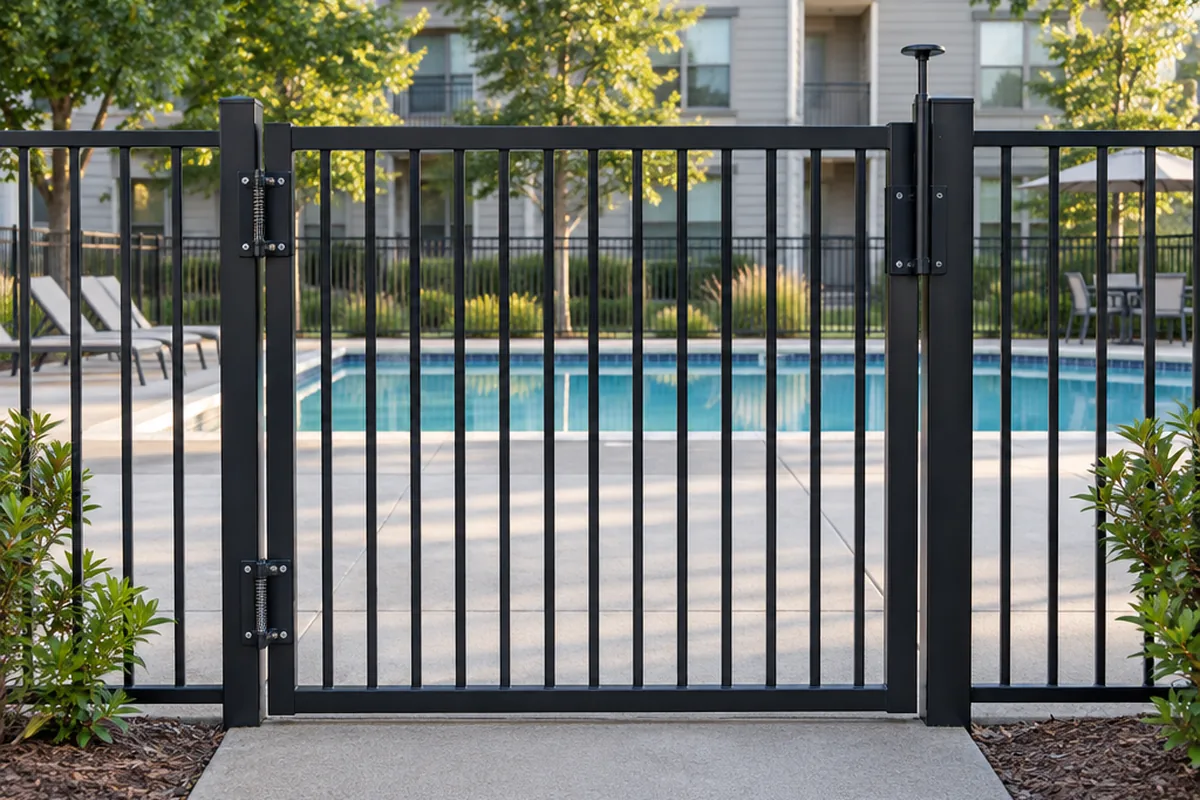
A pool latch catches by itself when the gate arrives. Many are magnetic, with a release knob on top of a tall post, placed so an adult can reach it and a small child cannot. The latch body and its striker have to meet squarely. When a gate sags a quarter inch they miss, which is why hinge and latch are always corrected together.
A gate that opens away from the pool gives a second chance. If it is left unlatched and a child pushes on it from outside, the push closes the gate and may even engage the latch. The Consumer Product Safety Commission explains this in its Safety Barrier Guidelines for Residential Pools, a public reference many inspectors and managers read alongside the adopted code.
Inspectors look at climbing aids and openings near the gate too. Horizontal rails, planters, benches and equipment close to the outside give a foothold. Chain link with large mesh, or a missing picket, gives a way through. Adding slats or fabric changes the picture again, as described under privacy screening for existing fence. We note these items even when the report did not.
Can't find your answer? Call 855-695-1195 and ask us anything.
Call 855-695-1195We cannot promise an outcome, and nobody honest can, because the health or building department decides. What we do is correct each item the inspection listed, measure the result against the rule your jurisdiction uses and give you photos to send in. Most write-ups involve the hinges, the latch or a gap.
It depends on the code your jurisdiction adopted. The 2021 model pool code puts an outside latch release at a public pool between 52 and 54 inches when it is not self-locking. California's public pool rules ask for 42 to 44 inches above the deck. We set the latch to the figure your inspector cites.
So that a push from outside closes it. If the gate is not fully latched and a child leans on it, an outward-swinging gate moves toward closed. The model code and the federal safety commission's barrier guidelines both call for pedestrian pool gates to open outward.
Yes, when the gate itself hangs square. The old latch comes off and a self-latching one goes on at the height your jurisdiction's rule gives, with its striker lined up and any opening near the release closed off. If the gate has sagged, the hinges are corrected first, because a new latch on a dropped gate misses its striker within weeks.
Usually the gate has sagged and the latch no longer meets its striker, or the hinge springs are too weak to carry the gate the last inch. We correct the sag, replace or re-tension both hinges and realign the latch, then test from nearly closed and from fully open.
No. Inspection and approval belong to the health or building department. We repair and document. On request we can walk the barrier and list what we see against the model code, but that list is a maintenance aid, not an official finding.
Gate corrections are normally planned for hours when the pool is already closed. If a gate has to come off for rebuilding, the opening is secured with a temporary barrier. The scope states how long each gate will be out of service.
It follows the count of gates and what each one needs. Hinges and a latch are the common case, a rebuilt gate or a reset post runs higher, and fence repairs beside the gate are priced separately. Each gate has its own written price before scheduling.
Often, because they drift. A quick test by site staff each week in season, releasing the gate from a few inches and from wide open, catches most failures. We can add pool gates to a recurring maintenance visit and log each test.
Send the address, the inspection report or notice if you have one, photos of each gate from both sides and the pool's closed hours. We reply with a written scope by gate. If the inspector's deadline is close, call 855-695-1195.
Listed items fixed, measured and photographed. The inspector decides.
We answer in under three rings, 24/7.No price games. You get a clear written quote before any work begins, backed by our workmanship warranty.
