
 BBBAccredited Business

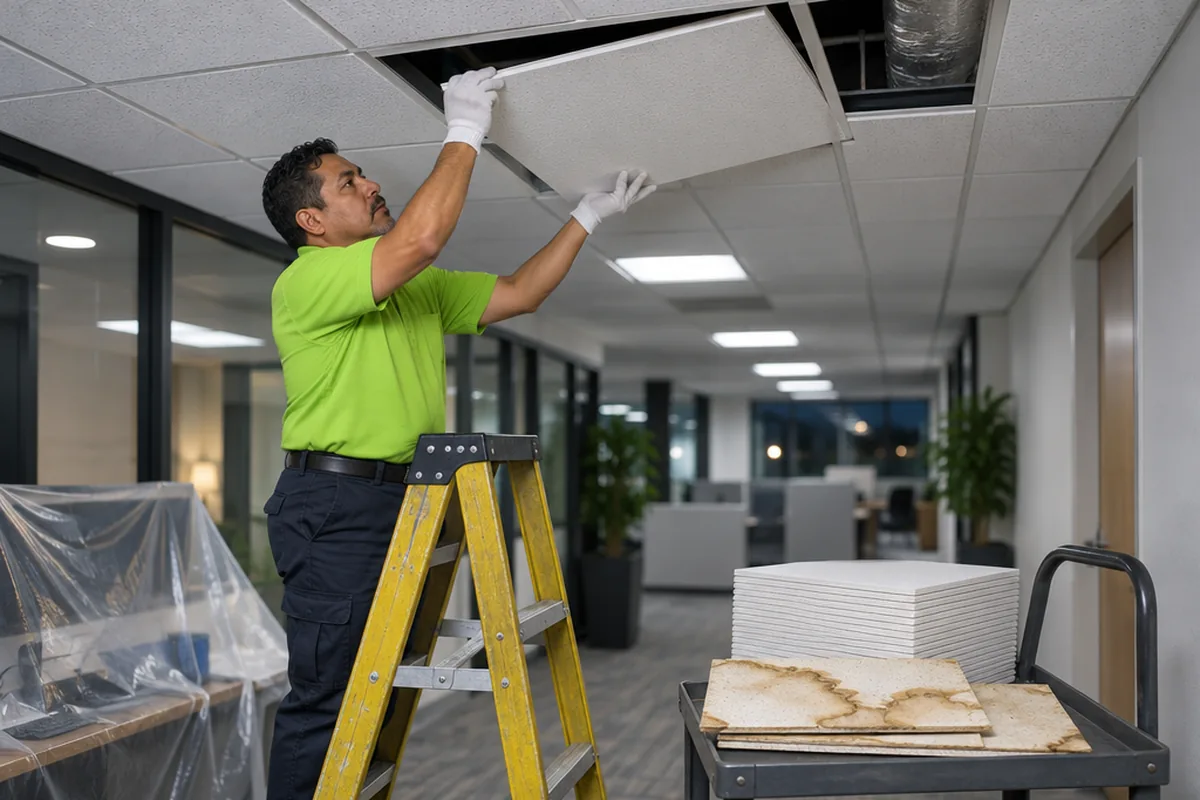
Kaminskiy Care and Repair handles ceiling tile replacement and drop ceiling repair in offices, stores, clinics and common areas: stained, sagging, broken and mismatched tiles, bent tees, loose wall angle and missing hanger wires. We identify the tile first so replacements match, and work after hours with desks covered. A fire-rated ceiling gets the tile its assembly lists, and tiles from the asbestos era are tested before they are moved. A hard lid is a different job: see drywall ceiling repair. Tile and grid upkeep is one piece of our commercial drywall and ceiling service.
Years of single-tile swaps leave an office ceiling in four shades of white and two surface patterns, with a ring under every old condensate drip. We map the ceiling and replace the stained tiles. Where the mix is too visible, we gather the good originals into one room and re-tile the main space from one lot, so the field reads as a single ceiling.
Customers look up more than staff do. A sagging tile over an aisle or a grease-yellowed one near the kitchen pass reads as a dirty store. Humidity makes standard tiles bow, so near kitchens and entries we fit a tile made for moisture or one with a washable face, and we reset the tiles that vendors left out of square around the lights.
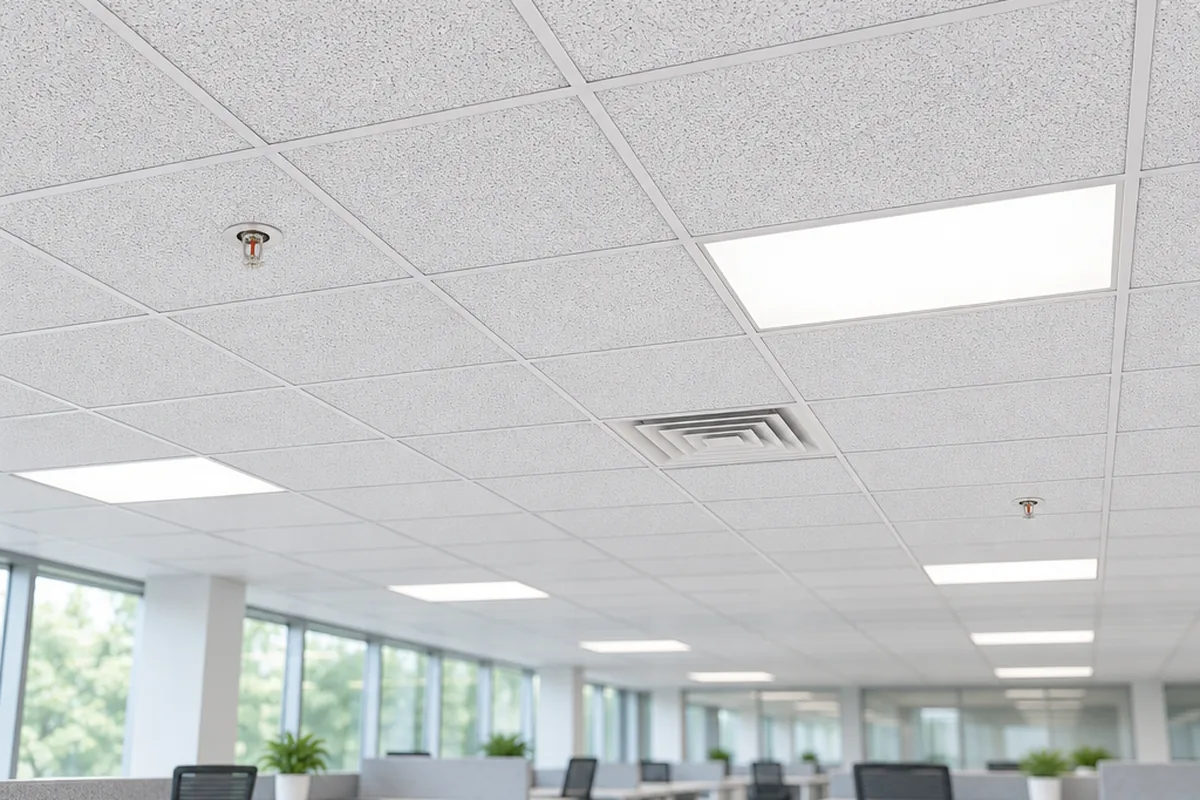
The corridor ceiling hides piping, cable and ductwork, so it is lifted constantly. Tiles pick up cracked corners, finger marks and chipped edges, and ladders bend the tees. We replace the damaged tiles, swap bent tees, re-hang dropped sections on new wire and refit the tiles cut around sprinkler heads and diffusers. A leak that soaked the walls as well is a water damage rebuild.
Send a photo of a tile face, its edge and the back stamp if there is one, plus the grid width. Size, edge detail and pattern decide the match, and we source it before scheduling.
Desks, counters and floors under the work are covered, since old tiles shed grit when lifted. New tiles are handled with clean gloves so the faces stay unmarked.
Before a stained tile is replaced we check above it. An active drip, a sweating pipe or a loose duct joint is reported with a photo, because a new tile under a live leak stains again.
Tiles go in square, border cuts are made cleanly, bent grid is corrected and the number of tiles used is recorded. Spare tiles are left labeled in your storage when the scope includes them.
The International Building Code, a model code many jurisdictions adopt, requires suspended acoustical ceilings to be installed in accordance with ASTM C635 and ASTM C636 (Section 808.1.1.1). The first covers the metal suspension system and the second its installation. For upkeep the point is simple: tees, wall angle and hanger wires are engineered parts, so a bent tee or a missing wire is replaced with a matching part, not improvised.
Where an acoustical ceiling is part of fire-resistance-rated construction, the same code requires it to be installed in the manner of the assembly that was tested (Section 808.1.1.2). Lay-in panels in a rated assembly that are too light to resist an upward force of 1 pound per square foot must be held down with wire or other approved devices (Section 711.2.5). So a rated ceiling gets the tile its listing names, with the hold-downs put back. The local official decides whether yours is rated.
EPA names ceiling tiles among the building products that have contained asbestos and notes that a material generally cannot be identified by looking at it. In an older building we ask for the survey, and suspect tile is tested before anyone lifts it. Separately, EPA's guide for commercial buildings is blunt about ceiling tiles soaked by a leak: discard and replace. Drying a stained tile and putting it back is not a repair.
Sources for the rules on this page: 2021 International Building Code, Sections 808.1.1.1 and 808.1.1.2; 2021 International Building Code, Section 711.2.5; EPA, Learn About Asbestos; EPA, Mold Remediation in Schools and Commercial Buildings Guide, Table 1.
Replacing a tile is easy. Replacing it with one that matches, over desks, around sprinklers, after hours, is the service.
For buildings with a lot of grid, we walk the ceilings on a schedule. Every stained, cracked, sagging or mismatched tile is counted by room, each stain is checked from above for a live cause, and bent grid is noted. You approve the count, we bring one matched lot and change them all in a single after-hours round. It pairs well with a scheduled maintenance program.
A stain means something leaked, so tell us whether it has been fixed. The rest is matching and careful hands, done while the space is closed.

Send photos of a tile face and edge, the grid, and a count of the tiles that need changing.

We identify the tile, confirm we can source the match and give you a written price.

Tiles and grid parts are replaced after hours, the area is cleaned and photos are sent.
The work is backed in writing by our workmanship warranty and done by a Kaminskiy-certified, background checked technician.
Four things define a tile: its size, usually 2 by 2 or 2 by 4 feet; its edge, square to lie flat on the grid or stepped to hang below it; its face pattern; and its thickness. Many tiles carry a maker's item number printed on the back. A photo of the back and the edge usually lets us name the tile without a site trip.
Tile faces yellow and gray with age, light and air movement. A new tile of the identical item still stands out in a twenty-year-old ceiling. There are three honest options: accept it in back rooms, consolidate the cleanest old tiles into the visible rooms, or re-tile a whole room in one lot. Painting old tiles to match can cost them sound absorption, so we steer away from it.
The most useful thing a building can own for its ceiling is two or three cartons of the current tile, stored flat and dry and labeled with the item number. Patterns are discontinued without notice. With stock on hand, a stained tile is a simple swap and the ceiling stays uniform for years. We can set that stock up when we re-tile a suite.
Tees are bent by ladders leaned on them and by trades dragging cable across the grid. Hanger wires get cut to make room for a new duct and never get replaced. From below it shows as a dip, a gap at the wall angle or a tile that will not sit flat. Straightening rarely holds on a kinked tee, so we replace the piece and re-hang the run on new wire.
Can't find your answer? Call 855-695-1195 and ask us anything.
Call 855-695-1195Usually we can identify the tile from its size, edge, pattern and the number on its back, and many long-running patterns are still made. If yours is discontinued, we find the closest current tile and suggest where to use it so the change is not obvious, such as a whole room or a corridor.
Because something above that spot is still wet: a roof leak, a condensate line, a sweating pipe or a valve. We look above the tile before replacing it and send you a photo of what we find. The leak itself goes to the roofer, the plumber or the mechanical contractor.
Yes. We cut the new tile to fit around the sprinkler pipe and refit the existing trim ring without moving the head. Tiles around light fixtures and diffusers are cut and seated the same way. Any work on the sprinkler itself belongs to a licensed fire sprinkler contractor.
Do not assume either way. Some ceiling tiles from that period contained asbestos, and it cannot be told by eye, so they are tested first. Ask for the building's survey. If the tiles are not covered by it, a sample goes to a lab before we disturb them, and a licensed abatement company removes any that test positive.
Yes, that is the normal way. Desks, equipment and floors under the work are covered, the old tiles are bagged as they come down and the area is vacuumed before morning. Staff should find nothing but a cleaner ceiling.
The tile itself, the count, the ceiling height and how much grid repair is needed. Specialty tiles, such as moisture-resistant or rated ones, cost more than standard office tile. You get a written price based on the count before we order, and leftover tiles stay with you as stock.
Repair is usually the right call. If the grid is level and sound, replacing the stained tiles and a few bent tees restores the ceiling with far less disruption than a new one. Replacement makes sense when the grid is rusted or out of level across the floor, or when the tile is discontinued and the mix of whites has become too visible to live with.
New grid and whole-ceiling installation are covered by our acoustic ceiling tile installation service. This page is about keeping an existing ceiling in good order: replacing tiles, correcting grid and setting up spare stock.
Send the address, the hours the space is empty, a photo of a tile face, edge and back, and a rough count of the tiles to change. We reply with the match and a written price. Or call 855-695-1195.
The tile identified first. Changed after hours. Spare stock left labeled.
We answer in under three rings, 24/7.No price games. You get a clear written quote before any work begins, backed by our workmanship warranty.
