 BBBAccredited Business

Kaminskiy Care and Repair repairs what a California balcony inspection report lists: decayed joists and ledgers, failed deck waterproofing and flashing, and loose guardrails on apartment buildings (SB 721) and condominium buildings (SB 326). We hold California License #1106209. For apartment owners, the SB 721 inspection itself is performed by Kaminskiy Design & Remodeling (CSLB #922807), a B general building contractor since 2008, which the owner hires directly. A condominium association's inspection must come from a licensed engineer or architect. We repair from either report. This California page sits inside our exterior repairs for commercial and multi-unit buildings.
Health and Safety Code 17973 covers balconies, decks, stairways and walkways more than six feet above ground that rely on wood for support. The owner hires the inspector. For that inspection we introduce Kaminskiy Design & Remodeling. When the report arrives, we price each finding and carry out the repairs.
Civil Code 5551 puts the duty on the association and requires a licensed structural or civil engineer or an architect to inspect. We are not that inspector. We take the stamped report, turn its recommendations into a scope the board can vote on, and repair the load-bearing wood and waterproofing it names.
A manager with twenty buildings needs the findings ranked. We sort every report item into three groups: block off now, permit and repair, and maintain. Then we schedule by building so each balcony is closed only as long as the work and cure times need. Open corridors with soft decking are covered under elevated walkway repair.
Email the full report with photos and locations. No report yet? Apartment owners can hire Kaminskiy Design & Remodeling for the inspection, and we wait for its findings.
Each finding becomes a line with a location and a method. Where the city requires a permit, the application is planned first, and residents get dated notices before any balcony is closed.
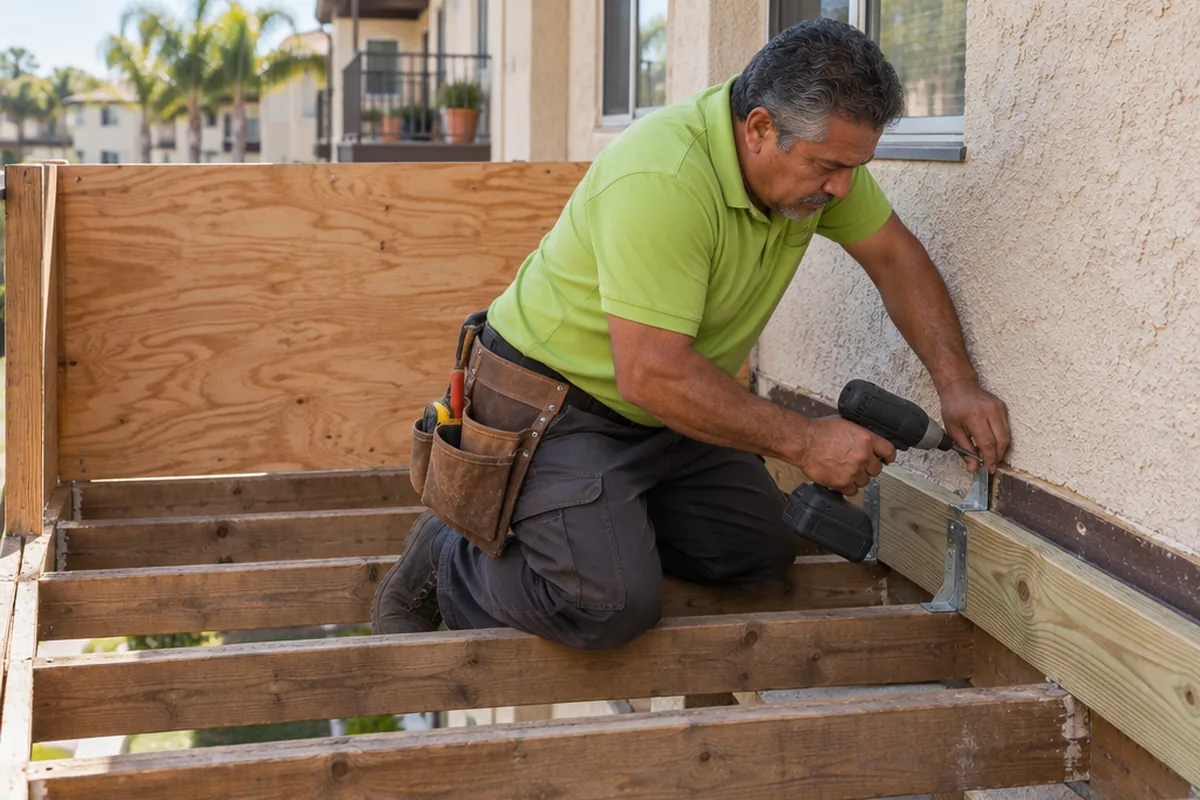
Decking comes up, decayed framing is replaced with treated lumber, flashing and the deck membrane are rebuilt, and guardrail posts are re-anchored. Each stage is photographed before it is covered.
You receive a repair record keyed to the report's item numbers. The inspector can use it for the final report, and it stays in the owner's or association's file.
In California, Health and Safety Code 17973 required the first inspection of exterior elevated elements on buildings with three or more multifamily units by January 1, 2026, and one every six years after. At least 15 percent of each type of element is inspected. A qualifying inspector may be an architect, a civil or structural engineer, a certified building inspector, or an A, B or C-5 contractor with five years of multistory wood-frame experience.
Under the same section the inspector delivers the report within 45 days of the inspection. For findings that are not an immediate threat, the owner applies for a permit within 120 days of receiving the report and has 120 days after permit approval to finish, unless the local agency extends it. Where the inspector finds an immediate threat, access is blocked at once and the report goes to local enforcement within 15 days.
Civil Code 5551 applies to associations with buildings of three or more attached units. The first inspection was due by January 1, 2025, then every nine years, by a licensed structural or civil engineer or architect, on a random sample large enough for 95 percent confidence. The report goes to the board and into the reserve study. Both laws say reports are kept for two inspection cycles.
Sources for the rules on this page: California Health and Safety Code section 17973 (as amended by Stats. 2025, Ch. 22); California Civil Code section 5551 (as amended by Stats. 2025, Ch. 516).
Inspection reports name conditions. We turn them into buildable repairs, in an order the building and its residents can live with.
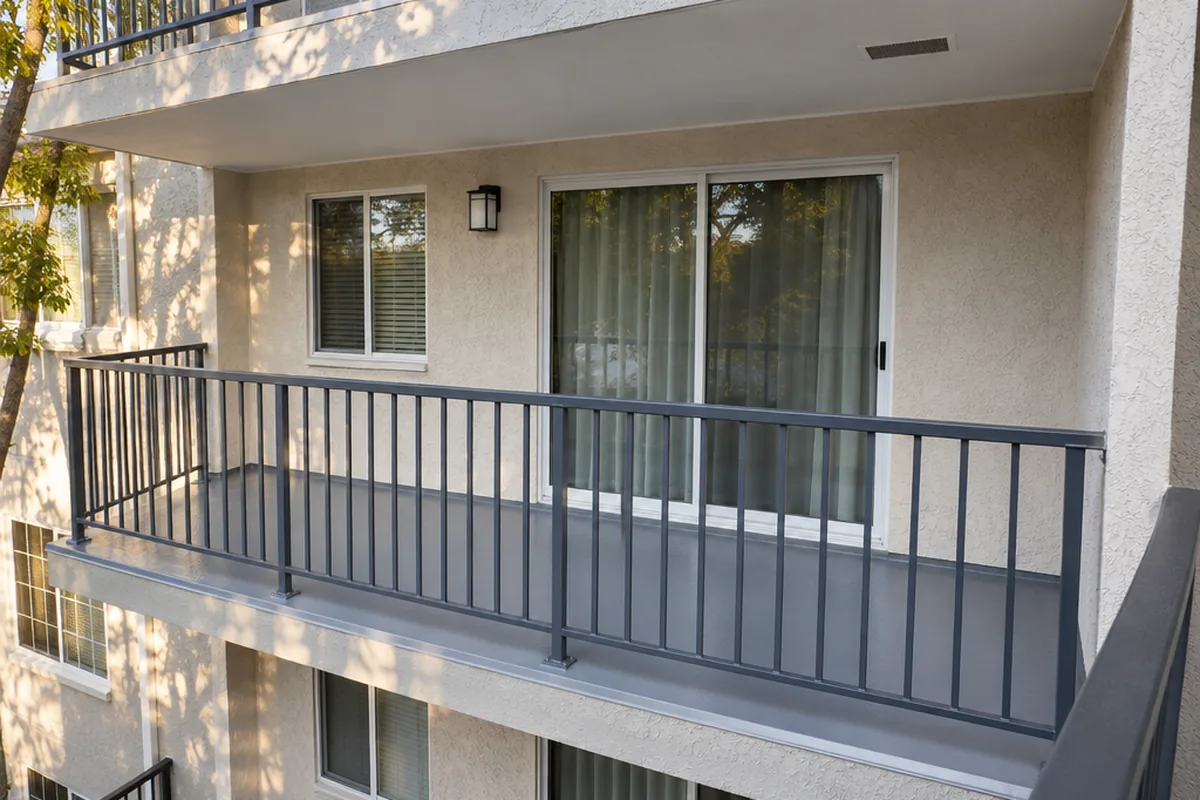
Most findings trace to one path: water got past the deck coating or the wall flashing and sat on the framing. So the repair is done as a set. Decayed joists, ledger or rim are replaced, the deck is re-sheathed with slope to the edge, metal flashing and a new membrane go on, and the guardrail is anchored into sound wood.
Each of these has a next step, and most start with the report itself. Send it and tell us how many buildings and balconies are involved. Railings on at-grade ramps and pool decks are a different job: see commercial railing repair. Balcony repair with no inspection report behind it, in California or any other state we serve, is on our deck, balcony and walkway repair page.

Send the inspection report, or ask us how apartment owners arrange the SB 721 inspection.

Approve a written scope that lists each finding with its location, repair method and price.

We repair, photograph each stage and deliver a record matched to the report's item numbers.
The work is backed in writing by our workmanship warranty and done by a Kaminskiy-certified, background checked technician.
Both statutes use the same test: a walking surface more than six feet above ground, built for people to use, extending beyond the exterior walls and supported wholly or largely by wood. Balconies, decks, stairways and walkways qualify, along with their railings and the flashings, membranes, coatings and sealants that keep water off the framing.
Read the report for three things. First, anything the inspector calls an immediate threat: block access right away and expect shoring. Second, items that need a permit and repair, which run on the two 120-day clocks. Third, maintenance notes such as recoating or caulking, which are small jobs now and become framing repairs if they wait for the next cycle.
Replacing a joist without fixing the membrane above it resets nothing. The apartment statute's own purpose statement pairs the wood with its waterproofing. A sound repair restores slope so water runs to the edge, laps the wall flashing behind the stucco or siding, seals the door threshold and leaves the soffit below vented so the framing can dry.
Permit steps differ by city, so each market we work in has its own page: San Diego SB 721 repairs, Irvine, Beverly Hills, Glendale, Temecula, Palm Desert, Walnut Creek, Sunnyvale and Roseville. Each covers that city's building types and its permit office.
Can't find your answer? Call 855-695-1195 and ask us anything.
Call 855-695-1195An SB 721 inspection is the periodic check that California Health and Safety Code 17973 requires on apartment buildings with three or more units. A qualified inspector examines at least 15 percent of each type of exterior elevated element: balconies, decks, stairways and walkways more than six feet above ground that rely on wood for support. The first was due by January 1, 2026, with another every six years, and the written report follows within 45 days.
No. We do the repairs. For apartment buildings, the inspection is performed by Kaminskiy Design & Remodeling, CSLB #922807, a B general building contractor since 2008, and the building owner hires that company directly. Once the report is issued, Kaminskiy Care and Repair, License #1106209, prices and repairs the findings.
Civil Code 5551 requires a licensed structural or civil engineer or an architect, so the association hires that professional. We work from the stamped report: we scope the recommended repairs, carry them out and give the board a record for the reserve study file.
Get the inspection scheduled and keep the paperwork showing when you ordered it. The statute sets the deadline and lets local enforcement agencies recover their enforcement costs, and each city handles late inspections its own way. Ask your building department how it treats a late report, then move straight to repairs on anything the inspector flags.
For findings that are not an immediate threat, Health and Safety Code 17973 gives the owner 120 days from receiving the report to apply for a permit and 120 days from permit approval to complete the work, unless the local agency grants more time. An immediate threat means blocking access right away and repairing under the inspector's direction.
If the owner has not complied within 180 days, the statute directs the inspector to notify the local enforcement agency and the owner. If the repairs are still not done 30 days after that notice, the local authority assesses a daily civil penalty and can record a building safety lien until the work is complete.
Yes. The work is outside. The balcony door is secured or barricaded while the deck is open, residents get written notice with dates, and furniture and planters come off first. Access returns after the new membrane has cured, which depends on the coating system and the weather.
How far the decay runs once the deck is opened, the number of balconies, access for materials on upper floors, the waterproofing system and whether the city requires a permit and plans. We price each finding separately so an owner or board can see what every line costs before approving it.
A repair record keyed to the report: location, what was found when opened, what was replaced, and photos before closing. SB 721 lets the owner request a final report from the inspector stating repairs are complete, and both laws require reports to be kept for two inspection cycles.
Health and Safety Code 17973 names four kinds of inspector: an architect, a civil or structural engineer, a certified building inspector, or a contractor holding an A, B or C-5 license with five years of multistory wood-frame experience. The owner hires the inspector. Condominium associations fall under SB 326 instead, which accepts only a licensed structural or civil engineer or an architect.
Attach the inspection report, the property address and the number of buildings. No report yet? Tell us and we explain how the inspection is arranged. Questions first: 855-695-1195.
Send it over. You get a scope by finding, a repair schedule and the records the law tells you to keep.
We answer in under three rings, 24/7.No price games. You get a clear written quote before any work begins, backed by our workmanship warranty.
