
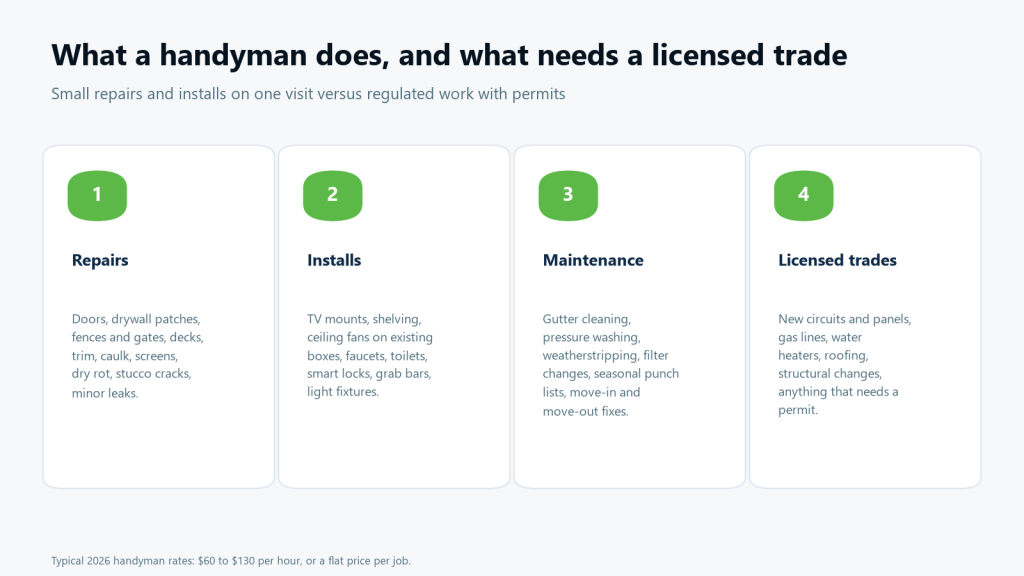
A handyman does the small and medium repairs, installations and maintenance a home collects between big projects, usually several in one visit: sticking doors, drywall holes, fence posts, deck boards, faucets, light fixtures, TV mounts and caulk. A handyman does not do work that needs a trade license or a permit: new circuits, gas lines, roofing, structural changes. In 2026 that visit costs $60 to $130 per hour or a flat $100 to $350 per repair. Here is what is included, what is not, and when to call one.
What you'll learn in this guide
- A handyman is a generalist: carpentry, drywall, basic plumbing and electrical swaps, painting touch-ups, assembly and mounting.
- The most booked jobs in 2026 are door repairs, drywall patches, fence and gate fixes, TV mounting and fixture swaps.
- The line is licensing and permits: new wiring, gas, HVAC, roofing and load-bearing work go to licensed trades.
- Bundling five or six small jobs into one half-day visit ($300 to $600) is how the price per job drops.
- Ask three things before booking: license or registration where required, insurance, and whether the price is flat or hourly.
The jobs a handyman does most
| Job type | Low | Typical | High |
|---|---|---|---|
| Doors: sticking, sagging, not latching, weatherstrip, locks | $85 | $150 | $250 |
| Drywall: holes, cracks, nail pops, texture and paint | $100 | $200 | $500 |
| Fence and gate: posts reset, panels, gates re-hung | $150 | $300 | $600 |
| Deck: boards, railings, stairs, sealing | $150 | $400 | $1,000 |
| Fixtures: faucets, toilets, lights, fans on existing boxes | $150 | $250 | $500 |
| Mounting and assembly: TVs, shelves, furniture, grab bars | $75 | $175 | $300 |
| Exterior: caulk, dry rot trim, stucco patches, gutters, pressure washing | $150 | $350 | $800 |
Beyond repairs, handymen handle seasonal maintenance (gutter cleaning, weatherstripping, filter and detector changes), move-in and move-out punch lists, rental turnovers, and aging-in-place installs such as grab bars, railings and ramps. A residential handyman service that fields employees rather than subcontractors can usually cover a whole list in one scheduled visit.
What a handyman does not do
- Electrical beyond like-for-like swaps. New circuits, panels, new wire runs and EV chargers are electrician work; Florida and Washington reserve even outlet swaps for electricians.
- Gas and major plumbing. Gas lines, water heaters, repiping and anything behind the wall that needs a permit.
- Roofing, HVAC and structural. Full roof work, furnace and AC systems, beams, load-bearing walls and foundation repairs.
- Large permitted projects. Additions, full kitchen and bath remodels, and any single job above the state's handyman threshold, $500 to $2,500 in most states that have one.
- Specialty glass. Insulated glass units and shower enclosures are a glazier's trade; the frames, tracks and hardware around them are handyman work.
What a handyman costs in 2026
Hourly rates run $60 to $130 nationally, with independents at the low end and licensed, insured companies at the high end, plus a minimum charge of $125 to $200. Flat prices for common repairs cluster between $100 and $350. A half day of bundled small jobs costs $300 to $600 and a full day $500 to $900. Materials are usually extra or supplied by the homeowner; a pro who supplies them adds a 20 to 50 percent markup. The full picture is in the companion guide on handyman cost.
When to call a handyman instead of a contractor
Call a handyman when the job is under a day, needs no permit, and involves fixing or installing something that already has its wiring, plumbing or framing in place. Call a licensed contractor when the job changes the house, needs a permit, or sits in a licensed trade. When a list has both, book the handyman for the small items and let them flag the ones that need a trade; a good one will say so on the walk-through rather than attempt them.
What this means for you
A handyman is the right call for the repairs, installs and maintenance that need skill but not a trade license, at $60 to $130 per hour or $100 to $350 per job in 2026. Write the whole list, ask about license, insurance and pricing model, and book one visit. Save the new circuits, gas lines and roofs for the trades.
Good questions, straight answers
A handyman does small and medium repairs and installs across many trades in a single visit, usually under a day and without a permit. A contractor is licensed for larger, permitted or specialized work such as remodels, roofing, electrical and plumbing systems. Many states set a dollar limit, often $500 to $2,500, above which a contractor license is required.
Minor plumbing, yes: faucet and toilet replacements, garbage disposals, supply lines, drain unclogging and fixture swaps on existing pipes. Water heaters, repiping, gas lines and work inside walls that needs a permit belong to a licensed plumber in most states.
Whether they are licensed or registered where the state requires it, whether they carry liability insurance, whether the quote is flat or hourly and what the minimum charge is, who supplies materials, and whether the work carries a warranty. A written price before the visit is the sign of a professional.
A single repair such as a door adjustment or a drywall patch takes 30 to 90 minutes. A bundled list of five or six small jobs fills a half day of 3 to 4 hours, which is the most cost-effective way to book, because the trip and minimum charge are spread across every item.
Rather have it handled? Call 855-695-1195 and we price the job over the phone. We answer in under three rings.