
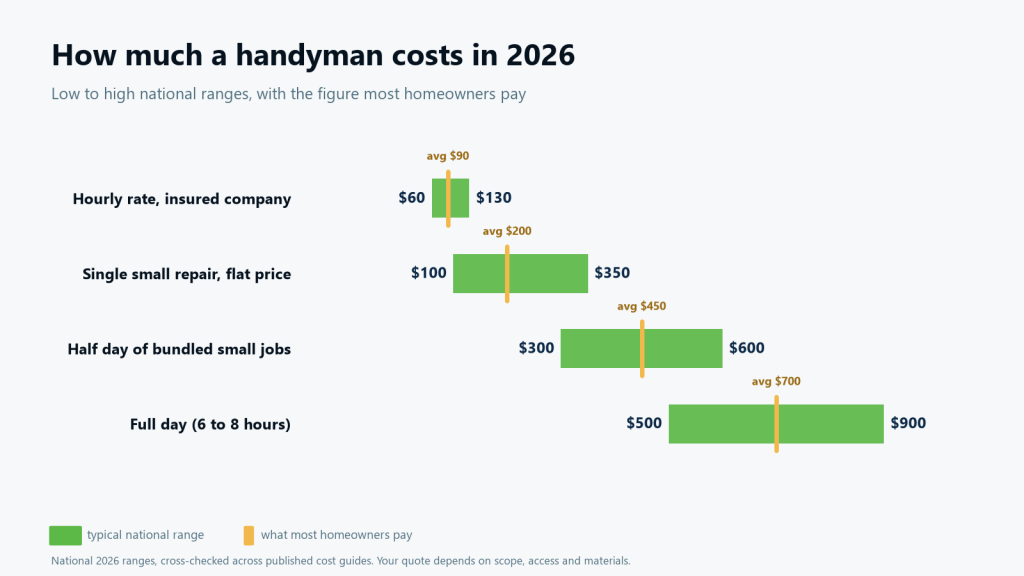
Hiring a handyman costs $100 to $350 for a typical single repair in 2026, and most homeowners pay about $200. By the hour, licensed and insured companies charge $60 to $130 nationally, and a half day of bundled small jobs runs $300 to $600. What you pay depends on how clearly the job is scoped, who buys the materials, and how hard the work is to reach. Here is the full breakdown.
What you'll learn in this guide
- Hourly rates run $60 to $130 in 2026; independents sit at the low end, insured companies at the high end.
- Most companies carry a minimum charge of $125 to $200, which is why one tiny job costs about the same as two.
- Common repairs priced flat: a door adjustment $125 to $250, a faucet swap $200 to $500, a TV mount $150 to $300.
- Two-story access, texture matching and unclear scope add the most to a quote.
- Bundling a list into one visit is the single biggest saving, often 30 to 50 percent per job.
Hourly rate or flat price: how handyman pricing works
There are two honest ways to price handyman work. An hourly rate fits small jobs where the scope may grow once a wall is open; you pay for the time it takes, plus materials. A flat price fits defined jobs; the number is agreed before work starts and cannot move on you. The 2026 national picture:
| Job | Low | Typical | High |
|---|---|---|---|
| Handyman hourly rate, independent | $50 | $65 | $80 |
| Handyman hourly rate, insured company | $75 | $95 | $130 |
| Minimum charge or trip fee | $75 | $150 | $200 |
| Half day, 3 to 4 hours of small jobs | $300 | $450 | $600 |
| Full day, 6 to 8 hours | $500 | $700 | $900 |
The third way to price a job is the vague verbal estimate that grows at the end. If the price will not go in writing before the work starts, keep calling around.
Handyman cost by job type
Flat prices in 2026 cluster in a narrow band for the jobs people book most. Materials are usually extra, or supplied by you.
| Job | Low | Typical | High |
|---|---|---|---|
| Door that sticks or will not latch | $85 | $150 | $250 |
| Drywall patch, doorknob-sized hole | $100 | $175 | $350 |
| Light fixture or ceiling fan on an existing box | $150 | $225 | $450 |
| Faucet replacement | $200 | $300 | $500 |
| TV mounted on drywall | $150 | $225 | $300 |
| Shelving, grab bars, small installs, each | $75 | $125 | $200 |
Larger fixed-price work such as a fence post reset or a full drywall sheet lands between $400 and $900, because it takes most of a visit.
What moves a handyman quote up or down
- Scope clarity. A clear photo and a one-line description earn a tighter quote than a mystery. Unclear scope is priced with a cushion.
- Materials. Handymen typically mark up materials 20 to 50 percent when they supply them. Buying the parts yourself, from a list the pro gives you, removes that markup.
- Access and height. Second-story exterior work, attics and crawl spaces add 20 to 40 percent because ladders and safety time are real hours.
- Finish matching. Matching a knockdown texture or a stain color adds $100 to $300 to a patch. The invisible repair costs more than the visible one.
- Insurance and licensing. A company that carries liability insurance, runs background checks and warranties its work charges more per hour than a neighbor with a truck. That gap is what protects you if something goes wrong.
The one real way to pay less
Bundle the list. The trip and the minimum charge are fixed costs. One visit that knocks out the sticking door, the wobbly fan, the cracked caulk and the leaning shelf costs far less per job than four separate calls; in practice the per-job cost drops 30 to 50 percent. Walk the house, write the list, and hand it over all at once. Two more habits help: buy the materials the pro specifies before the visit, and send photos so the quote is final rather than a range.
What this means for you
Budget about $200 for a single repair and $300 to $600 for a half day in 2026, and expect $60 to $130 per hour if the job is billed hourly. Get the price in writing before anyone starts, supply your own materials when you can, and save up the small jobs for one visit. Do those three things and you will land at the low end of every range on this page.
Good questions, straight answers
Between $60 and $130 per hour nationally. Independent handymen without insurance sit at $50 to $80, while licensed and insured companies charge $75 to $130. Most also carry a minimum charge of $125 to $200, so a ten-minute fix costs about the same as an hour.
Usually not for small jobs. The industry norm is payment on completion for work under about $1,000, and a deposit of 10 to 30 percent on larger projects or special-order materials. A deposit of more than half up front, or a demand for cash only, is a warning sign.
Either, and it changes the price. Handymen mark up materials they supply by 20 to 50 percent. Buying from a written list the pro gives you saves that markup; letting the pro shop saves you a trip and puts the responsibility for the right part on them.
Because the quotes include different things. Liability insurance, background checks, a written warranty and real employees all cost money and show up in the hourly rate. The lowest quote is usually missing at least one of them, and the difference matters most when a repair fails.
Rather have it handled? Call 855-695-1195 and we price the job over the phone. We answer in under three rings.