
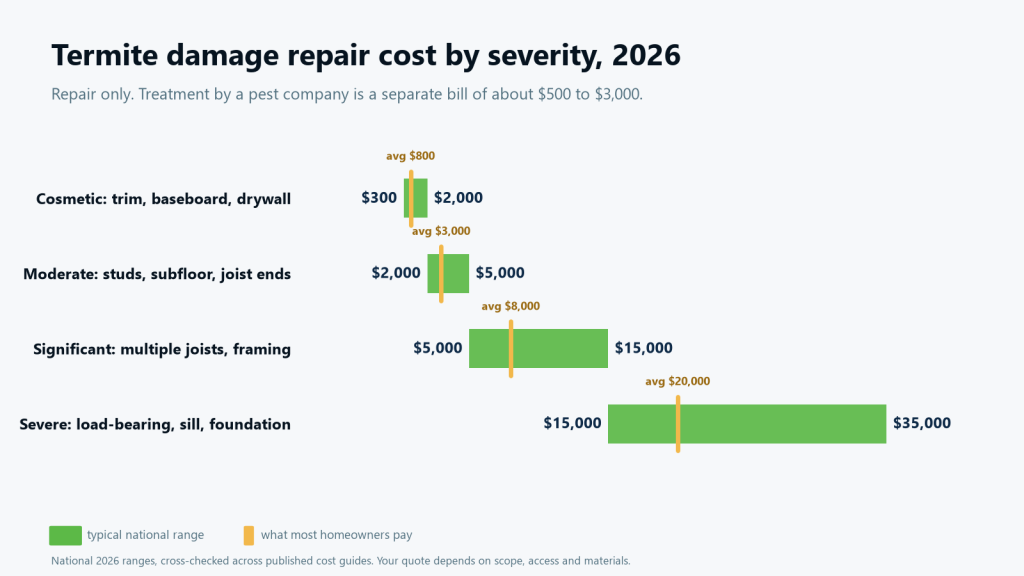
Termite damage repair costs $1,000 to $10,000 nationally in 2026, with most homeowners paying around $3,000. Cosmetic damage to trim, baseboards and drywall runs $300 to $2,000; structural repairs to joists, sill plates or load-bearing walls run $5,000 to $15,000, and severe cases pass $35,000. That is the repair only. Treatment to kill the colony is a separate bill of $500 to $3,000. Here is what drives the number and how to keep it at the low end.
What you'll learn in this guide
- Repairs are priced by what the termites reached: surface trim is hundreds, framing is thousands, a sill plate or beam is five figures.
- A drywall patch costs $300 to $900 per room; sistering a floor joist $200 to $1,000; replacing a sill plate $120 to $200 per linear foot.
- Treatment ($500 to $3,000) and an annual inspection ($300 to $500) are separate from the repair bill.
- Standard homeowners policies exclude termite damage as a maintenance issue, so this is an out-of-pocket repair.
- Any damage to load-bearing members needs a structural engineer's evaluation first, $350 to $900.
What sets the price of a termite repair
- Depth. Subterranean termites enter at the foundation and eat upward through sill plates, studs and joists, so their damage averages $3,000 to $10,000. Drywood termites live in the wood they eat, often trim and window frames, and average $600 to $3,000.
- Structure. A damaged floor joist can be sistered with a new joist bolted alongside for $200 to $1,000. A joist that must be fully replaced, with the subfloor opened, runs $500 to $2,500. A load-bearing beam or header is $800 to $10,000.
- Finish work. Every framing repair ends with drywall, texture, paint and trim to put the room back; budget $300 to $900 per room for that layer.
- Engineering. If a sill plate, beam or bearing wall is involved, a structural engineer evaluates the repair for $350 to $900, and many jurisdictions require a permit.
- Moisture. Termites follow water. If a leak or grading problem invited them, that fix is part of the price of not doing this twice.
Termite damage repair cost by severity in 2026
| Severity | Low | Typical | High |
|---|---|---|---|
| Cosmetic: baseboard, trim, drywall surface | $300 | $800 | $2,000 |
| Moderate: studs, subfloor, joist ends | $2,000 | $3,000 | $5,000 |
| Significant: several joists, wall framing | $5,000 | $8,000 | $15,000 |
| Severe: load-bearing beam, sill plate, foundation | $15,000 | $20,000 | $35,000+ |
| Component | Low | Typical | High |
|---|---|---|---|
| Drywall patch and paint, per room | $300 | $500 | $900 |
| Baseboard or trim, per linear foot | $6 | $10 | $15 |
| Subfloor replacement, per square foot | $3 | $6 | $10 |
| Floor joist sistered, each | $200 | $500 | $1,000 |
| Sill plate replacement, per linear foot | $120 | $160 | $200 |
| Structural engineer evaluation | $350 | $600 | $900 |
Most homes land in the first two rows because the damage is found at a sale inspection or a remodel before it spreads. The termite damage repair itself is carpentry: cut out the eaten wood, sister or replace the members, treat the new lumber, and rebuild the finishes so nothing shows.
Two bills, not one: treatment and repair
A pest control company kills the colony; a carpenter rebuilds what it ate. Treatment for subterranean termites runs $500 to $3,000 for liquid barriers or bait stations, and a whole-house fumigation for drywood termites $1,200 to $4,000. Repair should start only after treatment is complete, otherwise new wood becomes new food. An annual inspection at $300 to $500, or a termite bond with a repair clause at $300 to $500 a year, is the cheapest line on this page, because a colony caught in year one costs hundreds and a colony caught in year five costs thousands.
What this means for you
Expect $1,000 to $10,000 for termite damage repair in 2026, around $3,000 for the typical home, plus $500 to $3,000 for treatment. Get the colony treated first, have an engineer look at anything structural, and repair right away, because termites keep eating while quotes sit in an inbox. Insurance will not help, so an annual inspection is the policy that actually pays.
Good questions, straight answers
Almost never. Standard HO-3 and HO-5 policies treat termite damage as a maintenance issue and exclude it, along with rot and other slow damage. The exception is when termites cause a sudden collapse, and even then coverage is argued case by case. Budget the repair as out of pocket.
$500 to $3,000 in 2026 for the common subterranean methods, liquid soil treatment or bait stations, and $1,200 to $4,000 for a whole-house fumigation against drywood termites. Treatment comes first; repairs on an untreated house are new food for the colony.
Both, depending on how much is left. Lightly damaged framing is sistered, with a new member bolted alongside for $200 to $1,000 per joist. Wood that has lost its structure is cut out and replaced. Trim and drywall are always replaced rather than filled.
A wood-destroying-insect inspection, $300 to $500, maps where the activity is. Then a carpenter opens the worst spot: if the damage stops in trim or the ends of a few joists, it is a moderate repair; if it reaches the sill plate or a beam, an engineer prices the structural work.
One to two days for cosmetic and moderate work such as trim, drywall and a few sistered joists. Significant framing repairs take three to five days plus permit time, and severe structural repairs with engineering can run two to four weeks including treatment.
Rather have it handled? Call 855-695-1195 and we price the job over the phone. We answer in under three rings.