
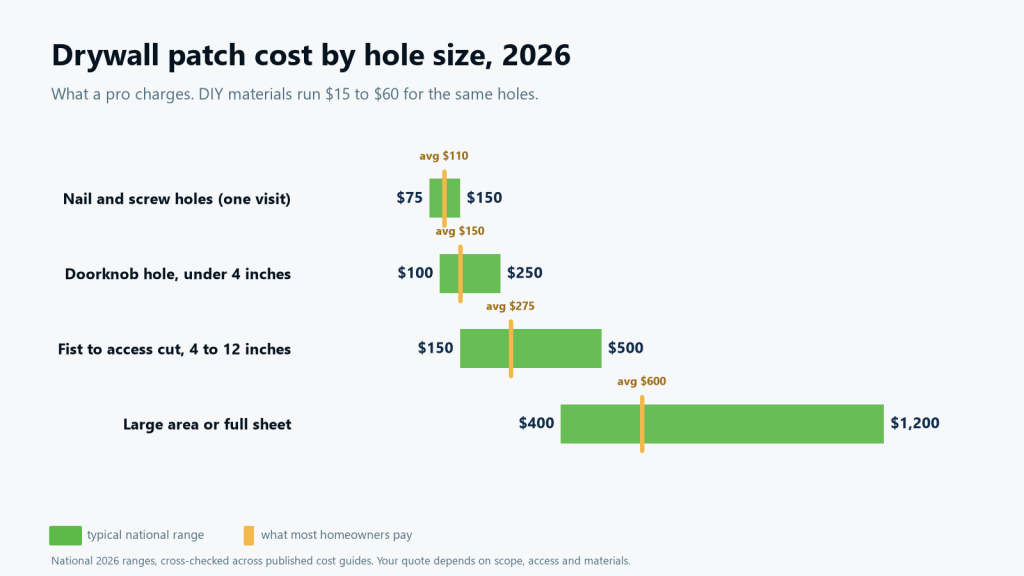
Patch drywall by matching the method to the hole: spackle for nail and screw holes, a self-adhesive mesh patch for holes under 4 inches, a California patch cut from scrap drywall for 4 to 8 inches, and a new piece screwed to backing strips for anything larger. Every method ends the same way: three thin coats of joint compound, a light sanding, matched texture, primer and paint. Materials cost $15 to $60; a pro charges $75 to $500 in 2026. Here is each method, by size.
What you'll learn in this guide
- Three thin coats of compound, each wider than the last, beat one thick coat every time; thick coats crack and shrink.
- A mesh patch handles holes up to about 4 inches; past that the compound sags without real drywall behind it.
- The California patch (a drywall piece with a paper flange) fixes 4 to 8 inch holes with no backing strips.
- Texture is the repair: an unmatched orange peel or knockdown shows from across the room even under paint.
- Pro prices in 2026: $75 to $150 for nail holes, $100 to $250 for a doorknob hole, $150 to $500 for 4 to 12 inches, $400 to $1,200 for a full sheet.
Nail and screw holes: spackle
Press lightweight spackle into the hole with a putty knife, scrape it flush, let it dry 30 minutes, and sand lightly. For nail pops, where a screw head has pushed through the paper, drive a new drywall screw an inch above and below the pop, set the old fastener slightly below the surface, and cover all three with compound. Prime the spots before painting or they will flash through as dull patches.
Holes under 4 inches: the mesh patch
A doorknob through the wall is the classic case. Cut away loose paper, stick a self-adhesive mesh patch centered over the hole, and spread a thin coat of joint compound over it with a 6-inch knife, pressing the compound through the mesh. Let it dry, then apply a second and third coat with a 10 or 12-inch knife, feathering each coat 2 to 3 inches wider than the last so the edges disappear. Sand between coats with 150-grit. Total drying time is about a day; working time is under 30 minutes. Install a door stop before painting or the same doorknob makes the same hole.
Holes 4 to 8 inches: the California patch
Square the hole with a drywall saw. Cut a piece of drywall 2 inches larger than the hole in each direction, then on its back score and snap away the gypsum 1 inch in from every edge, leaving the front paper intact as a flange. The plug fits the hole and the paper flange lies flat on the wall. Butter the flange with compound, press it in, and skim over it; then coat and feather as above. No backing strips, no screws, and the paper flange gives a flatter result than a mesh patch at this size.
Larger than 8 inches: back it and screw it
Cut the damaged area back to a clean rectangle. Screw two strips of 1x3 or scrap plywood inside the wall cavity behind the top and bottom edges so they overlap the opening by an inch each side; they become the backing. Cut a new piece of 1/2-inch drywall to fit, screw it to the backing every 6 inches, tape the seams with paper or mesh tape, and apply three feathered coats. Wet or moldy drywall is always cut out, never patched over.
Texture and paint: where patches succeed or fail
A perfectly flat patch on an orange peel or knockdown wall is visible from the doorway. Match the texture with a spray can of orange peel or knockdown texture, practicing on cardboard first, and knock down with a wide knife after a few minutes for knockdown walls. Texture and paint blending is most of what a professional drywall repair charges for, and it is the step DIY repairs most often skip.
What this means for you
Nail holes and doorknob holes are a $20 afternoon with spackle or a mesh patch and three thin coats. Holes from 4 to 8 inches take a California patch; bigger ones need backing and a new piece. If the wall has texture, budget the time to match it or the patch will show. Pro prices run $100 to $250 for a small hole and $400 to $1,200 for a sheet in 2026, with texture matching the part most worth paying for.
Good questions, straight answers
Yes, up to about 2 feet across. Cut the hole square, screw wood backing strips inside the wall, fit a new drywall piece to the backing, tape and coat the seams. Beyond 2 feet, or anywhere the drywall is water-damaged, replace the section between studs.
$75 to $150 for a round of nail holes, $100 to $250 for a doorknob-sized hole, $150 to $500 for holes of 4 to 12 inches, and $400 to $1,200 for a full sheet in 2026. Matching a textured finish adds $100 to $300. DIY materials for the same repairs run $15 to $60.
Working time is 20 to 40 minutes per small patch, but drying between coats sets the schedule: about 24 hours for three coats of compound, plus texture and paint the next day. Fast-setting compound cuts a small repair to a single afternoon.
Because the patch is flatter than the textured wall around it, the compound was not primed and flashes through, or the touch-up paint does not match the aged wall. Match the texture, prime the patch, and paint the whole wall corner to corner.
Rather have it handled? Call 855-695-1195 and we price the job over the phone. We answer in under three rings.