
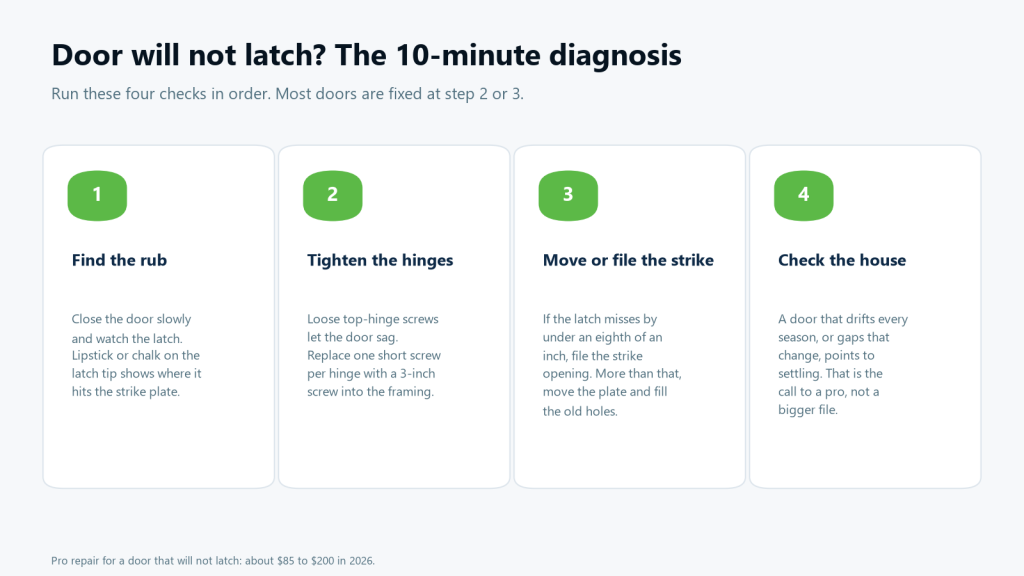
A door will not latch because the latch bolt is missing the hole in the strike plate, almost always by less than a quarter inch. The usual cause is a door that has sagged on loose hinge screws, and the second most common is a frame that has shifted with the seasons. Four checks, done in order, find and fix nine doors out of ten in about ten minutes with a screwdriver, a file and one long screw. Here is the sequence.
What you'll learn in this guide
- Lipstick or chalk on the latch tip shows exactly where it hits the strike plate and by how much.
- One 3-inch screw through the top hinge into the wall stud lifts a sagging door 1/16 to 1/8 inch, enough for most misses.
- A miss under 1/8 inch is filed; a bigger miss means moving the strike plate and filling the old screw holes with glued toothpicks.
- A door that latches in summer and not in winter is the house moving, not the door.
- A pro visit for a door that will not latch costs $85 to $200 in 2026.
Step 1: find the rub (two minutes)
Close the door slowly and watch the latch meet the strike plate. Rub lipstick or chalk on the tip of the latch bolt, close the door, and open it: the mark on the strike plate shows whether the latch is landing high, low or short of the hole. Landing high or low means the door has moved on its hinges. Landing short, not reaching the plate at all, means the door is not closing far enough, usually from a swollen edge or a warped weatherstrip. Check the gap around the door too: a wedge-shaped gap, wide at the top of the latch side, is the signature of a sagging door.
Step 2: tighten the hinges (three minutes)
Open the door and lift it by the knob. If it moves, the hinge screws are loose. Tighten every screw on all hinges. If a screw spins without biting, the hole is stripped: pull it, push in two or three wooden toothpicks or golf tees with wood glue, snap them flush, and drive the screw again. Then the trick that fixes most latch problems: replace one short screw in the top hinge, the one nearest the doorstop, with a 3-inch screw. It reaches through the jamb into the wall stud and pulls the top of the door back toward the hinge side, raising the latch 1/16 to 1/8 inch. Test the door. Many are finished here.
Step 3: move or file the strike plate (five minutes)
If the latch still misses by less than 1/8 inch, file the strike plate opening in the direction of the miss with a half-round metal file, a few strokes at a time, until the bolt drops in. If the miss is larger than 1/8 inch, filing weakens the plate; instead unscrew it, move it the distance of the miss, trace the new position, chisel the mortise slightly deeper if needed, fill the old holes with glued toothpicks, and screw it back. A latch that lands short is fixed differently: plane or sand the edge that rubs, or replace a bulging weatherstrip. A deadbolt that will not throw follows the same rules with its own strike.
Step 4: when it is the house, not the door
A door that latches in one season and not the other, gaps that change through the year, and cracks running from the corners of the frame are settling or moisture in the framing, not a hinge problem. Filing the strike every six months is chasing the symptom. That is the point where a door repair that rehangs the door and squares the jamb, or a look at drainage and foundation, saves the repeat visits.
What this means for you
Mark the latch, tighten the hinges, drive one 3-inch screw into the top hinge, then file or move the strike plate: that sequence fixes most doors that will not latch in about ten minutes and costs under $5 in parts. If the door drifts with the seasons or the frame has cracked, the fix is the door and jamb, and a professional visit runs $85 to $200 in 2026.
Good questions, straight answers
Because the door has moved a fraction of an inch relative to the strike plate. Loose hinge screws let the door sag, humidity swells the door or frame, and seasonal settling shifts the jamb. Lipstick on the latch tip shows the direction of the miss in one closing.
Tighten the hinges and replace one top-hinge screw with a 3-inch screw into the stud, which lifts the latch side of the door. If the latch still misses by under 1/8 inch, file the strike plate opening; if it misses by more, move the plate. Total parts cost is under $5.
$85 to $200 in 2026 for adjustment, hinge tightening and strike plate work, typically a 30 to 60 minute visit. Rehanging a door that has warped or squaring a jamb that has shifted runs $150 to $350, and a new slab door installed in the existing frame $425 to $700.
Wood doors and frames swell with humidity and shrink when the air dries, moving the latch up to 1/8 inch through the year. Setting the strike plate for the middle of that range, and sealing the door's top and bottom edges so they absorb less moisture, usually ends the seasonal problem.
Rather have it handled? Call 855-695-1195 and we price the job over the phone. We answer in under three rings.