
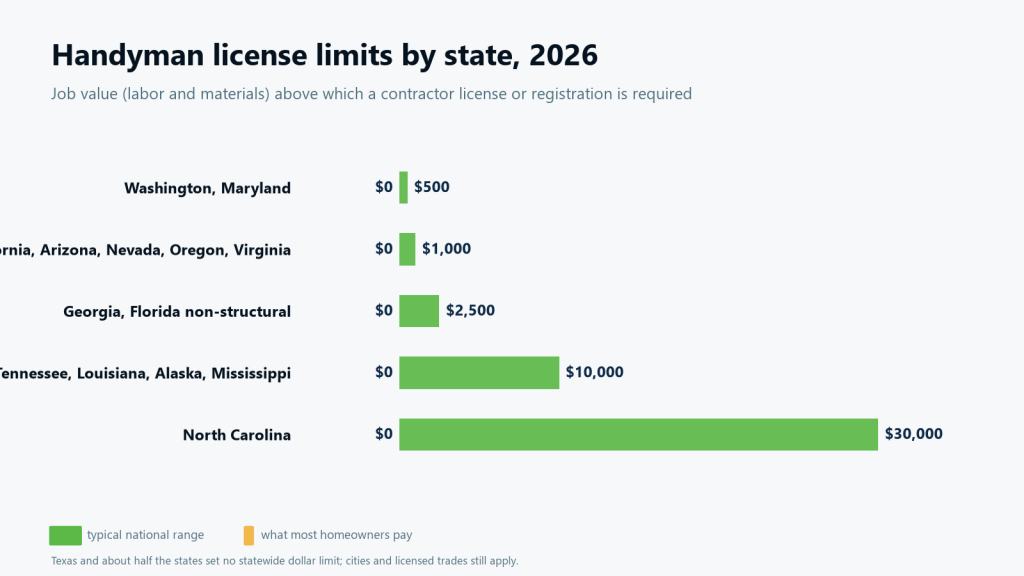
It depends on the state and the dollar value of the job. About half the states let a handyman work without a contractor license below a set job value: $1,000 including materials in California, Arizona, Nevada and Oregon, $2,500 for non-structural work in Florida, up to $30,000 in North Carolina. Texas and about 20 other states set no statewide handyman license. Everywhere, licensed trades such as electrical and plumbing need a trade license at any price. Below, the thresholds, the trades, and how to check a pro in two minutes.
What you'll learn in this guide
- The threshold is per job, labor and materials combined, and splitting one job into pieces to stay under it is illegal in most states.
- California raised its handyman exemption from $500 to $1,000 in 2025, with no employees and no permit allowed under it.
- Florida allows unlicensed handyman work up to $2,500 but still requires a licensed contractor for electrical, plumbing, HVAC, roofing and structural work at any price.
- Washington and Maryland require registration above $500; Oregon requires CCB registration and insurance for nearly all paid work.
- A license is not insurance: ask for both, and verify the license number on the state board's website.
Handyman license thresholds by state in 2026
| State | Requirement | Threshold | Basis |
|---|---|---|---|
| Washington, Maryland | Registration required | above $500 | per job |
| California, Arizona, Nevada, Oregon, Virginia, Hawaii | Contractor license | above $1,000 | per job |
| Georgia, Florida (non-structural), Arkansas, Iowa | License or registration | above $2,000 to $2,500 | per job |
| Tennessee, Louisiana, Alaska, Mississippi | License | above $3,000 to $10,000 | per job |
| North Carolina | General contractor license | above $30,000 | per job |
| Texas, Colorado, New York, Ohio, and about 20 others | No statewide handyman license | city rules apply |
Some states count the year, not the job: New Mexico's handyman certificate covers up to $7,200 in annual revenue and Idaho registers contractors above $2,000 a year. Thresholds change; California's went from $500 to $1,000 on January 1, 2025, and bills to raise Arizona's limit come up most sessions. The state contractor board website has the current number.
Licensed trades: the threshold does not apply
Electrical, plumbing, HVAC, gas, roofing and structural work are licensed trades in most states regardless of price. Florida is the clearest example: a handyman can take a $2,000 fence or drywall job without a license but cannot legally replace a $40 outlet, because electrical work belongs to licensed electrical contractors. Washington requires a specialty electrical license for all electrical work. The practical line in every state is the same: like-for-like fixture swaps sit in a gray zone, anything that adds wiring, pipe or structure is licensed work.
How to check a handyman's license in two minutes
- Ask for the license or registration number and the name it is issued under. A legitimate pro has it on the truck, the invoice and the website.
- Search that number on the state board site, for example the CSLB in California or the DBPR in Florida. Check that it is active, the business name matches, and there are no open complaints.
- Ask for a certificate of insurance showing general liability, and workers' compensation if the company has employees. Insurance is separate from the license and matters more if something breaks.
- For a job that needs a permit, ask who pulls it. A pro who asks you to pull it as the homeowner is usually not licensed to.
A licensed, insured and bonded handyman company lists all three on its site because the license is only one of the three protections.
Why the license matters to the homeowner
In most states an unlicensed contractor cannot enforce a contract or lien a home, which sounds like a benefit until a job goes wrong: there is no board to complain to, no bond to claim against, and the homeowner's insurer can deny a claim caused by unlicensed work. Licensed pros carry a bond, typically $15,000 to $25,000, and answer to a board that can suspend them. For a $200 repair the risk is small; for a $2,500 deck railing it is not.
What this means for you
A handyman needs a license when the job passes the state threshold, $500 to $2,500 in most states that have one, or when the work is a licensed trade at any price. Look up your state's number, ask for the license and the insurance certificate, and verify both on the board's website before the first visit. Two minutes of checking covers every risk on this page.
Good questions, straight answers
For any job over $1,000 including labor and materials, yes, a CSLB contractor license. Below $1,000 a handyman can work unlicensed under the minor-work exemption as long as no permit is required and no employees are used. Electrical and plumbing beyond simple swaps need the trade license regardless.
Not for general repairs under $2,500 that are non-structural, such as drywall, painting, fences, doors and trim. Florida does require a licensed contractor for electrical, plumbing, HVAC, roofing, gas and structural work at any price, and counties can add local registration.
No statewide handyman or general contractor license exists in Texas. Electricians, plumbers and HVAC technicians are licensed by the state, and cities such as Dallas, Houston and Austin have their own registration and permit rules for larger work.
A license is permission from the state to do the work. A bond is money set aside, usually $15,000 to $25,000, that a customer can claim if the contractor fails to perform. Insurance pays for damage or injury on the job. A good pro carries all three and can show each.
Rather have it handled? Call 855-695-1195 and we price the job over the phone. We answer in under three rings.