
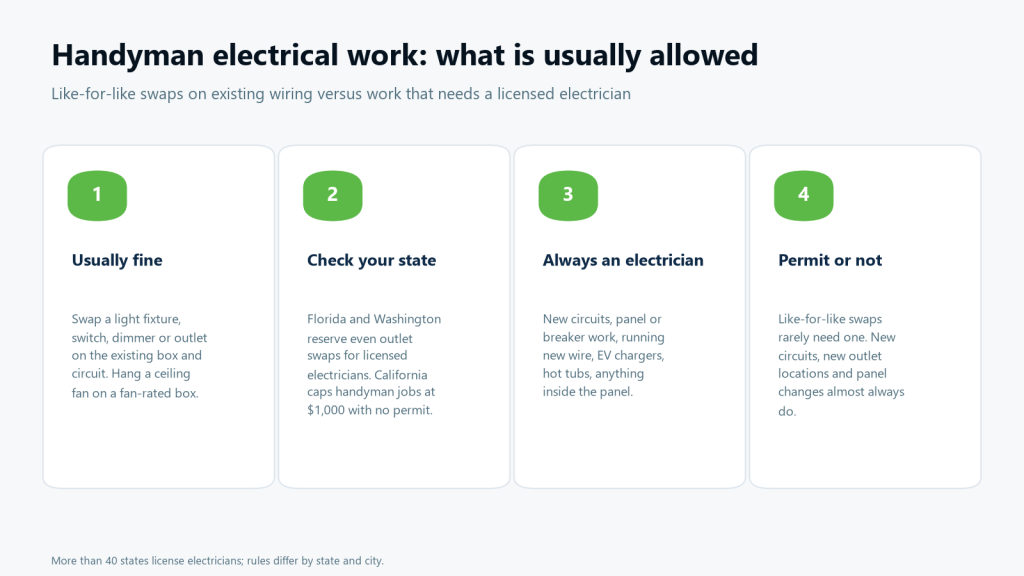
Yes, a handyman can legally do minor electrical work in most states, as long as it is a like-for-like swap on existing wiring: a light fixture, a switch, a dimmer, an outlet, a ceiling fan on a fan-rated box. Anything that adds or changes the system, meaning new circuits, new wire runs or panel work, needs a licensed electrician and usually a permit. Florida and Washington reserve even the small jobs for licensed trades. Below, what is allowed, what is not, and how to tell which your job is.
What you'll learn in this guide
- More than 40 states license electricians; the gray area is only the small like-for-like swaps.
- California caps unlicensed handyman jobs at $1,000 including materials, with no permit and no new circuit.
- Florida and Washington require a licensed electrician even to replace an outlet.
- New outlet locations, new circuits and panel changes almost always need a permit and an inspection.
- A handyman fixture or fan swap costs $150 to $450 in 2026; an electrician service call starts at $100 to $200 per hour.
What a handyman is usually allowed to do
- Replace a light fixture, chandelier or bathroom vanity light on an existing box.
- Swap a switch, dimmer, outlet or GFCI receptacle in an existing box, same circuit, same location.
- Hang a ceiling fan where a fan-rated box already exists.
- Replace a doorbell button or chime, a smoke or carbon monoxide detector, a bathroom exhaust fan of the same size.
- Install low-voltage items: smart thermostats, doorbell cameras, landscape lighting transformers, under-cabinet LED kits that plug in.
The common thread is that nothing changes in the system: same circuit, same box, same load. The job is mechanical replacement with the breaker off.
What always needs a licensed electrician
- Any new circuit, any new run of wire inside walls, any outlet in a new location.
- Anything inside the panel: breakers, subpanels, service upgrades, whole-house surge protection.
- EV chargers, hot tubs, ranges, dryers, HVAC, and other 240-volt or dedicated-circuit equipment.
- Aluminum wiring, knob-and-tube, and any repair where the existing wiring is damaged or ungrounded.
- A ceiling fan where the box is not fan-rated, because the box must be replaced and braced.
State examples: the rules differ
California allows a handyman to do a job, electrical included, when the total price including materials is under $1,000 and no permit or new circuit is involved; that covers a fixture or outlet swap but not a new circuit. Arizona and Nevada set the same kind of limit at $1,000. Florida requires a licensed electrical contractor for any electrical work, even replacing an outlet, regardless of the price. Washington requires a specialty electrical contractor for all electrical work; a general contractor registration does not cover it. Texas has no statewide handyman license but licenses electricians, so the like-for-like swap is the practical line there too. Cities add their own rules, so the local building department is the final word.
Permits: the simple test
Replacing what is there rarely needs a permit. Adding, moving or upsizing almost always does. A permit means an inspector checks the work, which is the homeowner's protection, and unpermitted electrical work can void insurance claims and complicate a sale. When a job lands in the gray zone, a handyman electrical service that knows the local line will say so and refer the rest to an electrician rather than guess.
What this means for you
For a fixture, fan, switch or outlet swap on existing wiring, a handyman is a legal and cheaper choice in most states, at $150 to $450 per job in 2026. For anything that adds wire, a circuit or a breaker, hire a licensed electrician and pull the permit. If you live in Florida or Washington, the electrician is the answer for both.
Good questions, straight answers
In most states, yes, when the new fixture goes on the existing box and circuit. The exceptions are states such as Florida and Washington, where any electrical work requires a licensed electrician. Expect $150 to $350 for a handyman fixture swap in 2026.
Yes where a fan-rated box already exists and the wiring is sound. If the ceiling has a standard light box, the box must be replaced with a braced fan box, and in many places that crosses into licensed work. A fan installation runs $200 to $450.
Usually, as a like-for-like swap in the same box, including upgrading a standard outlet to a GFCI. Florida and Washington require a licensed electrician even for this. Adding an outlet in a new location is new wiring and needs an electrician and a permit everywhere.
Almost never for a direct replacement. Permits are triggered by new circuits, new outlet or fixture locations, panel and breaker work, and dedicated-circuit appliances. Your city building department lists the exact triggers, and they vary.
Insurers can deny a fire claim tied to unpermitted or unlicensed work, home inspectors flag it at resale, and the homeowner, not the handyman, is usually responsible for bringing it to code. That risk is why the like-for-like line matters.
Rather have it handled? Call 855-695-1195 and we price the job over the phone. We answer in under three rings.