 BBBAccredited Business

Kaminskiy Care and Repair provides scheduled property maintenance services for commercial and multi-unit property: recurring visits, monthly or quarterly for example, that work a standing checklist per site. A round covers doors and closers, light fixtures, caulk, paint touch-up, gutters and safety items, with small repairs made during the round inside a budget the owner has approved. One coordinator schedules it, and a log with photos follows every visit. A single repair has its own page, such as door closer repair. Programs are the recurring side of our commercial remodeling and ongoing property services.
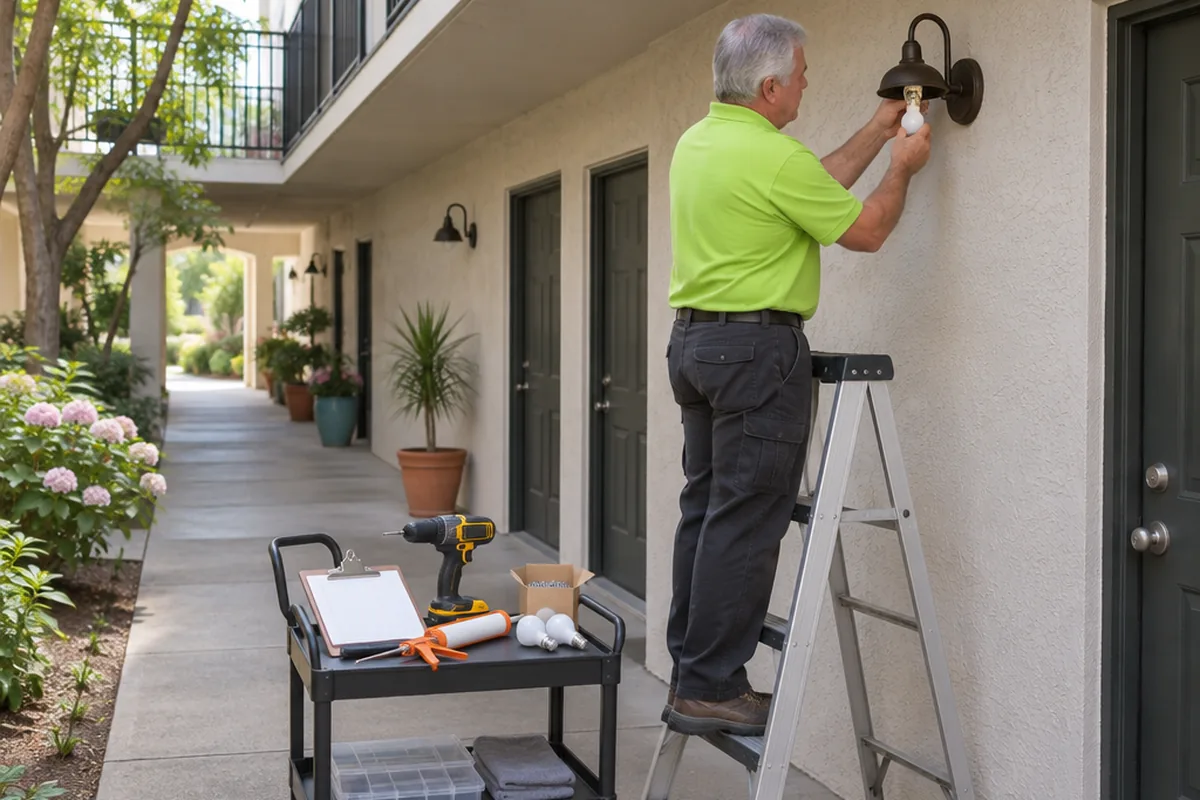
On-site staff are busy with turnovers and resident requests, so the breezeway light, the laundry room door and the pool gate latch wait. A program round walks every building's common areas against the checklist, fixes what a technician can fix during the round and lists what remains with photos. Gutters follow their own calendar under gutter cleaning programs.
A manager with five centers cannot test every entry door and exit sign personally. The round checks each tenant-facing door, the corridor and restroom finishes, exterior lights and the trash enclosure, suite by suite. Wall scuffs are handled the way our touch-up program describes, from the building's color log.
A clinic or private school has no building maintenance department, only an office manager with a drawer of work orders. A quarterly round clears the drawer: sticking doors, loose handrail brackets, failed caulk at sinks, a dead exit sign battery, ceiling tiles stained by an old leak. The log shows the owner what the building needed this quarter.
A first walk lists every item worth checking by building and area, and agrees which repairs the technician may make without asking and what budget covers them.
Rounds are booked ahead at the interval the property needs, with seasonal items placed in the right months. One coordinator holds the calendar.
The technician works the checklist in order, repairs approved items during the round, and photographs anything larger for a separate written quote.
After each round you receive the checklist marked item by item, photos of repairs and findings, and what was spent against the approved budget.
Federal ADA regulations (28 CFR 36.211) require a public accommodation to maintain in operable working condition the features that are required to be accessible. Isolated or temporary interruptions for maintenance or repairs are allowed. That is why door closers, lever hardware, grab bars, ramps and handrails sit on the checklist: the round confirms each one still works and records the date it was checked.
OSHA's general industry rule (29 CFR 1910.22) requires employers to inspect walking-working surfaces regularly and as necessary and keep them in safe condition, and to correct or guard a hazard before employees use the surface again. A program round covers the part a technician can repair: loose treads, lifted flooring edges, loose mats and handrail brackets. Related repairs are described under trip hazard repair.
Some items carry test intervals or replacement dates set by fire and life-safety codes, such as exit sign and emergency lighting tests and the replacement age of unit smoke alarms. The local fire authority decides what applies. The round can include those checks and record them, as explained on our exit sign and emergency lighting service page. Monitored fire alarm systems stay with their licensed contractors.
Sources for the rules on this page: U.S. Department of Justice, ADA Title III Regulations, 28 CFR 36.211, Maintenance of accessible features; OSHA, 29 CFR 1910.22, Walking-Working Surfaces: General requirements.
Buildings wear in small ways every week. A round on the calendar catches them while they are still small.
A typical checklist runs by area. Entries: door closing and latching, sweeps, thresholds, hardware. Corridors and stairs: lights, handrail brackets, flooring edges, wall scuffs. Restrooms and break rooms: caulk, running fixtures, partition latches, dispensers. Exterior: walkway lights, gate latches, downspouts, enclosure gates. Safety: exit signs lit, exit paths clear, unit smoke alarm dates. Each line is marked checked, fixed or quoted.
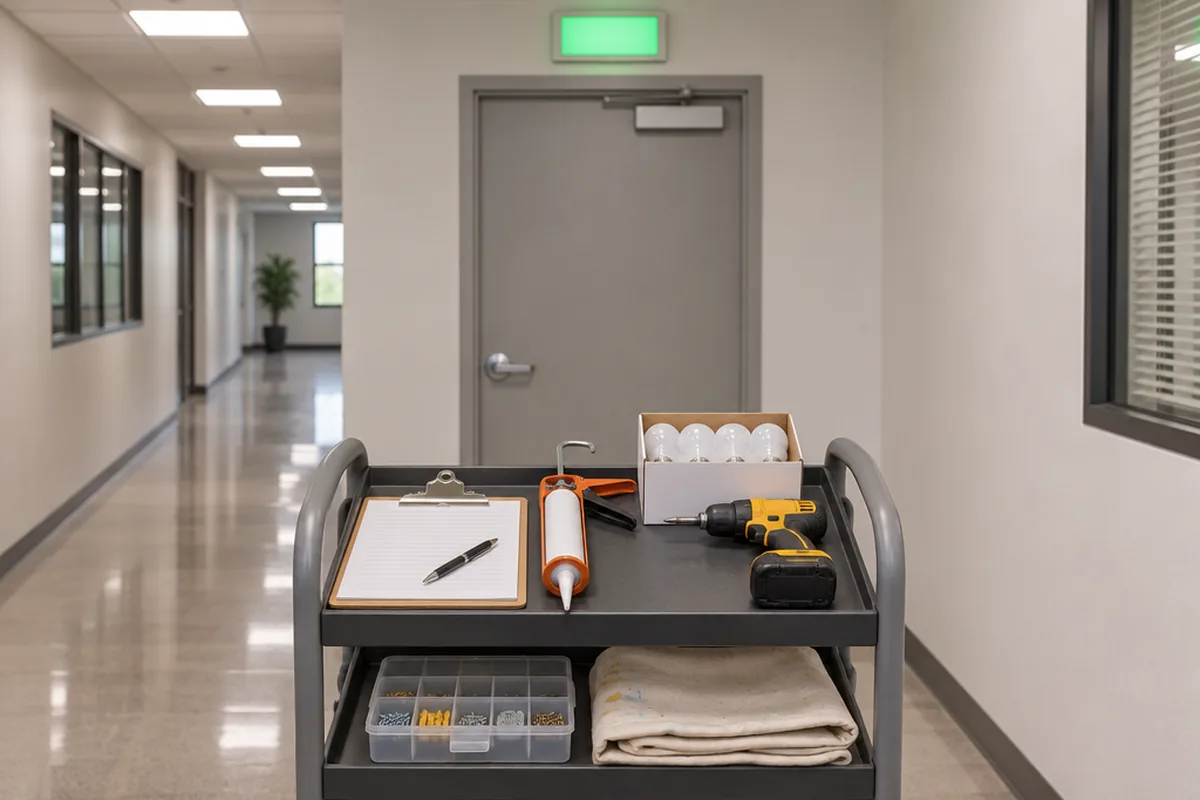
A program does not make repairs disappear. It moves them from complaints to a calendar, groups them so each trip does more, and leaves a record. Items that turn out to be bigger are quoted, never done on assumption.

Send the property list with addresses, building counts and the items that keep recurring.

We walk the property, draft the checklist and propose an interval and a small-repair budget.

Rounds run on the agreed dates, and a marked checklist with photos follows each one.
The work is backed in writing by our workmanship warranty and done by a Kaminskiy-certified, background checked technician.
Start from the last twelve months of work orders and the last inspection report. Whatever shows up twice goes on the list. Organize it by walking route, not by trade, so nothing is skipped: site, building exterior, entries, corridors, stairs, restrooms, shared rooms, roof access if safe. Put a count beside each line, such as 14 common doors or 22 walkway fixtures, so the log can show how many passed.
Match the interval to how fast things fail and how visible they are. Busy retail entries and community amenities wear monthly. Office corridors and small clinics hold for a quarter. Seasonal tasks get fixed months: gutters before the rains, exterior caulk and paint in dry weather, lighting checks when days shorten. An interval can change after two or three rounds show the real rate.
A round is efficient only if the technician can fix what is found. Decide two numbers before the first round: an amount per round for parts and minor repairs, and a per-item ceiling above which you want a written quote first. The log then reports what was spent and on what. Money left over stays unspent, and anything over the ceiling waits for your approval.
A good log answers three questions per line: was it checked, was it right, what was done. Photos show the repair and the finding, dated. Over a year the logs show patterns: the door that needs a new closer instead of another adjustment, the downspout that is crushed every winter. Those patterns are how a program feeds the capital plan, and repeat findings are flagged in writing.
Can't find your answer? Call 855-695-1195 and ask us anything.
Call 855-695-1195A scheduled maintenance program is a set of recurring visits that work a checklist written for your property: doors and closers, lights, caulk, paint touch-up, gutters, hardware and basic safety items. Small repairs are made during the round within a budget you approve. Larger items are photographed and quoted. A marked checklist with photos is sent after each visit.
As often as the property needs. Monthly and quarterly are common starting points, and seasonal tasks are placed in the months that suit them. We suggest an interval after the first walk and adjust it once a few rounds show how quickly items recur.
By the time a round takes, which follows from the size of the property and the length of the checklist, plus the small-repair budget you set for parts and minor fixes. Larger repairs found during a round are quoted separately in writing. You see the round's scope and the budget in writing before the first visit.
One coordinator. That person books the rounds, sends the logs, routes quotes for larger findings and is the contact for changes to the checklist. The technicians who walk your property are Kaminskiy-certified, background checked and in uniform.
Yes, and it should. Items that never fail can be checked less often, and new ones are added when a tenant, an inspector or the log itself points to them. Changes are made in writing so the checklist you hold always matches what the technician carries.
No. Fire alarm, sprinkler, extinguisher, elevator and backflow inspections are performed by licensed specialists on schedules set by code and the local authority. A program round can note that their tags are current and handle simple items such as a dark exit sign, but it is not a substitute for those inspections.
The technician photographs it, makes it safe if that is simple, and reports it in the log. You receive a written quote for the repair. If it involves a licensed trade, an engineer or a permit, the quote says so. Nothing beyond the approved small-repair budget is done without your approval.
It covers the handyman and repair part of building maintenance: the doors, lights, caulk, paint, hardware and small carpentry a technician can check and fix. It does not include janitorial service, landscaping, HVAC service or licensed system testing, which stay with those vendors. Many managers run a program beside those contracts and file the logs together.
Send the addresses, the number of buildings, what keeps breaking and any inspection report from the past year. We reply with a time to walk the property. Or call 855-695-1195.
A checklist you approve. Rounds on set dates. A log with photos each time.
We answer in under three rings, 24/7.No price games. You get a clear written quote before any work begins, backed by our workmanship warranty.
