
 BBBAccredited Business

Kaminskiy Care and Repair does trip hazard repair and floor safety work on commercial and multi-unit property. A technician walks the routes people use, measures and photographs every lifted edge, loose transition strip, curled mat, loose nosing, raised sill and slick spot, and repairs them in a scheduled round with before and after photos. Traction is added with tape, treads, coatings and matting. Heaved or sunken concrete is referred to a concrete contractor, and we do not test or certify floors. The walk-through is the place many managers start with our commercial flooring services.
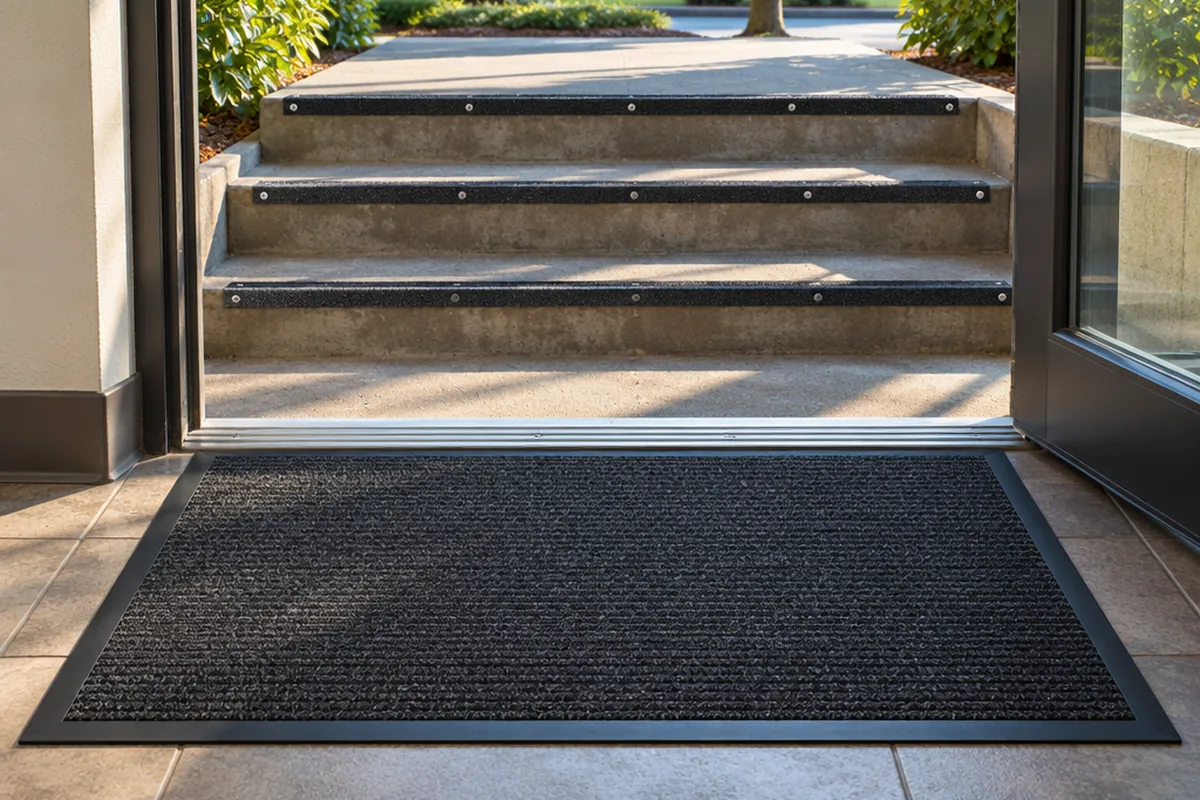
The entrance packs wet shoes, a mat, a door sill and a change of flooring into a few feet. We flatten or replace curled mats, extend matting that is too short, add grip to slick tile and measure the sill. A threshold that is loose or too tall is corrected as threshold replacement, and a lip that cannot be lowered may get a small threshold ramp.
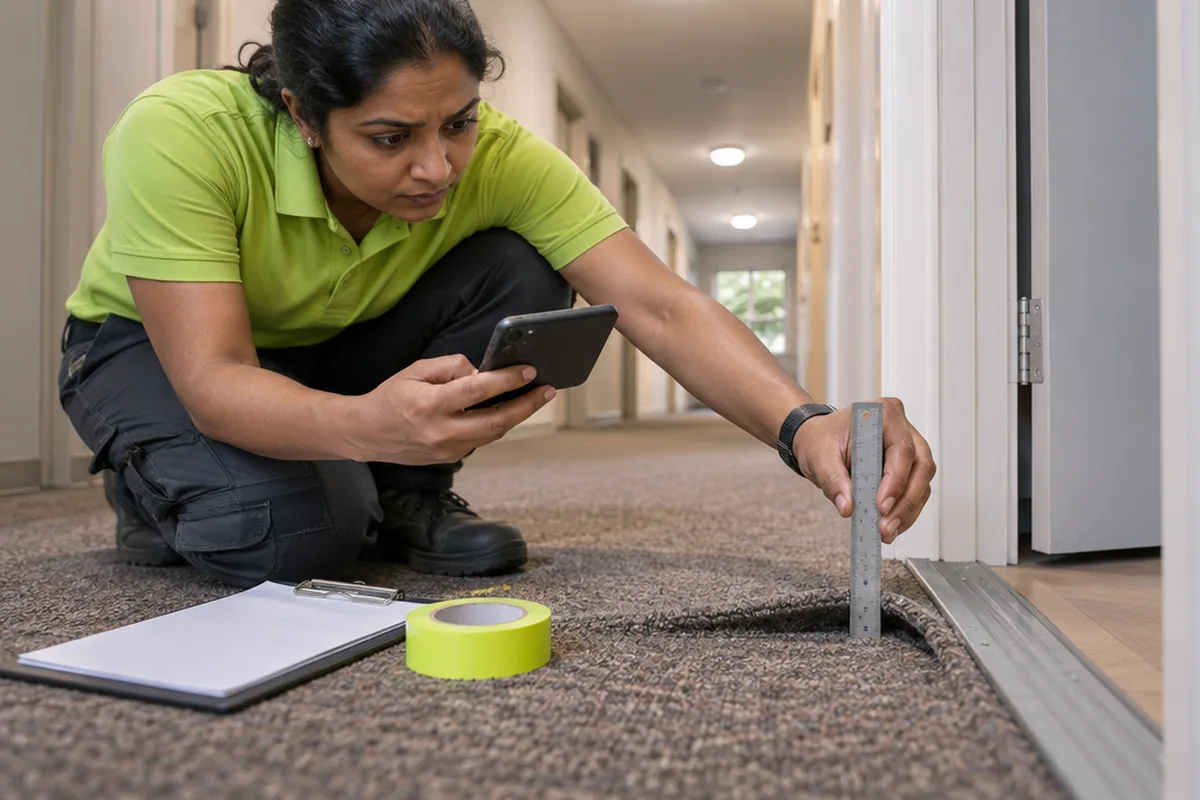
Indoors the hazards sit at seams: carpet rippled or lifted at a doorway, a metal strip torn loose, a tile standing above its neighbors, a vinyl tile with a corner snapped off. We re-secure carpet and replace strips ourselves on this service. Broken tile is handled as tile and grout repair and lifted vinyl as VCT repair. On the walk they all go on one sheet.
Outdoors we look at wood and at grip: a cupped or broken walkway board, a popped fastener, a loose tread, a ramp worn smooth. Boards at grade and exterior stair treads are replaced under exterior stair and walkway repair. Elevated wood walkways with soft framing go to elevated walkway repair. Steps and ramps get treads or a grit coating. Lifted concrete is measured, photographed and referred.
A technician walks from the parking area to each entrance, then through lobbies, corridors, stairs and common rooms, on the paths people really take and in the light they take them in.
Every raised edge is measured with a gauge or a rule and photographed with the reading in view. Slick spots are noted with what was on the floor. Items are numbered by building and door.
The list is split three ways: repairs we make, items for another trade such as concrete, and items to watch. Each of ours carries a price.
Approved items are repaired in a scheduled round, worst first. Each one is measured again and photographed, and the finished list comes back to you as a dated record.
No single national rule defines a trip hazard for every surface. The figure most often used comes from the 2010 ADA Standards, section 303, written for accessible routes: a level change may be vertical up to 1/4 inch, needs a bevel from there to 1/2 inch, and needs a ramp beyond that. Section 302.3 also limits openings in the surface to 1/2 inch. These are practical yardsticks for any walking surface, so we measure against them and record what we find.
OSHA's walking-working surfaces rule, 29 CFR 1910.22, requires employers to keep those surfaces free of hazards such as loose boards and protruding objects, to keep workroom floors clean and, where feasible, dry, to inspect regularly and as necessary, and to correct or repair a hazardous condition before employees use the surface again. If the repair cannot be made right away, the hazard has to be guarded. A dated walk-through list with the repairs noted is a simple record of that work.
Section 302.1 of the 2010 ADA Standards says floor and ground surfaces shall be stable, firm and slip resistant. The U.S. Access Board's guide adds that the Standards do not specify a minimum level of slip resistance or a coefficient of friction, and that applications used to increase slip resistance may require continued maintenance or re-application. So no product makes a floor meet a federal friction figure, because none exists.
Sources for the rules on this page: 2010 ADA Standards for Accessible Design, sections 302 and 303; OSHA, 29 CFR 1910.22, Walking-Working Surfaces; U.S. Access Board, Guide to the ADA Standards, Chapter 3: Floor and Ground Surfaces; Tile Council of North America, Dynamic Coefficient of Friction FAQ (ANSI A326.3); 2010 ADA Standards for Accessible Design, section 504 (stairways); FDA Food Code 2022, sections 6-201.11 and 6-201.15.
A transition strip covers the exposed edge where two interior floors meet and bridges the height difference between them. Kaminskiy Care and Repair replaces loose, bent and missing strips in offices, stores and rental units: reducers from a higher floor to a lower one, T-moldings between floors of equal height, and carpet edge trim. Each is cut tight to the jambs, bedded in adhesive and anchored into the slab or subfloor, away from the old stripped holes. We size strips to section 303 of the 2010 ADA Standards, under which an edge over 1/4 inch gets a bevel no steeper than 1:2 and a rise over 1/2 inch must be ramped. The sill under a door is door threshold work.
Slip-resistant treatments add traction to a surface that turns slick when wet; they do not make a floor meet a standard, and we do not test or certify. Kaminskiy Care and Repair fits anti-slip tape on smooth dry steps, rolls grit coatings onto ramps and landings, and applies etching treatments to suitable tile after a test patch you approve. We look for the cause first, because soap residue, grease or a glossy finish is often the whole problem. The tile industry's wet DCOF value of 0.42 under ANSI A326.3 is a product test, and the Tile Council of North America says it does not predict whether a person will slip. Every treatment wears, so each scope carries cleaning instructions and a review date.
A loose or cracked nosing on a stair is fixed by replacing it, not by taping over it. On stairs finished in vinyl, rubber or carpet we replace nosings and metal edge strips to match the old profile. On concrete, steel and wood steps we fasten bolt-down treads with a bonded abrasive surface, often in a contrasting color so the edge is easy to see. Section 504 of the 2010 ADA Standards limits the radius at the leading edge of a tread to 1/2 inch and a nosing's projection to 1 1/2 inches. A loose tread or stringer is carpentry, quoted as interior stair repair.
Entry matting works when there is enough of it and it lies flat. A single short mat is saturated early on a wet day, and a mat that creeps or curls becomes a trip edge of its own. Kaminskiy Care and Repair sizes a scraper mat outside and an absorbent mat inside so people take several steps on each, fits recessed mats into existing frames, and replaces mats with curled corners or worn backing. In food service areas the FDA Food Code (6-201.15) asks that mats be removable and easily cleanable, which rules out anything glued down. Where rain reaches the door from a roof drain or a broken downspout, that is fixed at the source.
Complaints arrive one at a time. A walk-through finds the other twenty edges and slick spots nobody has reported yet and puts them in order.
We walk the property with a level-change gauge, a camera and your site plan. Every edge, gap, loose strip, curled mat and slick surface gets a number, a measurement or a note, and a photo. You receive the list sorted by severity and by who fixes it, with our repairs priced. Many managers repeat the walk each year and compare lists.
One reported stumble usually means others went unreported. Send the complaint or the insurer's letter and we walk the whole route, not only the spot named in it. For slips, note when they happen: only in rain, only after mopping, only near the kitchen.

Send the site plan, any incident reports or insurer letters, and your access hours.

We walk and measure the property, then deliver a numbered list with our repairs priced.

You approve items, we repair them in order of severity and return the list with after photos.
The work is backed in writing by our workmanship warranty and done by a Kaminskiy-certified, background checked technician.
A person walking normally clears the ground by very little. A raised edge they do not expect, in a place they have crossed a hundred times, is what catches a toe. That is why a small lip in a lobby can cause more falls than a full step everyone can see. The hazards worth hunting are low, sudden and in the main path.
Broadloom carpet stretches over time and forms ripples that a power stretcher can pull out. Carpet tiles lift at the corners when the adhesive tires. Seams open in front of doorways where traffic turns. Most of these are repairs, not replacement. The 2010 ADA Standards (302.2) expect carpet to be securely attached, with pile no higher than 1/2 inch and exposed edges fastened and trimmed along their whole length.
A reducer slopes from the higher floor to the lower. A T-molding bridges two floors of equal height. Carpet trim grips the carpet edge and ramps down to the hard floor. Aluminum holds its shape under pallet jacks; vinyl and rubber glue down quietly with no exposed screws, which clinics prefer. Fitting a flat T where a reducer belongs is the usual mistake, and it leaves a curb for wheels.
A floor is rarely slippery by itself. Water, grease, dust or polish makes it so. Before any product goes down we check drainage, mat coverage, the cleaner and its dilution, and the floor finish. Sometimes a change of cleaner and a proper rinse restores the grip, and the budget goes to mats and stair edges where it does more good.
Abrasive tape is quick and wears out fast on a busy step. Bolt-down treads cost more and hold up far longer, and they are the choice on wood and on anything that stays wet. Grit coatings suit ramps and landings and need recoating in the walking path. Etching treatments help on some tile and do little on others, which is why a hidden tile is tested first.
A hazard that cannot be repaired on the spot should not be left as it was found. A cone, a strip of contrasting tape or a temporary bevel of patching compound buys time and shows the problem was acted on. We carry all three on a walk-through and leave the worst items marked or eased before we go.
Can't find your answer? Call 855-695-1195 and ask us anything.
Call 855-695-1195There is no single legal number for every surface. The common reference is the 2010 ADA Standards, section 303: on an accessible route a vertical edge may not exceed 1/4 inch, and up to 1/2 inch must be beveled. We measure each edge and report the figure, and you and your insurer decide priorities.
Most of the small ones: lifted carpet and carpet tile, loose and broken transition strips, raised or missing floor tiles, curled mats, loose stair nosings and treads, raised door thresholds, and damaged wood walkway and deck boards. Concrete, asphalt and pavers are listed and referred to the right contractor.
No. Grinding, cutting, lifting and replacing concrete is a concrete contractor's work, and a sidewalk in the public right of way may be the city's responsibility. We measure and photograph raised panels during the walk so you can send an exact list to the contractor.
Wheels and weak fastening. Carts hit the leading edge thousands of times, and strips are often held by short screws in plastic plugs or nailed into the edge of the flooring. Once one fastener loosens, the strip rocks and the others follow. Adhesive plus anchors in solid floor stops the cycle.
No, and you should be wary of anyone who says they can. The ADA Standards require slip-resistant surfaces without giving a number, and the tile industry's DCOF value is a product test. We add traction and document what was installed. A floor safety consultant can test a floor if you need measurements.
It varies with traffic, cleaning and the product. Tape on a busy stair wears fastest. Coatings wear in the walking path and are recoated there. Tile treatments fade as the surface polishes with use. Every option needs upkeep, so we write an expected review date on the scope instead of a lifetime.
No. Our list is a maintenance record: what was found, what was measured, what was repaired and when. It is not an accessibility survey, a safety certification or a legal opinion. A certified access specialist or a safety consultant provides those. Many clients keep our record alongside theirs.
Once or twice a year is typical, plus after storms, heavy seasonal use or any reported fall. OSHA's rule for workplaces says regularly and as necessary without naming an interval. Properties with many entrances and wood walkways benefit from the shorter cycle.
Mostly, yes. Interior repairs are done after hours or one doorway at a time. Exterior boards and treads are replaced in short sections with the route coned and an alternate path marked. If an area must close while adhesive, coating or patching compound sets, the scope says so in advance.
The walk is priced by the size of the property and the number of buildings and entrances. Repairs are then priced item by item on the list, so you can approve by severity or by budget. Strips and treads are priced per opening or step, coatings by area. Recurring walks can be added to a maintenance plan.
Send the property address, a site plan if you have one, and any incident report or insurer letter. We arrange the walk and return a measured, priced list. Call 855-695-1195.
One measured walk. One sorted list. Repairs with dated photos.
We answer in under three rings, 24/7.No price games. You get a clear written quote before any work begins, backed by our workmanship warranty.
