 BBBAccredited Business

Kaminskiy Care and Repair handles office painting and other commercial interior painting while the tenant stays in business. A crew works nights and weekends, one zone per shift, with desks and equipment covered and reset before staff return, using low-odor, low-VOC waterborne coatings. The same service keeps the walls right afterward: scheduled touch-up rounds, color matching for repairs and scrubbable coatings for corridors and restrooms. An empty suite between tenants is turnover painting on a vacancy deadline. Occupied repaints are part of our commercial painting services.
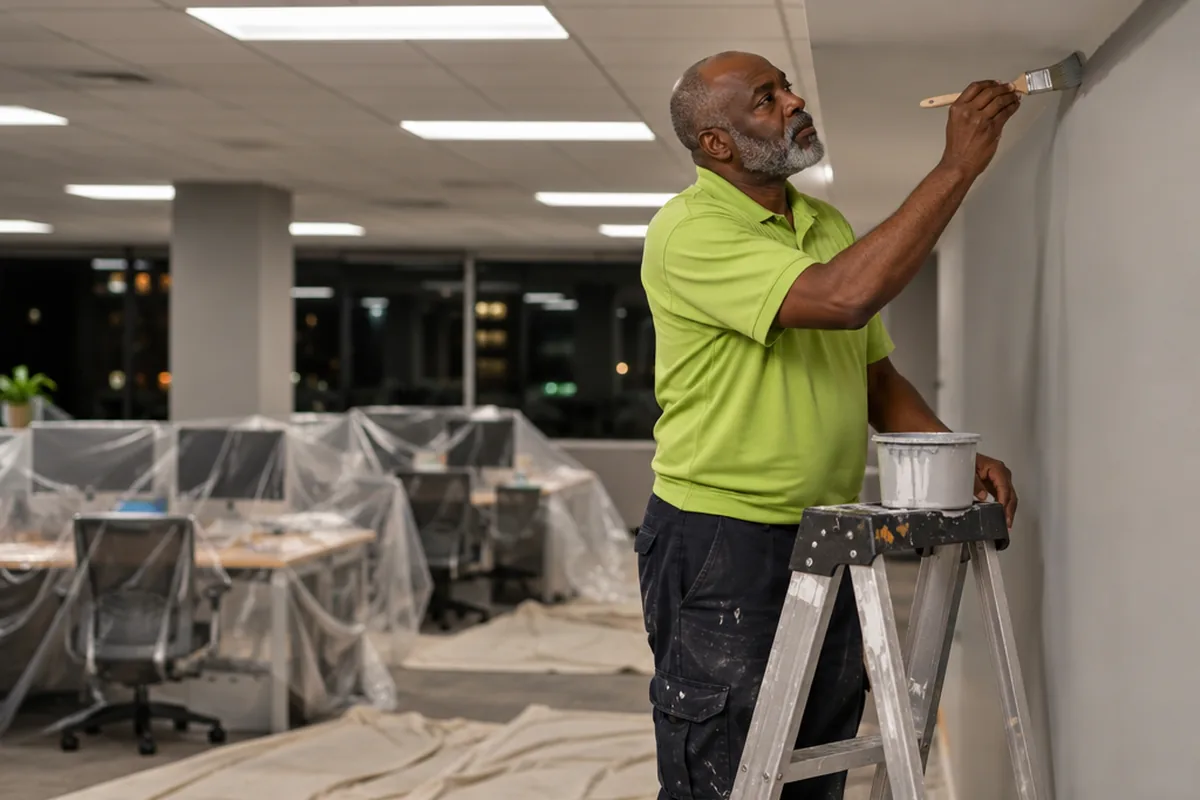
Systems furniture is wired and bolted, so it stays put. We pull what rolls, cover the rest in plastic and paint the perimeter walls and columns from behind the panels with short rollers and brushes. The floor is split into zones a crew can finish and reset in one shift, so nobody arrives to a half-painted department.
Private offices are painted a few per night. Each occupant boxes the desktop, we shift furniture to the middle, remove cover plates, and hang artwork back on its original hooks. Conference rooms get the lowest sheen that still wipes clean, because a long wall under downlights shows every roller lap in a shinier finish. Dents and anchor holes are filled first under drywall patching in occupied space.
A dental or medical suite has exam rooms, a waiting room and a front desk that all open together. We paint in a weekend block, keep casework and equipment wrapped, and use a washable eggshell or satin where hands and chairs touch the walls. Odor matters more here than anywhere, so the building's ventilation runs through the shift and after it. Walls wiped with disinfectant daily may need a harder, scrubbable coating.
We walk the suite with your contact and mark zones on the floor plan: what each shift covers, where furniture goes and which rooms cannot be down on a weekday.
Freight elevator hours, after-hours air conditioning, alarm codes, security escort and the certificate of insurance are arranged before the first night, not during it.
Each shift masks floors and furniture, cuts in and rolls two coats where the color changes, then pulls the masking and puts every desk and chair back on its marks.
Your contact gets photos of the finished zone before opening. At the end, a sheet lists the color and sheen used in each room.
EPA lists paint among the common indoor sources of volatile organic compounds and reports that concentrations of many of these compounds run higher indoors than outdoors, by as much as ten times. Its advice is plain: increase ventilation while such products are in use and follow the label. In practice that means a low-VOC coating, the air handlers left on through the night, and no painting behind closed doors an hour before staff arrive.
Three ASTM standards sit behind the words on a paint label. ASTM D2244 is the practice for calculating the difference between two colors from instrument readings, which is how a paint counter judges a match. ASTM D523 measures gloss at angles of 20, 60 and 85 degrees, and two cans with one color name and different gloss will never blend. ASTM D2486 scrubs a coated panel by machine and reports the cycles the film survives, the figure to compare when a data sheet says scrubbable.
EPA's Renovation, Repair and Painting rule does not cover ordinary offices and stores. It does cover a child-occupied facility in a building from before 1978, such as an on-site daycare, including the restrooms and other rooms those children routinely use. There, sanding or scraping over 6 square feet of painted surface in a room must follow lead-safe practices under a certified firm, and EPA counts work in one room within 30 days as a single job.
Sources for the rules on this page: U.S. EPA, Volatile Organic Compounds' Impact on Indoor Air Quality; U.S. EPA, Frequent Questions About Renovations Covered by the RRP Rule; ASTM D2244, Standard Practice for Calculation of Color Tolerances and Color Differences from Instrumentally Measured Color Coordinates; ASTM D523, Standard Test Method for Specular Gloss; ASTM D2486, Standard Test Methods for Scrub Resistance of Wall Paints.
Shared lobbies, corridors, stairwells and amenity rooms are repainted in sections at night, the way a suite is, with one difference: they never fully close. A corridor is painted one run between doors at a time, an elevator lobby after the evening rush, a stairwell a flight or two per shift with the way around it posted. Long hallway walls lit from an end window show every lap and patch, so each is rolled corner to corner in one pass. Corners that are struck every month need corner guards or a bumper rail, not more paint.
A touch-up program is a standing round, on a cadence you pick, that repairs scuffs before they add up to a repaint. On the first walk we list every painted surface along a set route through lobbies, corridors, stairwells and restrooms, and log its color, formula, product line and sheen. On each later round a technician brings labeled paint for that building, fills chips, primes the filler and repaints corners, door frames and base from break to break. You receive a photo report naming any wall that has collected too many repairs to hide; that wall is repainted in full and its date reset in the log. It is upkeep, not a repaint and not a color change.
Kaminskiy Care and Repair matches an existing wall, door or trim color from a physical sample, not from a name. A flat chip about an inch across is cut from a hidden spot, such as behind a cover plate, and read by a spectrophotometer at the paint counter. The mix is made in the right product and sheen, brushed beside the repair and judged dry, straight on and from down the hall, under the room's own lights. If the test patch disappears, the repair is blended. If it does not, which is common on satin, semi-gloss, deep colors and long corridor walls, the honest answer is a repaint to the nearest corner or frame. The formula goes into the property's color schedule.
High-traffic coatings are harder wall finishes for corridors, stairwells, service halls, restrooms and janitor closets, where standard office paint burnishes, stains or wipes off. We choose by what hits the wall and what cleans it: a scrubbable acrylic for most corridors, a two-component waterborne epoxy where chemicals, moisture and steel carts meet the wall, and a urethane-modified enamel on doors, frames and rails. Old glossy enamel is degreased, then sanded dull or given a bonding primer. The scope states when each surface can be touched, used and washed, because a coating is not at full strength until it cures. These are wall and trim coatings; we do not coat floors.
Fresh walls, the same desk layout and no smell of paint at nine o'clock. That is the whole standard for an occupied job.
A typical floor is cut into zones of a few offices or one open bay. Each evening the crew covers that zone, repairs small wall damage, paints it and resets it. Common paths such as the reception area and the main corridor are saved for the weekend, when two coats can dry without foot traffic. Staff lose no working hours and the floor is never fully torn up.
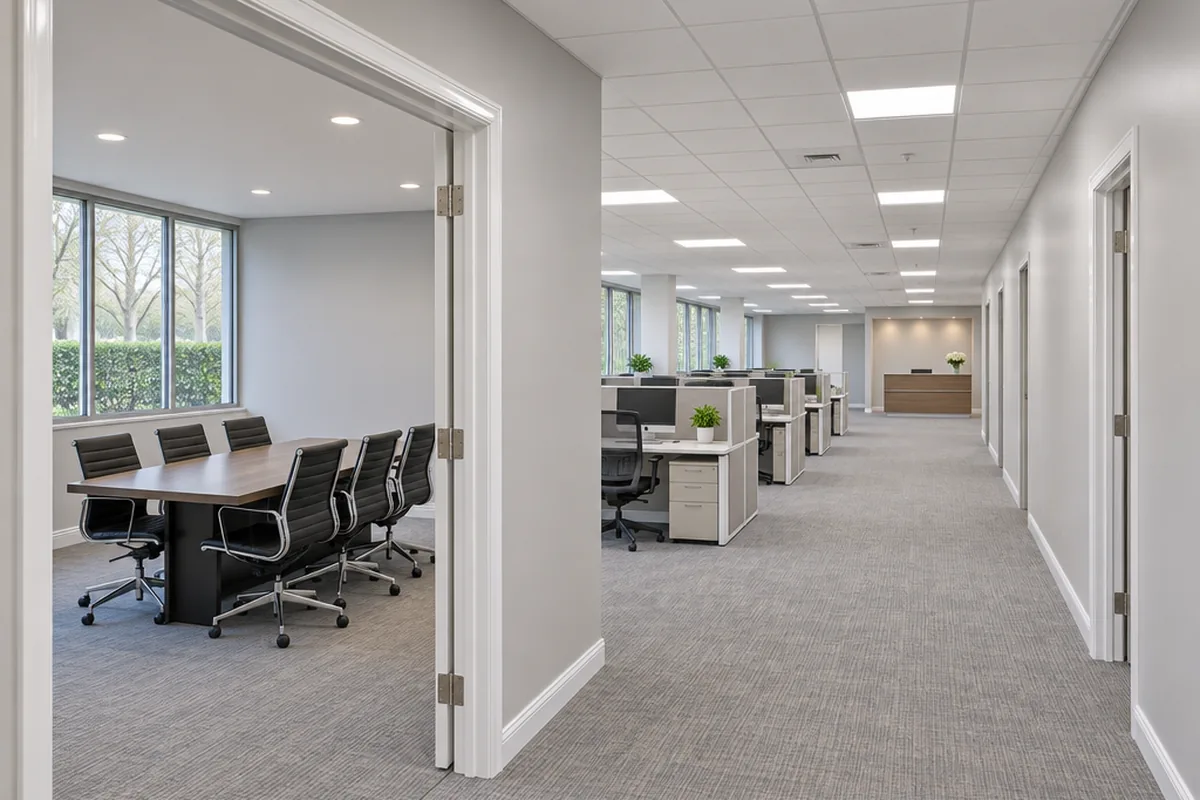
If the wall surface is sound, this is paint work, not a renovation. Send the floor plan, your hours and what the walls are cleaned with, and we will show how it phases. Larger holes and dents are repaired first as paint-ready wall prep.

Send a floor plan or a rough room count, plus the hours the suite sits empty.

Review the written scope: zones per shift, colors, sheens, coats and what staff should box up.

We paint zone by zone at night and send photos each morning until the floor is done.
The work is backed in writing by our workmanship warranty and done by a Kaminskiy-certified, background checked technician.
The floor plan is cut into zones a crew can cover, paint and put back in a single shift: a few private offices, or one open bay. Zones follow how the tenant works, so a department is never split across two nights. Reception, the main corridor and other shared paths are held for the weekend, when two coats can dry with nobody walking through. The count of shifts, and what each one covers, is on paper before the first night.
Ceilings take a dead flat so light does not rake across them. Office and conference walls do well in a matte or eggshell that hides drywall joints and still wipes down. Break rooms and copy rooms earn a scrubbable satin because coffee and toner end up on the walls. Doors, frames and base get semi-gloss. A higher sheen is a tighter film that cleans more easily and shows every dent, while flat paint rubs into shiny streaks. Writing the sheen beside each room prevents one finish everywhere.
Flashing is a repair that shows as a dull or shiny halo even though the color is right. Five things cause it: a different product or sheen sold under the same color name, a different batch, a brush used on a rolled wall, bare filler that was never primed, and age, since the wall has been cleaned and sunlit and the new paint has not. The cure is the logged product, primer on the filler, the same roller nap and edges feathered while wet.
The paint on a wall after eight years is no longer the formula it was mixed from. Sun fades some pigments, cleaning shifts the gloss, and old oil-based enamels yellow in dim rooms. Light matters too: two paints can agree under store tubes and part ways under warm lobby LEDs, an effect called metamerism. So a match starts from a chip of the wall as it is today and is approved only after it dries on that wall, in that room's light.
Going from one off-white to another usually covers in a single coat over spot-primed repairs. A deep accent color, or covering one, is different. Deep colors are mixed in a clear base with little hiding pigment, so they need a tinted primer and two or three finish coats. If the schedule is tight, the number of coats per wall should be settled on paper before the first night.
The walls are dry when people return, but the film is still soft. Keep chair backs and carts off fresh paint and do not tape posters to it. Washing waits for the cure time on the data sheet, which is longer than the dry time and longer again for an epoxy; early scrubbing is how most new coatings get marked. We write the first-wash date into the schedule and post it for the cleaning crew.
Can't find your answer? Call 855-695-1195 and ask us anything.
Call 855-695-1195Yes. The floor is divided into zones, and a crew paints one zone per night or several over a weekend. Furniture is covered or moved a few feet, never out of the suite, and it is back in position before the first person arrives.
Usually very little. We use low-odor, low-VOC waterborne coatings and ask the building to keep the air handlers running during and after each shift. Low odor and low VOC are separate claims, and deep tints can add VOC to a clean base, so we go by the data sheet of the tinted product. Anyone sensitive to odors can tell us in advance, and that area is scheduled ahead of a weekend.
We move freestanding furniture to the center of the room and cover it. Workstations that are wired or bolted stay where they are, and we paint around them. Computers, phones and printers are covered in place, and we do not unplug equipment. Staff help most by boxing their desktops and taking down anything taped to the walls the day before.
A matte or eggshell for general walls, satin for break rooms and copy areas, flat on ceilings and semi-gloss on doors and frames. The lower sheens hide surface flaws under long runs of ceiling lights, while the higher ones take cleaning where hands and equipment touch.
Usually because the touch-up paint was not the wall's paint. A different product, sheen or batch, a brush on a rolled wall, or filler that was never primed each leave a dull or shiny patch, and an older wall has also shifted in gloss. A color and sheen log, the right roller and repairs carried to a corner or a frame fix most of it.
Yes. A physical chip about an inch across is enough. It is read by a spectrophotometer at the paint counter, mixed in the right sheen, then tested dry on your wall under your lighting. An old can or a color name helps, but the wall as it looks today is what gets matched. On glossy or deep-colored walls we may still advise repainting to the corners.
It depends on traffic. A busy residential lobby often suits a monthly round and an office floor a quarterly one, and some properties add a round ahead of leasing season or a board walk. We suggest a cadence after the first walk, and you can change it once you see how fast the building wears.
Washable means stains wipe off with a soft cloth. Scrubbable means the film survives repeated cleaning with a brush or pad, and the figure on a data sheet normally comes from the ASTM D2486 scrub test. Most corridors do well with a scrubbable acrylic. Walls that meet chemical cleaners, standing moisture or steel carts every day are where a waterborne epoxy earns its cost.
Price follows wall area, ceiling height, the amount of patching, how many coats the colors need, the coating type and how many after-hours shifts the phasing takes. A suite full of fixed workstations takes longer than an empty-walled one. You receive a written price by zone before anything is scheduled.
No. An empty suite between tenants is faster and simpler, since nothing has to be protected or reset, and it is covered on our tenant turnover painting page. This page is about space where people are working during the project.
Send the suite address, a floor plan or room count, your business hours and the building's vendor rules. We reply with a phasing plan and a written price by zone. Or call 855-695-1195.
Zones painted at night. Furniture reset each morning. Colors and sheens on record.
We answer in under three rings, 24/7.No price games. You get a clear written quote before any work begins, backed by our workmanship warranty.
