
A water stain on the ceiling means water reached the drywall from above, and the source is one of three things: the roof, a plumbing line, or condensation. The brown ring is minerals the water left behind as it dried; it is harmless, but the leak that made it is not, and it will happen again until the source is fixed. Below, how to tell the three sources apart in ten minutes, what to do today, what the repair costs in 2026, and the signs that mean hurry.
What you'll learn in this guide
- Timing and location identify the source: after rain near an outside wall is roof; below a bathroom is plumbing; humid seasons near ducts is condensation.
- Water travels along framing, so the stain is often 3 to 6 feet from the actual leak.
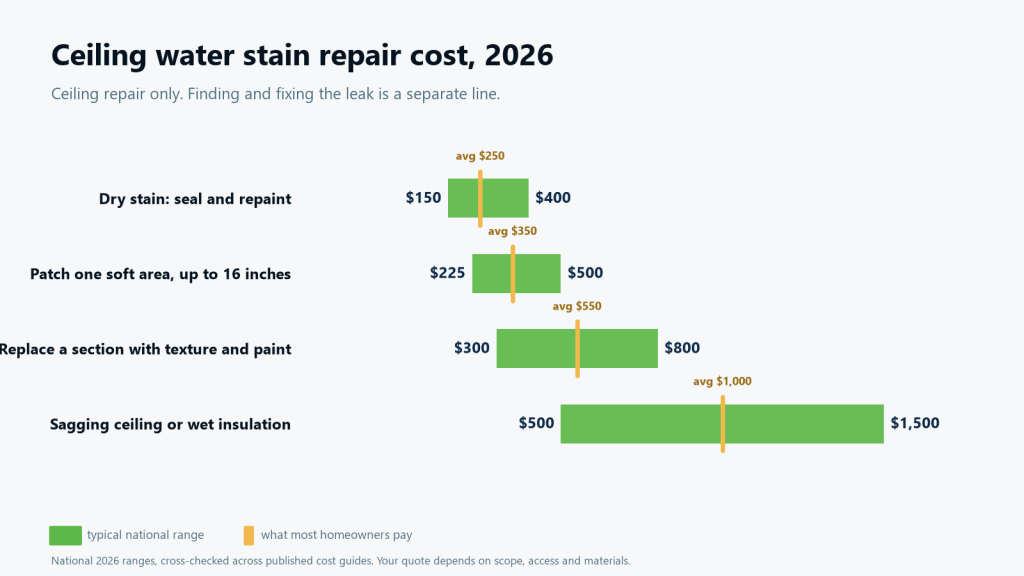
- A dry stain costs $150 to $400 to seal and repaint; a soft patch $225 to $500; a sagging section $500 to $1,500 in 2026.
- A stain that is still wet, growing, or bulging is an emergency for the ceiling, not just a cosmetic issue.
- Painting over a stain without a stain-blocking primer lets the ring bleed through in weeks.
Roof, plumbing or condensation: reading the stain
- Appears or darkens after rain, near an exterior wall, a chimney, a skylight or under the attic. Roof. Look for a lifted shingle, failed flashing, or a gutter backing water under the eave. Attic insulation above the stain will be damp.
- Below a bathroom, kitchen, laundry or a second-floor water line, and unrelated to weather. Plumbing. Supply leaks drip constantly; drain leaks show up only when that fixture is used. Run each fixture above for five minutes and watch the stain.
- Uniform, seasonal, near ducts or in a poorly ventilated room, often with a musty smell. Condensation on cold pipes or ductwork, or moisture from a bathroom with no working fan.
- Old, dry, edges crisp, never changes. A leak someone fixed and never repainted. Confirm with a moisture meter, then repair cosmetically.
What to do today, in order
- Check whether it is wet. Press a finger against the stain. Soft, cool or bulging drywall is holding water. Put a bucket under it and, if it bulges, poke a small hole in the lowest point with a screwdriver so the water drains instead of bringing the ceiling down.
- Find the source, not the stain. Water runs along joists and pipes before it drops. Trace 3 to 6 feet uphill from the stain: the attic above a roof stain, the fixture above a plumbing stain.
- Stop the water. Shut the supply valve for a plumbing leak, tarp the roof section for a roof leak, run the bath fan or a dehumidifier for condensation.
- Dry it for a week. A ceiling patched while damp fails. Fans and a dehumidifier bring drywall back in five to seven days if it was not saturated.
- Then repair. Cut out anything that stays soft, patch, texture, prime with a stain-blocking primer and paint the whole ceiling for an invisible finish.
What a ceiling water stain repair costs in 2026
| Repair | Low | Typical | High |
|---|---|---|---|
| Dry stain: stain-block primer and repaint | $150 | $250 | $400 |
| Cut and patch one soft area, up to 16 inches | $225 | $350 | $500 |
| Replace a section, texture and paint, 10 to 25 sq ft | $300 | $550 | $800 |
| Sagging ceiling or wet insulation replaced | $500 | $1,000 | $1,500 |
| Fix the leak itself (roof or plumbing), separate | $150 | $600 | $2,500 |
Texture match is the difference between a $250 repair you can see and a $350 repair you cannot. A proper ceiling drywall repair matches the existing knockdown, orange peel or smooth finish and paints corner to corner, because a painted patch on an older ceiling always shows.
When a ceiling stain is an emergency
Hurry when the stain is spreading while you watch, when the ceiling sags or bulges, when water is dripping, when a light fixture sits inside the stain, or when the smell is musty. Wet drywall loses its strength within a day or two and a saturated ceiling can come down; water in a light fixture is a shock and fire risk, so switch that circuit off at the breaker. Mold starts within 24 to 48 hours in wet drywall, and a moldy section costs $800 to $2,500 to replace.
What this means for you
A ceiling water stain is a message, not a blemish: find the source first, stop it, let the ceiling dry, then repair. Expect $150 to $400 for a dry stain, $225 to $500 for a patch, and $500 to $1,500 if the ceiling has sagged, plus the cost of fixing the roof or pipe. Painting over it without stopping the leak is the one thing not to do.
Good questions, straight answers
Only if the leak is fixed and the drywall is dry and firm. Use a stain-blocking primer, oil-based or shellac, then two coats of ceiling paint. Ordinary paint over a stain lets the ring bleed through within weeks, and paint over an active leak hides the problem while the ceiling keeps getting weaker.
$150 to $400 to prime and repaint a dry stain in 2026, $225 to $500 to cut out and patch a soft area, and $500 to $1,500 for a sagging section with wet insulation. Repairing the roof or plumbing that caused it is a separate cost of $150 to $2,500.
Start with timing: a stain that grows after rain is the roof; one tied to a shower, toilet or washer upstairs is plumbing. Then look 3 to 6 feet uphill from the stain along the joists, because water travels before it drops. A moisture meter, about $30, shows the wettest point.
Rather have it handled? Call 855-695-1195 and we price the job over the phone. We answer in under three rings.